
Last Updated 5 hours ago
Overview
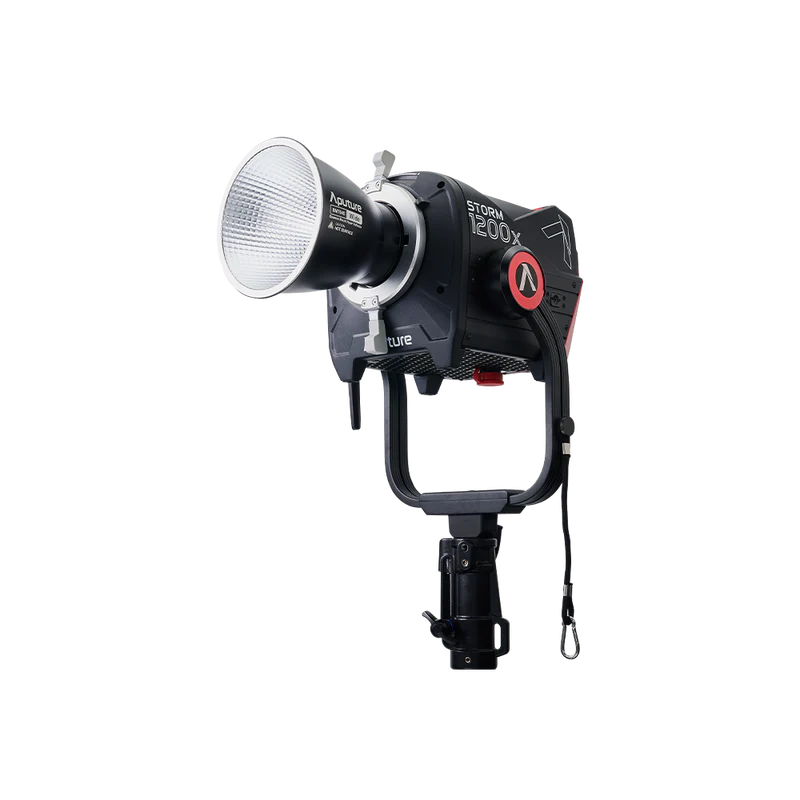
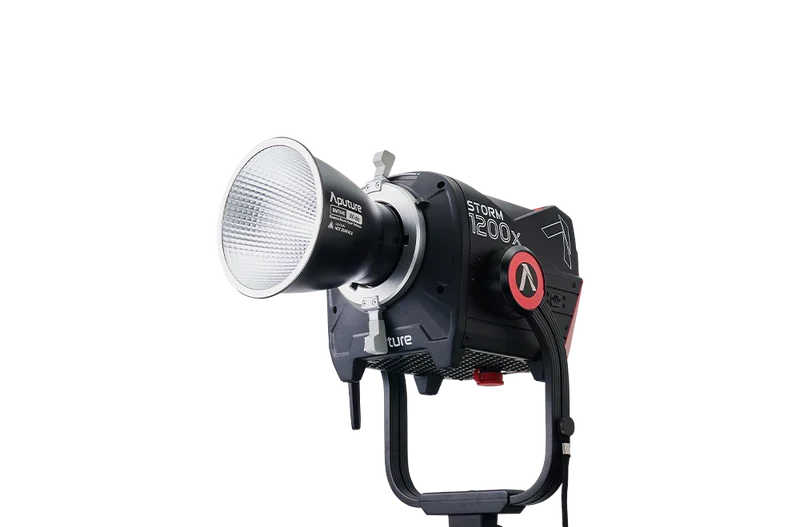
The Aputure STORM 1200x is a tunable-white point-source LED built around the BLAIR engine and a ProLock Bowens mount. It combines a wide white-light range with green–magenta adjustment and colour controls whose availability depends on the installed firmware.
The 1200x combines a wide white/tint range with directional output for windows, bounce and large modifiers. Its electrical demand and CF12 optical system make it a substantial head-and-controller kit.
Key specifications
| Specification | Details |
|---|---|
| Engine | BLAIR: Blue, Lime, Amber, Indigo and Red |
| CCT | 2500K–10,000K; ±100% green/magenta adjustment |
| Maximum electrical input | 1550W |
| Maximum LED output power | 1200W |
| Mount | ProLock Bowens |
| Weather rating | IP65 |
| Head with yoke / control box | 9.50kg / 5.92kg |
| Control | Onboard, Sidus Link, DMX/RDM, CRMX, Art-Net and sACN |
Strengths and limitations
Strengths
- Wide white-light/tint control and a locking accessory interface support controlled window and bounce work.
- Internal CRMX and Ethernet suit larger console-operated rigs.
Limitations
- Its colour modes have a limited gamut and depend on firmware.
- The CF12/F10 compatibility distinction and 1,550W maximum input can materially change an existing package.
Practical uses
Use it for a controlled window source, a large bounce or a soft key through substantial diffusion. Confirm the accessory and firmware combination before planning projection work or colour cues, and include the controller and head cable in the rigging plan.
| Setup | How to use this fixture |
|---|---|
| Window or sunlight effect | Choose the required reflector coverage or CF12 beam first. Record CCT and output mode with the exposure, especially when multiple units must match. |
| Large bounce or soft key | Fill the bounce or diffusion surface rather than relying on a narrow-reflector centre reading. Meter the final light at the subject. |
| Changing time of day | Program white/tint transitions with a consistent white-light standard. Limited-gamut colour modes can add selected looks, but require their own exposure and gamut assessment. |
Output and colour
BLAIR provides 2,500–10,000K white tuning and green–magenta correction. Limited-gamut colour operation depends on installed firmware and is distinct from a full-colour RGB fixture. At 5,600K and 5m Aputure publishes 36,400 lux with the 15° reflector, 15,500 with 30° and 7,100 with 45°; beam coverage changes with those readings.
| 5,600K reflector | 5m |
|---|---|
| 15° | 36,400 lux |
| 30° | 15,500 lux |
| 45° | 7,100 lux |
Photometric & exposure calculator
Estimate centre-beam illumination and the corresponding camera aperture from this fixture’s published measurements.
Estimated output
Select a configuration to calculate.
Manufacturer readings are for the stated optic, colour setting and full output, measured at the beam centre. Values between measured distances are interpolated. Point-source values outside those distances are approximate inverse-square estimates; large sources cannot be reliably extrapolated and are limited to their measured range. Exposure uses frame rate, shutter angle, ISO and the selected incident-meter calibration. Only the optics and diffusion explicitly listed in the measurement are included; additional modifiers, bounce, beam edges, ambient light, ND filters and camera exposure-index differences are not accounted for. Confirm critical exposures on set with a meter. Photometric source
Sources: STORM 1200x | Aputure; Aputure STORM 1200x specifications.
The reflector table uses a 5m test distance. The LS 1200d Pro figures cited elsewhere use 3m. Distance, CCT, beam angle and operating mode all affect the comparison.
BLAIR’s white-light controls and firmware-dependent Limited HSIC+/x,y functions are distinct from the gamut of a full-colour c-series lamp. Choose a colour-capable alternative when a particular saturated hue is a firm requirement, then test that exact hue and intensity on camera.
Tests and reviews
Gaffer & Gear tests reflectors, dimming, power draw and DMX, with separate Blackbody and CIE Daylight measurements. Another Camera Channel describes several weeks of use and discloses a studio relationship with Aputure.
Watch Andrew Lock’s STORM 1200x tests; the photometric table above is manufacturer data.
Power and batteries
Maximum electrical consumption is 1,550W. The 1,200W model class is the light-engine rating. Include the real AC load, the supply arrangement and other connected equipment in distribution planning.
The 9.50kg head with yoke and 5.92kg controller are separate components. Keep the controller reachable and supported; its weight and cabling still belong in the working package when the head is positioned overhead or outside a window.
Control, cooling and camera operation
| Control path | Hardware and operating notes |
|---|---|
| Local / app | Onboard controls and Sidus Link; preserve output mode, white-light standard and tint with the preset. |
| Console | Wired DMX/RDM and internal CRMX; choose the profile for the actual installed firmware and intended colour mode. |
| Network | Art-Net/sACN for network-controlled rigs; label protocol, universe and address. |
| Colour modes | White tuning plus supported limited-gamut colour operation. Feature availability depends on firmware. |
Make the cooling decision before approving a dialogue setup. A fan setting that changes available output also changes the exposure budget through diffusion. Test the warm fixture in its intended position relative to microphones.
When matching several 1200x units, align firmware, white-light standard, output mode and tint before making small intensity trims. Matching only the Kelvin display can leave an avoidable colour or brightness difference between otherwise similar heads.
Modifiers, rigging and the working package
Compatible accessory profiles · Aputure Quick Dome 90 Softbox · Aputure Spotlight Max Projection Attachment (19°, 36° and 50°) · Aputure CF12 Fresnel and CF12 Barn Doors
The ProLock Bowens mount uses the CF12 Fresnel pairing. Aputure explicitly says the F10 Fresnel does not fit the STORM 1200x. Check optic clearance and support with the complete accessory fitted. Maintain the specified sealed connections for IP65 operation; the rating is not a substitute for the unit's actual operating instructions.
| Package component | Compatibility or handling detail |
|---|---|
| Head and yoke | 9.50kg before modifier |
| Controller | 5.92kg before cables and clamps |
| Fresnel | CF12; Aputure explicitly excludes the F10 from the 1200x |
| Reflectors | Record the exact 15°, 30° or 45° configuration used |
| Weather arrangement | Prescribed sealed power/data connections for IP65 operation |
The ProLock mechanism improves retention and optical alignment, but does not remove the need to balance and support a large modifier. Exercise the full intended tilt with the CF12 or softbox mounted. Keep connector access and cable strain relief available after the head is raised.
Alternatives and related fixtures
| Fixture | When to compare it |
|---|---|
| Aputure Storm 700x | Compare the smaller STORM with its own CF10 optics when lower weight and input are useful. |
| Aputure Light Storm LS 1200d Pro | Compare fixed daylight and the F10 ecosystem if tunable white is unnecessary. |
What people are saying
Gaffer & Gear
Andrew Lock tests the BLAIR engine, reflectors, dimming, power draw and DMX cues. His measurements separate Blackbody and CIE Daylight settings. Watch video.
Another Camera Channel
The review follows several weeks of use and includes findings after launch. The creator discloses that Aputure used their studio for part of its keynote production. Watch video.
Videos
Gaffer & Gear tests the STORM 1200x, including beam comparisons, dimming, DMX cues and colour measurements.
Rental and used-fixture checks
- Confirm the CF12, reflector set and accessory-lock engagement.
- Record firmware and colour/output mode before matching a multi-lamp cue.
- Warm the lamp in the intended fan mode and check exposure and microphone pickup.
Documentation and specifications
- Aputure STORM 1200x specifications
- STORM 1200x | Aputure
- CF12 Fresnel: STORM 1200x accessory information
- Aputure Light Dome 150
- Nanlux Evoke 1200B
- ARRI Orbiter
Browse Aputure lights · COB lights · all equipment.