
Last Updated 2 days ago
Overview
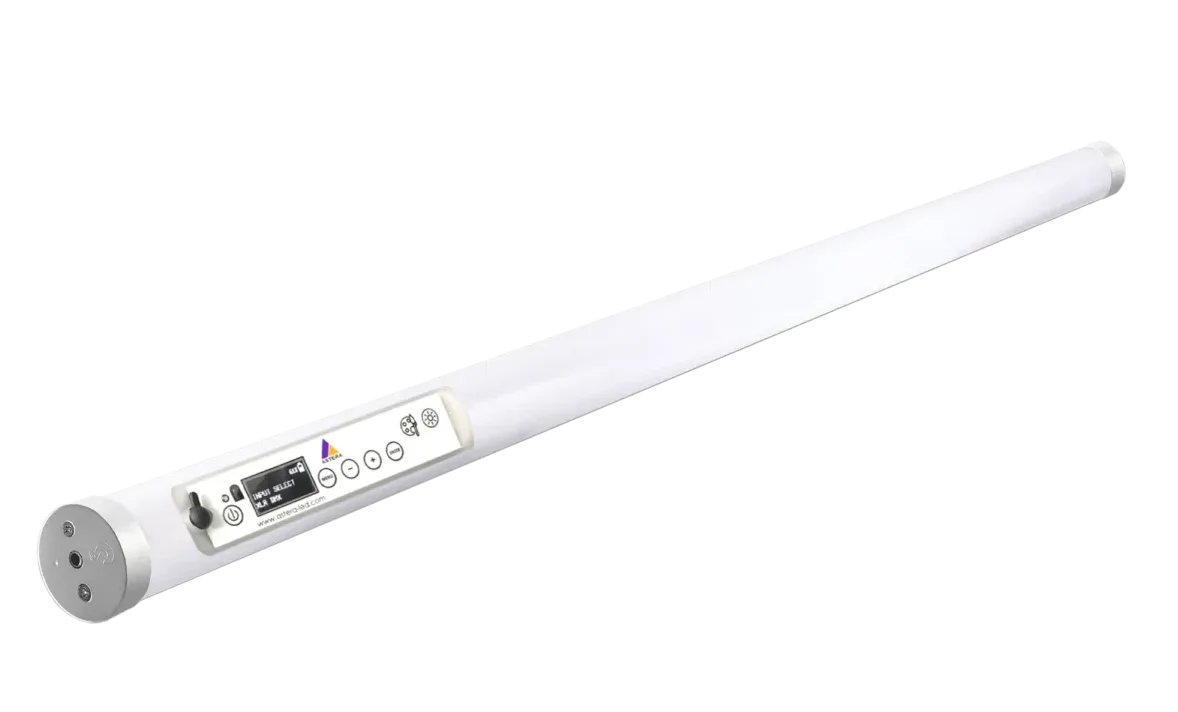
The Astera Titan Tube is one of the most influential lighting tools of the last decade. It is a fully battery-powered RGB LED tube designed for film, TV, and commercial production. Known for exceptional colour quality, incredible wireless control options, and unmatched versatility, Titan Tubes appear on nearly every modern music video, commercial, and narrative project.
What makes them so essential is the combination of wireless power, wireless DMX, battery operation, and precision colour control. They function as practicals, accents, fill lights, rigged set pieces, or complex RGB effects devices.
Key Specs
- Type: Titan Engine RGB–Mint–Amber pixel tube
- Length: 1035mm (~40″)
- Battery life: up to 20 hours in a reduced-output programme; approximately 1 hour 45 minutes at maximum output
- CCT: 1750K–20,000K
- Pixel control: 16 pixels per tube
- CRI/TLCI: 96+
- Dimming: 0–100%
- Control: App, wireless DMX (CRMX), IR, manual
- Ingress rating: IP65 with the specified FP1-SP port protection fitted; not immersion-rated
Pros
- Completely wireless: power + control
- Long battery runtime
- Good colour accuracy
- Pixel mapping capabilities
- Lightweight and easy to rig
- Extremely flexible placement
Cons
- Fragile — tubes can crack or scratch
- Expensive, especially in multi-unit kits
- 8 Set Kit Extremely Heavy!
- App interface overwhelms beginners
- Output is limited compared to other tubes
Variants & Related Fixtures
- Astera Helios (half-length)
- Astera Hyperion (double-length)
- Nanlite PavoTubes
- Quasar Science T8 and Crossfade tubes
Common Mistakes Beginners Make
- Expecting strong output at distance
- Using internal effects without matching ambient exposure
- Forgetting to lock DMX/channeling and resetting tubes
- Not checking battery levels before long takes
What It Replaces / Alternatives
Possible replacements, subject to matched output, coverage and colour:
- Practical fluorescent tubes
- Small RGB panel lights
- Accent lighting done with gelled kino tubes
Alternatives:
- Nanlite PavoTube 30C
- Quasar Q-LED
- Digital Sputnik Voyagers
Titan Tube Specifications and Runtime
| Specification | Manufacturer figure |
|---|---|
| Engine | Titan Engine RGBMintAmber |
| Pixels | 16 |
| Length / diameter | 1,035mm / 43mm |
| Tube weight | 1.35kg |
| LED engine total / LED power draw | 72W / 48W |
| White output at 1m, 3,200K | 708 lux |
| White output at 1m, 4,000K | 785 lux |
| DC input | 24V / 2A |
| Nominal recharge time | 3 hours |
| Wireless DMX | Built-in CRMX receiver |
| Ingress protection | IP65 only with the specified FP1-SP port protection |
Astera’s Titan Tube manufacturer data sheet separates total installed LED power from operating LED power draw. The lux readings describe the complete tube in white mode; they are not the output of an individual pixel or a saturated colour.
“Up to 20 hours” is a runtime-managed operating condition, not maximum brightness for 20 hours. Set the required runtime and then check exposure at the resulting output. The Titan data sheet gives approximately 1 hour 45 minutes at maximum brightness.
A non-BTB tube needs an external AsteraBox/compatible bridge for phone-to-Astera radio control. The later FP1-BTB version has the Bluetooth Bridge built in; this revision is separate from the CRMX receiver that both versions already contain. Wired DMX and continuous power use the proper PowerBox/DataLink and power/data cable path, not an arbitrary DC charger.
Choose a console profile matching the tube’s pixel configuration and selected precision mode before assigning addresses. Use the tube holders and M5 attachment points with suitable suspension. The tube’s IP65 condition requires the specified port protection; the PowerBox has its own rating and must not be assumed to share the tube’s protection.
Compare the Helios Tube for the other size. Length, weight, complete-tube output and number of pixels change; the shorter tube is not simply a full-length tube with the same total light output.