
Last Updated 22 hours ago
Overview
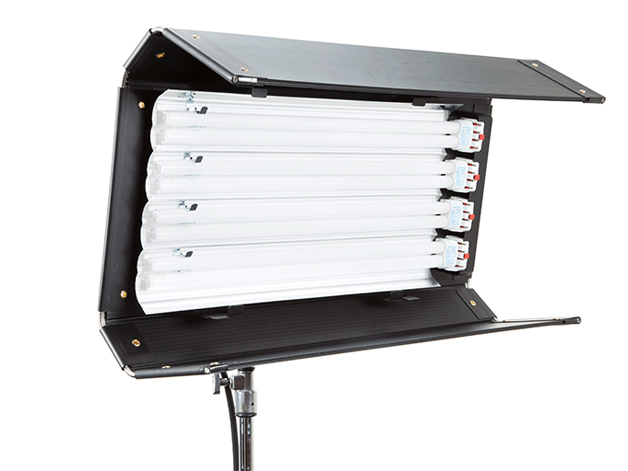
The Kino Flo Diva-Lite 400 is a portable fluorescent softlight with four 55 W compact lamps and an integrated dimming ballast. It became a familiar interview and location-lighting tool because the fixture, reflector, doors and ballast travel as one main assembly rather than as a separate bank and remote ballast.
The ‘400’ is a model name: four 55 W lamps total 220 W of nominal lamp ratings, not a 400 W tungsten lamp or a guaranteed mains-input figure. This is the original fluorescent 400 and its Universal variant. The 401, later LED Diva fixtures and LED-tube conversions must be identified separately.
Key specifications
| Specification | Details |
|---|---|
| Source / lamps | Four 55 W 2G11 compact fluorescent lamps |
| Colour options | Kino 55C-K32 / KF32 or 55C-K55 / KF55 matched lamp sets |
| Original fixed-voltage versions | 120 V or 230 V, 50/60 Hz, depending on model |
| Universal variant | DIV-400-120U / 230U; later manual lists 100–240 V input |
| Original input-current figures | 2.0 A at 120 V or 1.1 A at 230 V in the original catalogue |
| Universal current rating | Confirm the exact nameplate; do not read an archive’s broad-range current entry as constant at every voltage |
| Ballast frequency | 30 kHz for the documented fluorescent versions |
| Dimming / lamp selection | Published 100–5% dimming; two/four lamp switching |
| Dimensions | 26 × 12 × 6 inches, with 6-inch barn doors in the catalogue |
| Original / Universal mass | 13 lb / 5.9 kg standard; 14.2 lb / 6.4 kg Universal, with lamps as specified |
| Mount | Centre mount; confirm supplied baby-receiver/lollipop and offset hardware |
| Remote dimming | DIM-5 on models fitted with the corresponding REMOTE DIM input |
| Spill / softening accessories | Model-specific louver, gel frame and Flozier |
Strengths and limitations
Strengths
- A bank of fluorescent tubes provides a broad close source.
- The established modifier and mounting system supports fast setup.
Limitations
- Lamp type, age and ballast configuration affect colour and output.
- Inspect older connectors, lamp holders and ballast cabling before use.
Practical uses
The Diva 400 is useful as a close soft key, fill or controlled background source when a relatively compact fixture is preferable to a four-foot bank. Its folding doors and louver help contain spill, while a Flozier blends the visible compact-lamp pattern. Position and apparent source size still determine softness; the model name does not describe a particular look on every subject.
The ballast is built into the head, which simplifies the number of separate boxes but adds weight at the stand. Include the mount, offset, cable and any diffusion in the working load. A whole kit’s case weight should not be confused with the manufacturer’s fixture-only figure.
The specified compact lamps use a 2G11 base, with manufacturer KF32 and KF55 colour options. Match all four for type and condition, seat them correctly with power disconnected, and follow the manual’s lamp orientation. An ordinary compact fluorescent that physically fits may differ in spectrum, output or ballast compatibility.
Allow the lamps to stabilise before judging colour. The fluorescent Diva operating manual instructs starting at full dimmer level and waiting about three to five minutes before dimming. It also warns that deep dimming can lower colour temperature and introduce a noticeable magenta shift. A colour match made immediately at switch-on may not hold after the lamp warms.
| Setup | Working approach |
|---|---|
| Close interview key | Set lamp arrangement and diffusion, then check white balance through the camera. |
| Reflection or fill | Orient the bank for the required highlight and control spill with the correct louver. |
Output and colour
The original Kino Flo catalogue publishes the following Diva-Lite 400 readings. They describe that catalogue’s fluorescent configuration, not an LED-retrofitted shell or a guarantee for every later ballast generation. Lamp condition, operating temperature, louver, diffusion and ballast selection can change the delivered level.
| Distance | Centre illuminance |
|---|---|
| 4 ft / 1.22 m | 170 fc |
| 6 ft / 1.83 m | 78 fc |
| 8 ft / 2.44 m | 44 fc |
| 10 ft / 3.05 m | 28 fc |
Power and batteries
The original catalogue separates 120 V, 230 V and Universal 400 versions. The Universal version has a higher listed mass, while the later manual covers the 401 alongside the 400 Universal. Do not take the lightest mass from one row, the widest input range from another and present the result as an exact specification for every 400.
Read the plate on a used unit. A fixed-voltage fixture is not made universal by changing its cord. The catalogue/manual also prints a broad-range Universal current figure that should not be interpreted as identical consumption at all mains voltages. Use the actual unit’s rating for distribution planning, and keep the nominal 220 W lamp total separate from electrical input.
Control, cooling and camera operation
The published control range is 100–5%, but that describes the available adjustment, not perfect spectral consistency throughout it. The manual says colour changes are relatively limited within about one stop and can become more visible beyond that. For critical work, meter and camera-test the actual level instead of assuming LED-like constant-colour behaviour.
Two/four lamp switching provides another level adjustment, with a change in emitting area and visible reflection pattern. A DIM-5 remote works only on the model with the appropriate input; plugging it in takes over the onboard control on those versions. A conventional Diva 400 should not be patched using a later LED Diva DMX personality.
Modifiers, rigging and the working package
Keep the fixture’s cooling paths open and use the proper gel frame rather than trapping heat directly around the lamps. Switch off and disconnect before relamping or inspecting sockets. If lamps fail to start, follow the correct manual’s power, dimmer and lamp-seating checks; do not repeatedly hot-connect lamp bases or attempt internal ballast repairs on set.
On a used 400, inspect both lamp pairs, dimming across the range, selector switch, remote input if present, mount and tilt lock. Look for cracked lamp bases, darkened tubes, heat damage, unreliable connectors and worn power-cable strain relief. Check the reflector, louver, doors and diffusion accessories for missing or damaged parts.
Alternatives and related fixtures
A complete fluorescent Diva can still be useful for an owner-operated interview kit or a studio that already stocks matched lamps. Confirm replacement-lamp and service availability, test the intended camera settings and transport tubes in suitable protection. Fluorescent lamps require appropriate handling and recycling; do not treat them as ordinary disposable plastic accessories.
The two-lamp Diva 200 is narrower and lighter, a four-foot 4Bank creates a longer source with a separate ballast, and a current LED panel offers more convenient colour and control changes. An LED retrofit changes the electrical and optical system and should be documented with its own specifications rather than retaining this fluorescent chart.
| Fixture | Choose it for |
|---|---|
| Kino Flo FreeStyle LED | A separate LED engine and controller system. |
| Kino Flo Diva-Lite LED | An LED alternative with different colour modes and power hardware. |
What people are saying
Erik Naso: original lamps and retrofit differences
Erik Naso describes using fluorescent Diva 400s for broadcast work, but later favouring other sources for output and colour. His retrofit article explains why the actual installed lamps matter; a converted unit is a different configuration. View the source.
Videos
Kino Flo Diva-Lite 400 (Fluorescent): family guide
An overview and setup guide for the fluorescent Diva-Lite kit; verify the model and ballast revision.
Rental and used-fixture checks
Check the exact lamp and ballast revision, all lamp holders, protective parts and power cables. Test every lamp switch, the intended dimming or output mode, and the camera white balance after warm-up.
Documentation and specifications
Manufacturer operating manual, original manufacturer catalogue with photometrics, Kino Flo manual archive and photograph and rental-inventory source. Current lamp and service-part availability should be confirmed for the exact unit.
Product photograph: Product image via Sanwa Group.
Browse Kino Flo lights · fluorescent lights · all equipment.