
Last Updated 22 hours ago
Overview
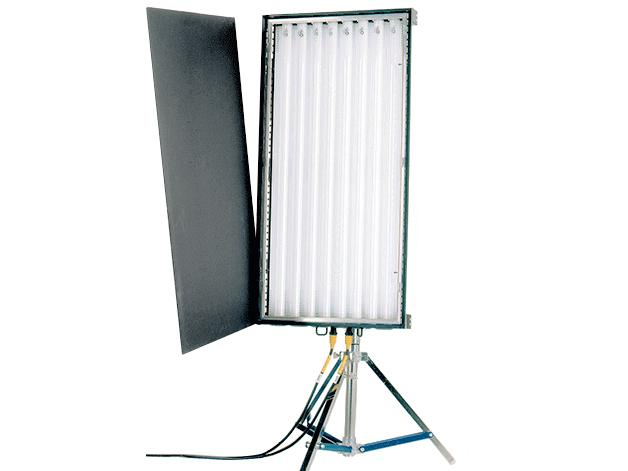
The Kino Flo Flathead 80 is an eight-lamp, four-foot fluorescent softlight designed to create a much larger emitting surface than a standard 4Bank. It uses two remote four-lamp ballast circuits, giving a broad source for keys, beauty work, overhead illumination and large-area fill without mounting the ballast weight directly behind the lamps.
The ’80’ is a model name, not an 80 W rating. This is the CFX-4808 fluorescent Flathead, not a shell converted to LED tubes. A complete system includes the fixture, eight matched lamps, appropriate mount, two compatible ballasts and two head cables.
Key specifications
| Specification | Details |
|---|---|
| Fixture / lamps | CFX-4808; eight F75/T12 four-foot fluorescent lamps |
| Colour examples | KF29, KF32 or KF55 safety-coated lamps listed by Kino |
| Dimensions | 51 × 24 × 4 inches / 129 × 61 × 10 cm |
| Fixture weight with lamps | 27 lb / 12 kg in the 2011 manual; older catalogue lists 26 lb |
| Mount | MTP-K81 twist-on centre mount with 28 mm / junior pin |
| Ballast arrangement | Two Select 4Bank or compatible Select/DMX 4Bank ballasts, four lamps each |
| 2011 BAL-415 / BAL-455 input figures | Two × 5 A = 10 A at 120 V; two × 2.5 A = 5 A at 230 V |
| Older catalogue configuration | Two older ballasts: 9.2 A at 120 V; do not substitute ratings across revisions |
| Extensions | Two X16 4Bank runs; manufacturer documents up to 75 ft with specified extensions |
| Manual switching | Four individual lamp switches per ballast |
| Circuit arrangement | Connector 1 operates four inner lamps; connector 2 operates four outer lamps |
| DMX ballast footprint | Five addresses per documented 4Bank DMX ballast; verify the exact ballast chart |
| Normal output selector | 4ft for four-foot lamps; documented 2ft mode reduces output and affects operating colour |
| Included / matching controls | Gel frame and louver; fit and generation must be checked |
Strengths and limitations
Strengths
- A bank of fluorescent tubes provides a broad close source.
- The established modifier and mounting system supports fast setup.
Limitations
- Lamp type, age and ballast configuration affect colour and output.
- Inspect older connectors, lamp holders and ballast cabling before use.
Practical uses
The broad lamp surface can create a wraparound key or a large overhead source while keeping electronic ballasts off the head. That makes the fixture different from a self-ballasted Image 85, even though both use eight four-foot tubes. Their mass, mounts, controls and package handling should not be merged.
The Flathead is useful when the source size matters more than compact transport. It can cover a face or group from nearby, illuminate a larger area or provide broad fill. Moving it further back reduces apparent size and level. If additional diffusion is used, check that the whole material is illuminated and allow for its output loss.
| Setup | Working approach |
|---|---|
| Close interview key | Set lamp arrangement and diffusion, then check white balance through the camera. |
| Reflection or fill | Orient the bank for the required highlight and control spill with the correct louver. |
Output and colour
The original catalogue provides the following Flathead readings. They apply to its documented fluorescent system. A later ballast or an LED conversion may produce different results, and a single centre reading does not describe uniformity across an entire diffusion frame or set.
| Distance | Centre illuminance |
|---|---|
| 1 m | 4,748 lux |
| 2 m | 1,443 lux |
| 3 m | 678 lux |
| 4 m | 394 lux |
Power and batteries
The 2011 manual specifies two BAL-415 or BAL-455 units and gives a combined 10 A at 120 V or 5 A at 230 V. The older catalogue gives different figures for its earlier ballast generation. A later rental package may carry other compatible ballasts; read those labels and manuals instead of assuming that every Flathead draws one fixed current.
The manual’s voltage-specific Select ballasts require their proper regional supply. Do not dim the mains with an SCR dimmer; the instructions call for a non-dim source. Keep the two ballast/cable circuits identified so an on-set fault can be traced without confusing which group of lamps is being driven.
Control, cooling and camera operation
Connector 1 drives the four inner lamps and connector 2 the four outer lamps in the documented system. Switching individual lamps changes the luminous surface as well as level. That matters for reflections and shadow shape, particularly when the fixture is close to a glossy subject.
With the specified Select/DMX ballasts, each ballast uses five DMX addresses, including its lamp-length/output selection function. The two ballasts therefore need a deliberate patch; there is not one built-in RGB fixture personality in the head. The manual also explains that applied DMX disables manual controls unless the documented local-control arrangement is selected. Use the chart for the actual ballast revision.
Modifiers, rigging and the working package
Match all eight tubes and keep airflow around them unobstructed. Kino describes using 2ft mode on four-foot lamps in some hot operating conditions to reduce a colour-temperature and green-spike problem, with approximately half a stop less level. It is an operating adjustment, not a calibrated tunable-white control.
Switch off the ballast before changing lamp, harness or extension connections. Use the correct X16 cable system and respect the manual’s maximum 75 ft arrangement. Inspect the junior mount’s lock and the fixture’s documented rigging points. The 27 lb figure is a lamped fixture value; add the mount, louver, frame, cables and any other working accessories to the load.
Alternatives and related fixtures
Check lamp holders, pins, all eight channels, both input circuits, cable locks, frame retainers, reflector and louver. Look for a warped body, damaged rigging hardware, brittle insulation or a mount that will not lock positively. Confirm that a sale includes two working ballasts and cables rather than pricing only the fluorescent shell.
High-frequency operation does not remove the need to test high-speed filming and unusual shutter settings. Protect tubes in transit and confirm replacement availability. An LED softlight may be easier for colour, fades and a smaller operating package, while the Flathead remains useful when a broad fluorescent source and an existing complete kit meet the scene’s requirements.
| Fixture | Choose it for |
|---|---|
| Kino Flo FreeStyle LED | A separate LED engine and controller system. |
| Kino Flo Diva-Lite LED | An LED alternative with different colour modes and power hardware. |
What people are saying
The Substream: fluorescent-light overview
The Substream introduces Kino Flo fluorescent lighting. The overview gives family context; use the exact lamp, ballast and mounting specifications for this model. View the guide.
Videos
Kino Flo: fluorescent-light overview
A family guide to the fluorescent format.
Rental and used-fixture checks
Check the exact model and revision, complete power package, mounting hardware and control leads. Inspect lamp holders, protective glass and ballast connections. Test the intended operating level, fade and camera settings before rigging.
Documentation and specifications
Manufacturer operating manual, original manufacturer catalogue with photometrics, Kino Flo manual archive and photograph and rental-inventory source. Current lamp and service-part availability should be confirmed for the exact unit.
Product photograph: Product image via Sanwa Group.
Browse Kino Flo lights · fluorescent lights · all equipment.