
Last Updated 22 hours ago
Overview
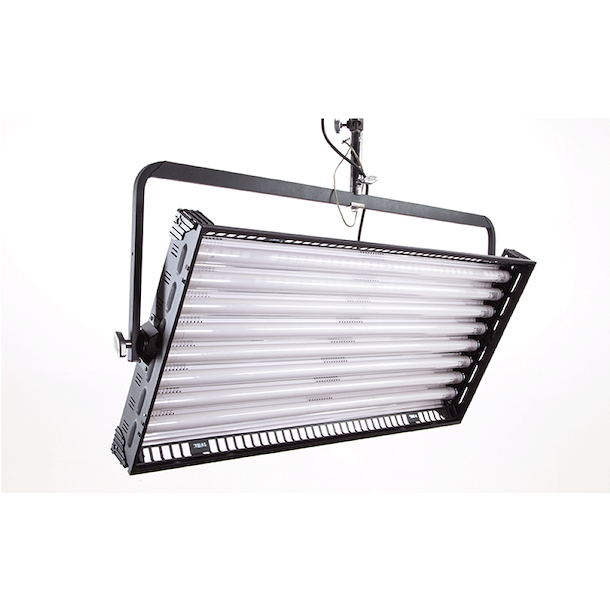
The Kino Flo Image 85 DMX is an eight-lamp, four-foot fluorescent softlight with electronics integrated into a substantial studio-style fixture. It is suited to broad keys, overhead lighting, cyclorama or screen illumination and controlled soft fill where the fixture can remain on a stand or grid as part of a larger lighting system.
The Image 85 fluorescent fixture has yoke and pole-operated configurations. It is not the later Image 87, a four-lamp Image 45 or an LED-retrofitted body. Its DMX primarily switches lamps and selects output mode; it should not be treated as a modern LED panel with continuous colour and dimmer channels.
Key specifications
| Specification | Details |
|---|---|
| Models | IMG-85X yoke; IMG-85P pole-operated, regional 120 V or 230 V versions |
| Lamps | Eight F75/T12 four-foot True Match fluorescent tubes |
| Colour examples | KF29, KF32 and KF55; specialised blue/green lamp options are documented |
| Supply / input-current figures | 120 V: 8.6 A; 230 V: 4.3 A, 50/60 Hz, as specified |
| Ballast frequency | 25 kHz |
| Yoke dimensions | 54 × 28 × 6½ inches / 137 × 71 × 16.5 cm |
| Yoke weight with lamps | 38 lb / 17.1 kg in manufacturer literature |
| Pole-operated dimensions / mass | 54½ × 28 × 6½ inches; 40 lb / 18 kg |
| Mount / support | Junior-pin yoke hardware; identify the installed assembly |
| Local controls | Rotary lamp-count selection, HO/STD and power |
| DMX footprint | Nine addresses: eight lamp controls plus HO/STD control |
| DMX modes | Individual-lamp or Fixture mode; five-pin XLR in/out with termination switch |
| STD versus HO | STD is approximately half a stop below HO in the operating manual |
| Power-loss versus DMX-loss | Manual warns that loss of DMX signal holds the last command |
Strengths and limitations
Strengths
- A bank of fluorescent tubes provides a broad close source.
- The established modifier and mounting system supports fast setup.
Limitations
- Lamp type, age and ballast configuration affect colour and output.
- Inspect older connectors, lamp holders and ballast cabling before use.
Practical uses
Eight parallel tubes create a broad emitting area suited to a large soft key or overhead fill. The yoke provides an adjustable studio-style support, while a pole-operated version is useful for inaccessible grid positions. The integrated electronics make the fixture a different handling proposition from a Flathead with two remote ballasts.
For screens or a cyclorama, the useful result is even illumination across the receiving surface, not maximum centre lux. Choose spacing, angle, output mode and lamp count to control overlap, then meter the screen. Specialised blue or green lamps are different spectral sources; their availability in the lamp list does not make the fixture an RGB colour-mixing light.
| Setup | Working approach |
|---|---|
| Close interview key | Set lamp arrangement and diffusion, then check white balance through the camera. |
| Reflection or fill | Orient the bank for the required highlight and control spill with the correct louver. |
Output and colour
The original catalogue publishes these Image 85 readings. They are useful references for a healthy fluorescent system, but replacement lamps, operating temperature, output mode and accessories need to match the test context before treating the numbers as a prediction for a particular used unit.
| Distance | Centre illuminance |
|---|---|
| 1 m | 4,748 lux |
| 2 m | 1,443 lux |
| 3 m | 678 lux |
| 4 m | 394 lux |
The rotary selector controls lamp count locally. Applying DMX disables manual lamp and HO/STD controls in the documented arrangement; the manual describes address 000 for local control with the data cable connected and a five-second transition delay. Check that operating mode before diagnosing the physical controls as broken.
STD reduces output by approximately half a stop relative to HO. The ninth address selects that function, not colour temperature. The manual also states that a fixture holds its last command if DMX disappears: turning off the console is not a reliable way to extinguish the lamps. Send an explicit off/blackout command and follow the site’s proper shutdown procedure.
Power and batteries
Use the correct 120 V or 230 V fixture version and its nameplate rating. The specified 8.6 A or 4.3 A values belong to the relevant regional unit; do not assume universal input or calculate the mains load simply as eight times a nominal tube wattage. The electronics require the supply arrangement specified in the manual.
Use matched lamps, keep cooling paths open and allow stable operation before a critical colour or exposure check. Switching lamp count changes the luminous surface and reflection pattern. Test unusual shutter angles or high-speed work with the actual lamp and ballast combination rather than treating high-frequency catalogue language as an unlimited guarantee.
Control, cooling and camera operation
The Image 85/45 manual assigns eight addresses to lamps and the ninth to HO/STD. In Individual mode the console can switch lamp positions separately. In Fixture mode a fader steps the lamp count according to the documented sequence. Neither is a continuously variable LED dimmer applied uniformly to every tube.
The console’s output curve should follow the manual’s linear-response guidance. Check the selected mode, base address, termination and cable type, and do not use microphone cable as a substitute for proper DMX data cable. A generic ‘eight-lamp panel’ personality can omit the ninth function or produce unexpected switching.
Modifiers, rigging and the working package
A lamped yoke fixture is listed at 38 lb, and the pole-operated version at 40 lb; packed cases and full rigging loads are different figures. Inspect the yoke, pin, clamps or suspension hardware, tilt locks and pole mechanisms as applicable. Include barn doors, louver, gel frame and power-cable pull when planning support.
Test all eight channels and both output modes, the DMX sockets and terminator, local controls and signal-loss behaviour. Inspect sockets, lamp clips, cable, strain relief and the electronics for damage or signs of overheating. Protect tubes during handling and confirm replacement-lamp and service support. An Image converted to LED needs an updated identity and the conversion’s own operating and output information.
Alternatives and related fixtures
A Flathead 80 provides a similar eight-lamp source with remote ballasts and a different mounting arrangement. The Image 45 is a narrower four-lamp fixture; the Image 87 is another revision and must be checked from its own documentation. Current LED softlights add electronic colour and continuous dimming conveniences. The Image 85 is most useful when a complete healthy fixture fits an established studio or location workflow.
| Fixture | Choose it for |
|---|---|
| Kino Flo FreeStyle LED | A separate LED engine and controller system. |
| Kino Flo Diva-Lite LED | An LED alternative with different colour modes and power hardware. |
What people are saying
Fluorescent system and package overview
New England Studios presents its Image 85 rental kit, giving a view of the complete studio-light package. Match the actual ballast, mounting hardware and DMX arrangement to the intended installation. View the source.
Videos
Kino Flo Image 85 DMX (Fluorescent): family guide
A fluorescent-system guide; the exact fixture and ballast specifications are given above.
Rental and used-fixture checks
Check the exact model, matching power components and control leads. Inspect the emitting surface, protective parts, mounts and connectors. Test the intended operating mode, low-level control and camera settings before rigging.
Documentation and specifications
Manufacturer operating manual, original manufacturer catalogue with photometrics, Kino Flo manual archive and photograph and rental-inventory source. Current lamp and service-part availability should be confirmed for the exact unit.
Product photograph: Product image via Expressway Cinema Rentals.
Browse Kino Flo lights · fluorescent lights · all equipment.