
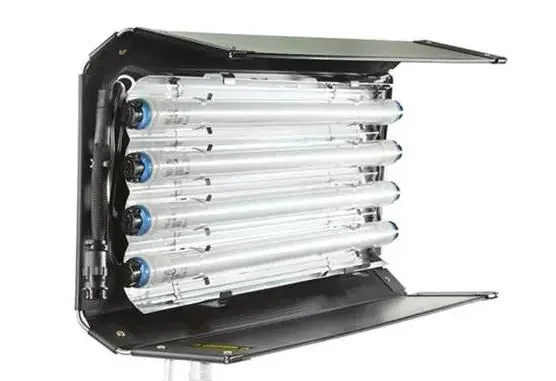
Fluorescent lights are soft lighting fixtures that produce light by exciting gas inside a tube coated with phosphor. For many years, fluorescent lighting was a staple of film, television, and broadcast production, especially for interviews, dialogue scenes, and studio work.
Before LED panels and tubes became dominant, fluorescent fixtures were the go-to solution for soft, low-heat, color-accurate lighting on professional sets.
⮞Go to Lighting Categories.
⮞Browse Lighting by Brands.
⮞Browse All Equipment.
Lights
What Fluorescent Lights Are
Fluorescent lights use long tubes powered by ballasts to produce a broad, soft source. In film and television, these fixtures are typically purpose-built units rather than household shop lights, designed with high-quality lamps, color-correct ballasts, and proper housings.
Most professional fluorescent fixtures are balanced to either tungsten (3200K) or daylight (5600K), depending on the tubes installed.
What Fluorescent Lights Are Known For
Soft, even light quality
Low heat output
Efficient power usage
Good color rendering with proper tubes
Flattering light for skin tones
Fluorescent fixtures became popular because they delivered consistent, usable soft light without the heat and power draw of tungsten soft lights.
Common Types of Fluorescent Lights
Fluorescent soft lights
Multi-tube fixtures designed for key and fill lighting in studios and interiors.
Fluorescent banks
Fixtures holding multiple tubes arranged behind diffusion for increased output.
Single-tube and strip fixtures
Slim fixtures used for edge light, background light, or set integration.
Portable fluorescent kits
Compact systems used for interviews and small crews.
Where Fluorescent Lights Are Used
Interviews and talking-head setups
Dialogue-heavy narrative scenes
Studio and broadcast environments
Film schools and training environments
Controlled interior locations
Fluorescent lighting excels where soft, even illumination is required at close range.
Fluorescent vs Other Light Types
Compared to tungsten soft lights:
Fluorescents run cooler
Use less power
Compared to LED panels:
Fluorescents have fixed color temperature
LEDs offer more control and flexibility
Compared to LED tubes:
Fluorescents require external ballasts
LED tubes are more portable
Advantages of Fluorescent Lighting
Naturally soft light output
Low heat on set
Efficient for long shoot days
Predictable, even coverage
Proven studio workflows
Limitations of Fluorescent Lighting
Fragile tubes
Limited dimming capability
Fixed color temperature per tube
Ballast-related flicker issues if poorly designed
Largely replaced by LED in modern workflows