
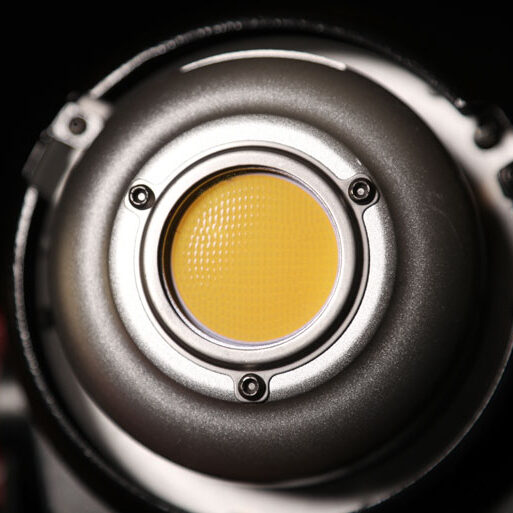
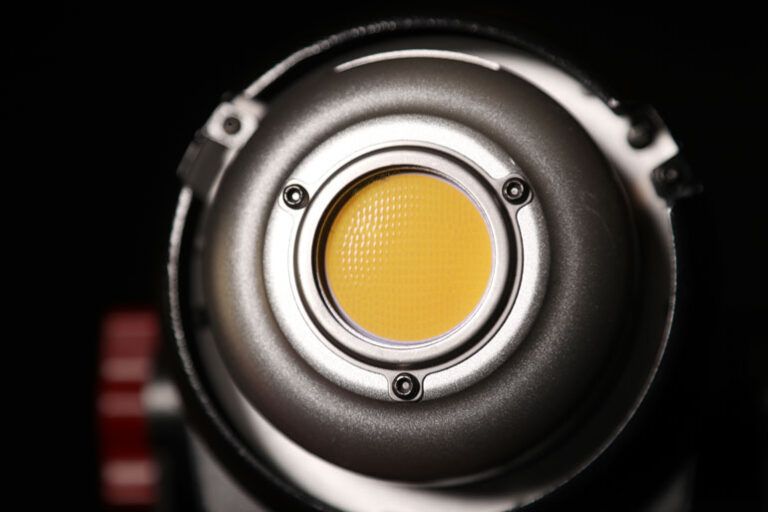
A COB LED light is a type of LED fixture that uses a single, high-output light source where multiple LED diodes are mounted together on one chip. In film and video production, COB LEDs are primarily used as powerful, directional “hard” light sources that can be shaped with modifiers such as reflectors, Fresnels, and softboxes.
What Does “COB” Mean?
COB stands for Chip On Board.
Instead of hundreds or thousands of small LEDs spread across a panel, a COB fixture concentrates many LED diodes into one unified light-emitting surface. This creates a single, controllable source that behaves similarly to a tradition “hard” lamp.
In practical terms, this means one source, one beam, and hopefully one shadow.
How a COB LED Light Works
A COB LED produces light from a concentrated point, which allows it to create hard, punchy output with defined shadows and strong beam control. Because the source is compact, the light can be shaped precisely using reflectors, Fresnel lenses and projection attachments.
This is why COB LEDs have become the primary LED replacement for tungsten and HMI fixtures on many professional film and video productions.
What Are COB LED Lights Used For?
COB LEDs are used when control and output matter more than instant softness.
Common uses include key lighting for interviews, motivated window light, sun replacement, bounce sources, exterior night lighting, and any setup where cutters, flags, or Fresnels are required.
If a lighting setup demands precision, a COB light is usually the correct tool.
COB LED vs LED Panel Lights
COB LED lights use a single source that produces directional light with strong throw and defined shadows. They accept modifiers easily and excel at controlled lighting setups.
LED panel lights use many small LEDs spread across a large surface. They produce soft, even light but offer limited throw and limited beam shaping.
Panels are convenient. COBs are versatile and scalable.
Typical Features of COB LED Fixtures
Most professional COB LED lights include a modifier mount such as Bowens, interchangeable reflectors, high output ratings ranging from 100W to well over 1000W, daylight, bi-color, or RGB options, wired and wireless control, active cooling, and yoke mounting for stands or grids.
These fixtures are designed to deliver high output without the heat and power draw of traditional hot lights.
Pros and Cons of COB LED Lights
Advantages include strong output from a compact source, excellent beam control, compatibility with industry-standard modifiers, natural shadow quality, and flexibility across many lighting styles.
Disadvantages include naturally hard light without diffusion, larger physical footprint once modifiers are added, potential fan noise on lower-end models, and being overkill for very small spaces or simple setups.
Common Beginner Mistakes
Common mistakes include using a COB light bare and expecting soft results, ignoring reflector beam angles, underestimating modifier size requirements, and assuming COB lights replace every other type of fixture.
A COB light without modifiers is only half the system.
When You Shouldn’t Use a COB LED
COB LED lights are not ideal for ultra-soft lighting in tight spaces, fast run-and-gun setups, or situations where speed matters more than control.
In those cases, panels or tube lights can often be the better choice.
Final Take
A COB LED light is the backbone of modern film and video lighting. It offers control, output, and flexibility that scale from small interviews to large narrative and commercial sets.
They are not flashy tools. They are workhorses.