
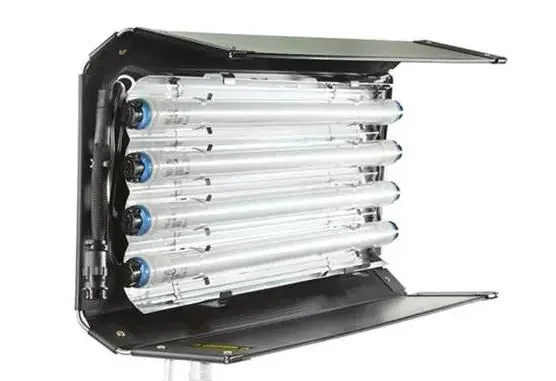
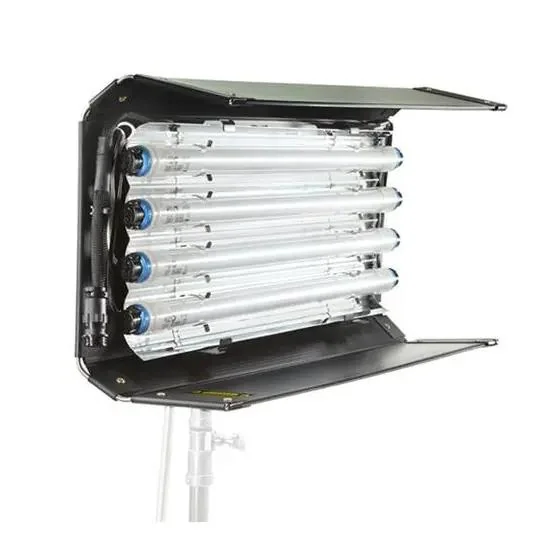
A fluorescent light is a soft lighting fixture that produces light by exciting gas inside a tube, causing a phosphor coating to glow. In film and video production, fluorescent lights have historically been used for soft, even, low-heat illumination, especially in interviews, interior scenes, and controlled studio environments.
Before LEDs became dominant, fluorescents were the go-to soft light on professional sets.
How Fluorescent Lights Work
Fluorescent lights pass an electrical current through gas-filled tubes, usually containing mercury vapor. This produces ultraviolet light, which then excites a phosphor coating on the inside of the tube, creating visible light.
Because the light is emitted along the entire length of the tube, the source is naturally soft and diffuse with gentle shadow falloff.
Unlike tungsten or HMI, fluorescents do not rely on heat to produce light.
Color Temperature and Color Quality
Fluorescent fixtures are available in different color temperatures, most commonly 3200K (tungsten) and 5600K (daylight) tubes.
Early fluorescents suffered from poor color rendering and green spikes, which required corrective gels. Professional fixtures solved much of this with high-quality tubes and electronic ballasts, but color consistency still depended heavily on tube quality.
This limitation is one reason LEDs replaced fluorescents so quickly.
What Fluorescent Lights Are Used For
Fluorescent lights are used when soft, wraparound light is needed without heat or heavy power draw.
Common uses include interview lighting, fill light, beauty lighting, tabletop product work, and interior scenes where heat-sensitive locations or talent comfort matter.
They were especially popular in documentary, television, and studio-based production.
Fluorescent vs LED Lighting
Fluorescent lights produce soft light with low heat and modest power consumption.
LED lights offer the same softness with higher output, better color control, adjustable color temperature, and no tube replacement.
Modern LED panels and tube lights have largely replaced fluorescents because they do everything fluorescents do, with fewer drawbacks.
Fluorescents are functional, but no longer competitive.
Typical Types of Fluorescent Fixtures
Common fluorescent fixtures include multi-tube softlights, tube-based banks, and practical fluorescent housings designed to appear on camera.
These fixtures are lightweight but bulky, fragile, and dependent on consumable tubes.
Pros and Cons of Fluorescent Lights
Advantages include soft light quality, low heat output, relatively low power draw, and comfortable working conditions for talent.
Disadvantages include fragile tubes, inconsistent color between lamps, limited output, slow warm-up on older fixtures, and declining availability as manufacturers move away from fluorescent technology.
Fluorescent lighting works, but it’s aging out.
Common Beginner Mistakes
Common mistakes include mixing mismatched tubes, ignoring green spike issues, assuming all tubes match their rated color temperature, and investing in fluorescent fixtures instead of modern LED alternatives.
Fluorescent lighting requires more maintenance than it appears.
When You Shouldn’t Use Fluorescent Lights
Fluorescent lights are not ideal for exterior work, high-output needs, precise beam control, modern color workflows, or long-term investment.
In nearly all modern production scenarios, LED fixtures are the better choice.
Final Take
A fluorescent light is a soft, low-heat lighting tool that defined professional film and television lighting for decades. While still usable, it has been largely replaced by LED technology that offers greater control, efficiency, and reliability.
Fluorescent lighting isn’t wrong.
It’s just been surpassed.
Understanding fluorescents helps explain why modern LED panels and tube lights are designed the way they are.