
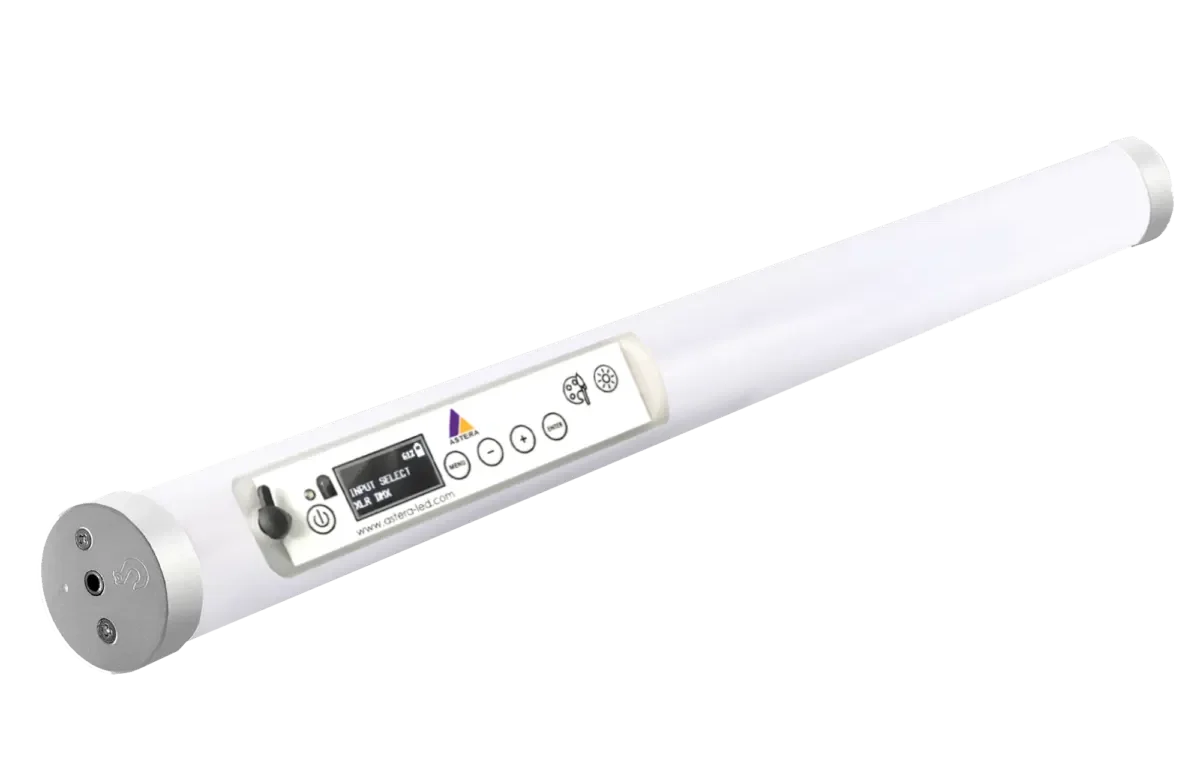
A Tube LED light is a cylindrical LED fixture designed to produce soft, even light along its entire length. In film and video production, tube LEDs are commonly used as practical lights, accent sources, and flexible fill lights that can be mounted almost anywhere on set.
Tube LEDs are valued less for raw output and more for their versatility, portability, and ability to appear naturally within a scene.
How Tube LED Lights Work
Tube LEDs use a linear array of LEDs housed inside a diffused cylindrical casing. Light is emitted evenly along the tube rather than from a single point.
Because the source is long and diffused, the light is naturally soft with gentle falloff. Shadows are minimal and directional control is limited compared to point-source fixtures.
Most tube LEDs rely on placement and proximity rather than modifiers to shape the light.
What Tube LED Lights Are Used For
Tube LEDs are used when flexibility and placement options matter more than power.
Common uses include practical lighting in-frame, accent and edge lighting, kickers and rim lights, under-cabinet or architectural lighting, handheld or hidden sources, and quick fill in tight spaces.
They are especially common in music videos, commercials, documentary work, and modern narrative lighting where visible sources are part of the design.
Tube LED vs COB and Panel Lights
Tube LEDs produce soft, linear light with minimal setup and maximum placement flexibility.
COB LEDs produce powerful, directional light that can be shaped with modifiers and thrown long distances.
LED panels produce broad, soft light from a flat surface with more output than tubes but far less control than COB fixtures.
Tube lights do not replace COBs or panels. They solve different problems.
Typical Features of Tube LED Lights
Most professional tube LEDs include internal batteries, RGB or full-spectrum color control, wireless or app-based control, mounting options and/or magnets, multiple rigging points, and pixel or segment control on higher-end models.
Their design prioritizes mobility and creative placement over beam shaping.
Pros and Cons of Tube LED Lights
Advantages include extreme mounting flexibility, soft light quality, fast setup, and the ability to function as both light sources and visible practical elements.
Disadvantages include limited output, poor throw, minimal beam control, and overuse leading to repetitive looks if relied on too heavily.
Tube lights are tools, not shortcuts.
Common Beginner Mistakes
Common mistakes include trying to use tube LEDs as key lights from a distance, relying on RGB effects for every setup, placing tubes too close to faces without motivation, and using tubes everywhere simply because they are easy.
Tube LEDs work best when they are motivated and intentional.
When You Shouldn’t Use Tube LED Lights
Tube LEDs are not ideal for sun simulation, exterior night work, long-throw applications, heavy diffusion setups, or situations requiring precise shaping with flags or cutters.
In those cases, COB LEDs or Fresnels are the correct tools.
Final Take
A Tube LED light is a flexible, soft lighting tool. It excels as a practical, accent, backlight or fill source where traditional fixtures are too bulky or restrictive.
Tube lights are generally not powerful fixtures. They are problem solvers.
Used deliberately, they elevate a scene. Overused, they become visual noise.