
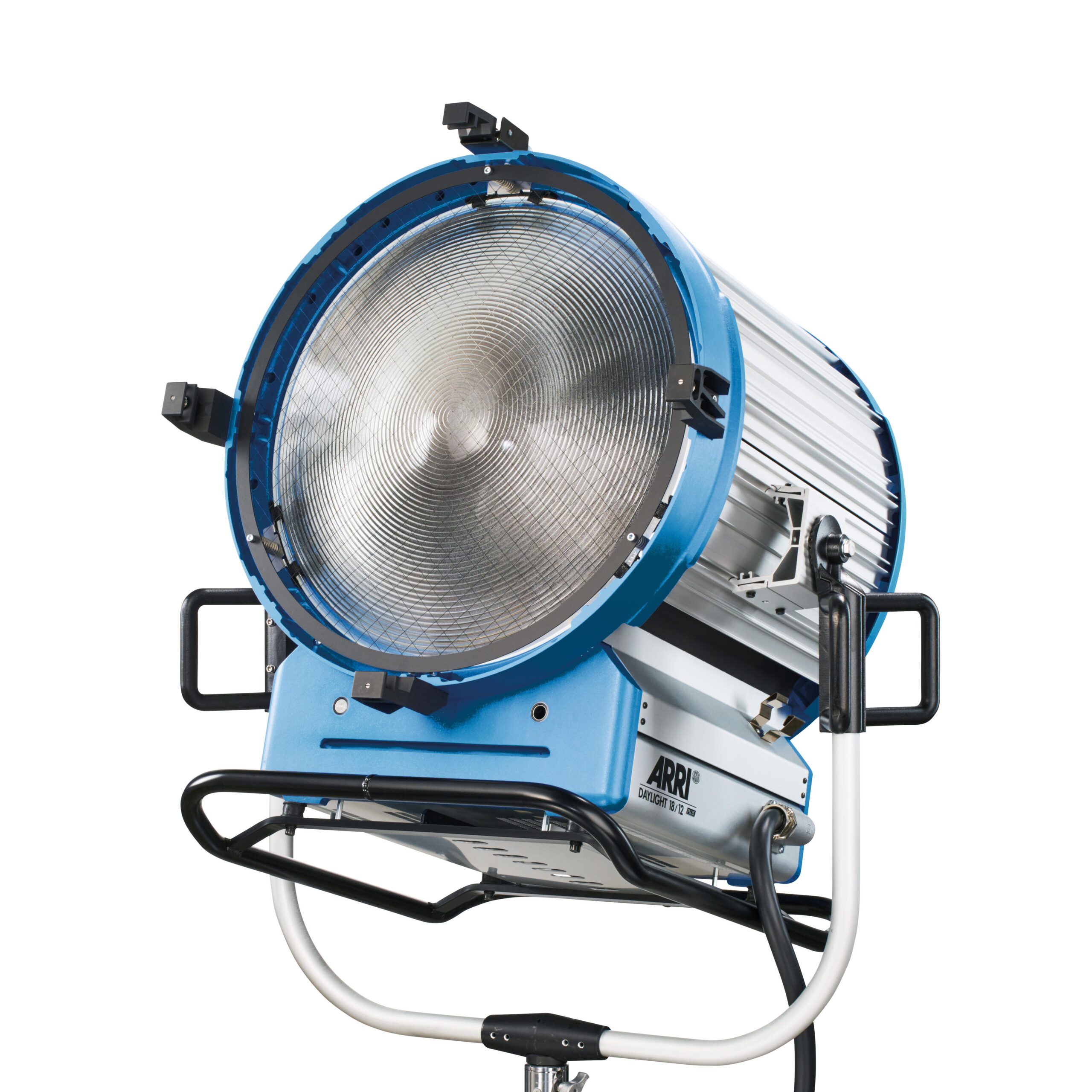
An HMI light is a high-intensity discharge (HID) lighting fixture that produces extremely bright, daylight-balanced light using an electric arc rather than a filament. In film and television production, HMI lights are used primarily when maximum output and long throw are required, especially for exterior work or simulating sunlight.
Before high-output LEDs, HMIs were the only practical way to create daylight indoors or overpower the sun.
How HMI Lights Work
HMI stands for Hydrargyrum Medium-arc Iodide.
Instead of a glowing filament, an HMI lamp creates light by striking an electric arc between two electrodes inside a quartz bulb filled with mercury vapor and metal halides. This arc produces an intense, efficient light output.
Because the arc requires high voltage to start and regulate, HMIs must be powered through a ballast, which controls ignition, flicker, and output stability.
Color Temperature of HMI Lights
HMIs operate at approximately 5600K.
Overtime the bulb may become warmer and shift green/magenta.
What HMI Lights Are Used For
HMI lights where the standard for sunlight for decades. They are still used on many sets all over the world. In some cases they are slowly being replaced by high output LED and are beginning to only be used when no other source delivers enough punch.
Common uses include exterior day fill, sun replacement through windows, large interior day scenes, bouncing light off buildings or large surfaces, and any situation requiring long throw and high output.
They are standard on commercial, television, and feature film sets where scale demands power.
HMI vs LED Lighting
HMI lights deliver enormous output with a small source size, allowing sharp shadows and strong beam control.
LEDs are more efficient, quieter, and safer to handle, but only recently have they begun to approach HMI-level output at comparable beam angles.
High-output LED COB fixtures are replacing HMIs on many sets, but HMIs still win when raw daylight punch matters most.
Typical Types of HMI Fixtures
Common HMI fixtures include Fresnel and PARs. PAR HMIs are especially valued for their ability to throw light long distances with interchangeable lenses.
These fixtures are large, heavy, and usually require dedicated power distribution.
Pros and Cons of HMI Lights
Advantages include extreme output, daylight color accuracy, long throw, and suitability for large-scale lighting setups.
Disadvantages include heat, ballast complexity, lamp warm-up and cool-down times, fragile bulbs, high replacement costs, and safety concerns during handling.
HMIs are powerful tools, but they demand experience.
Common Beginner Mistakes
Common mistakes include hot-restriking lamps too quickly, mishandling bulbs without gloves, ignoring ballast compatibility, underestimating power requirements, and treating HMIs like plug-and-play fixtures.
HMI lights are not forgiving.
When You Shouldn’t Use HMI Lights
HMIs are not ideal for small crews, tight indoor spaces, fast setups, low-budget productions, or situations where silent operation and low heat are required.
In those cases, LED sources are usually the better option.
Final Take
An HMI light is a daylight powerhouse designed for scale. It exists to solve problems that smaller fixtures simply cannot.
Even as LED technology advances, HMIs remain the benchmark for daylight intensity and throw.
If you understand HMIs, you understand why modern lighting fixtures are designed the way they are.