
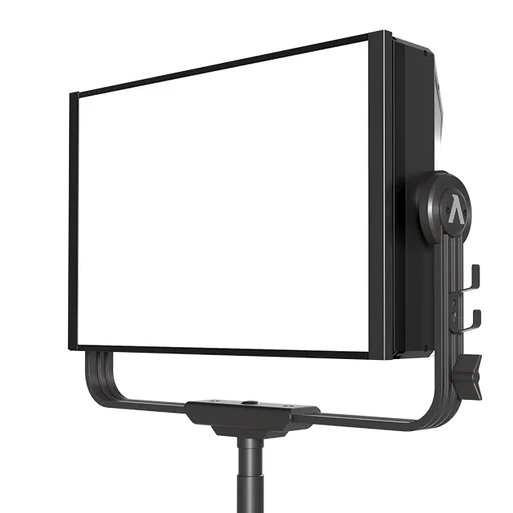
An LED panel light is a flat, multi-diode LED fixture designed to produce soft, even illumination across a wide area. In film and video production, LED panels are commonly used for interviews, corporate video, documentary work, and situations where fast setup and gentle light quality matter more than beam control or long throw.
LED panels are popular because they are simple, lightweight, and forgiving, especially for small crews and controlled indoor environments.
How an LED Panel Light Works
Unlike COB LED lights, LED panels use many small LEDs spread across a large surface area. The light is emitted from the entire face of the fixture rather than a single point source.
Because the emitting surface is large, the light is soft by default. Shadows are minimal, falloff is gentle, and the light wraps easily around faces and objects without heavy diffusion.
Most panels rely on internal diffusion layers rather than external modifiers to shape the light.
What LED Panel Lights Are Used For
LED panels are used when speed, softness, and simplicity are the priority.
Common uses include interview key lights, fill lights, beauty lighting, tabletop product shots, talking-head videos, and small studio setups with limited space.
They are especially common in corporate, educational, and content-creator environments where lighting needs to be consistent and repeatable.
LED Panel vs COB LED Lights
LED panel lights emit soft light from a broad surface. They are quick to set up, easy to aim, and require little modification to look flattering.
COB LED lights emit hard, directional light from a single source. They offer greater output, longer throw, and far more shaping control when used with modifiers.
Panels are convenient. COBs are precise.
Neither replaces the other, but panels reach their limits much faster as productions scale.
Typical Features of LED Panel Lights
Most LED panels include built-in diffusion, bi-color or RGB color control, onboard dimming, battery plate options, wireless or app control, and simple mounting via yokes or baby pins.
Panels rarely accept optical modifiers like Fresnels or projection lenses. Their design prioritizes even coverage over beam shaping.
Pros and Cons of LED Panel Lights
Advantages include soft light quality without additional diffusion, fast setup, low learning curve, lightweight design, and suitability for small spaces.
Disadvantages include limited throw, poor performance outdoors or at distance, minimal beam control, flat lighting if overused, and reduced flexibility compared to point-source fixtures.
Panels are easy to use, but easy to outgrow.
Common Beginner Mistakes
Common mistakes include trying to push LED panels too far from the subject, expecting them to compete with daylight, stacking panels instead of using a stronger source, and relying on panels exclusively for every lighting situation.
LED panels solve some problems well, but not all problems.
When You Shouldn’t Use an LED Panel
LED panels are not ideal for exterior work, long throw applications, motivated hard light, sun simulation, or any setup that requires flags, cutters, or precise beam control.
In those situations, a COB LED or Fresnel fixture is usually the better choice.
Final Take
An LED panel light is a soft, forgiving tool designed for speed and simplicity. It excels in controlled environments where consistency and ease of use matter more than power or precision.
Panels are not cinematic by default. They are practical.
Used correctly, they are invaluable. Used exclusively, they become limiting.