
Last Updated 4 days ago
Overview
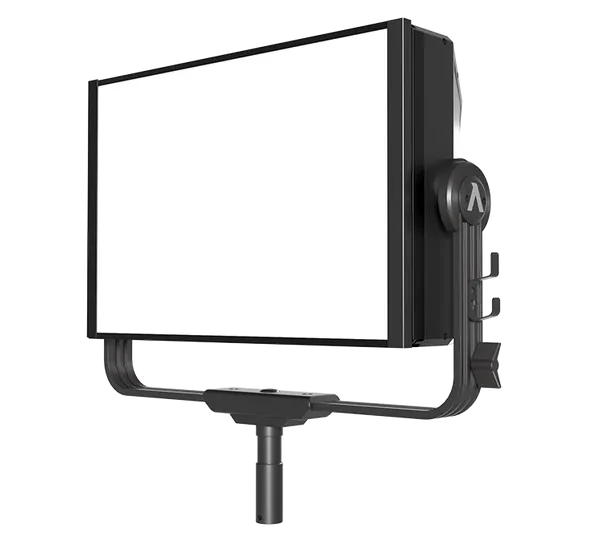


The Aputure Nova P300c is a 300W-class RGBWW soft panel with an integrated power supply and a separate control interface. Its broad source suits close and medium-distance soft lighting, with white-light adjustment, colour modes and effects.
The original P300c is an RGBWW soft panel for compact interview and interior setups. Its external receiver and battery requirements add to the weight and cost of a portable kit.
- RGBWW Soft Panel Original 300 W-class Nova P300c with integrated power supply and a detachable control interface. Learn about RGBWW
- 360 W Maximum Input 100–240 V AC, 50/60 Hz, or a suitable 24–48 V DC supply. Battery capacity and current capability both matter.
- Colour Temperature2,000–10,000 K Tunable white with green/magenta adjustment, plus colour and effects modes.
- Weight 10.35 kg light. Separate control box: 0.45 kg. Combination 16 / 28 mm Baby/Junior mounting pin. Include accessory and cable loads.
- Beam Angle Broad 120° native spread, not a focusing beam. A compatible softbox enlarges the source; a grid or barn doors controls spill.
- IP Rating Keep the fixture dry. No numeric IP rating stated in the cited specifications. Aputure’s manual prohibits use in damp environments. IP rating guide.
Key Specifications
| Specification | Details |
|---|---|
| Type | RGBWW soft panel |
| CCT Range | 2000K–10,000K |
| Power Draw | 360W |
| CRI/TLCI | 95+ |
| Beam Angle | 120° |
| Weight | 10.35kg light; 0.45kg separate control box |
| Control | onboard, Sidus Link Bluetooth Mesh and wired 5-pin DMX512; external receiver required for CRMX |
Output Calculator
Select the published setup and a manufacturer distance, or enter a custom throw where supported. The results describe centre-beam output, not the brightness across the whole beam.
Camera Settings
If the calculator does not load, use the published photometric table or source on this page. JavaScript is required.
F-stop is a planning estimate, not a meter reading. It uses direct, on-axis illuminance and includes only the optics and diffusion named in the selected setup. Meter on set to account for lens transmission, filters, added diffusion, bounce, dimming and ambient light.
How the exposure estimate works
N = √(E × ISO × t / C), where E is illuminance in lux and t = shutter angle ÷ (360 × fps). The default C = 340 is a dome reference; C = 250 is a flat reference. These are calibration constants, not a measured T-stop. A small nonzero digit is tenths of a stop above the displayed full stop.
Distance estimates and comparisons
Published points are used as given. Between published points the calculator fits a curve through the two nearest readings. Outside those points it uses the inverse-square law only when the fixture’s dataset permits it. Distances outside a configuration’s supported range are reported separately. Comparisons use one shared distance and camera setup; equal lux does not imply equal coverage.
View published readings for the selected configuration
Strengths and Limitations
Strengths
- Broad soft output and RGBWW colour are available without a point-source modifier.
- The removable control interface is useful when the lamp is above reach.
Limitations
- No built-in CRMX receiver or P600c-style multi-zone engine.
- The 10.35kg lamp and required high-current DC package deserve more handling and battery planning than the 300W-class name implies.
Practical Uses
Use it as an interview key, soft fill or a coloured background source. A grid controls spill, while a softbox increases the apparent source size. Budget for the complete DC power solution if the location has no suitable AC supply.
| Setup | How to use this fixture |
|---|---|
| Interview key | Place the panel close enough to make its aperture useful as a soft source; add the P300c softbox when a larger apparent source is needed. A grid reduces spill onto walls and background. |
| Coloured background | Set the actual hue and saturation before establishing exposure. Saturated colours do not retain the white-mode lux figure. |
| Overhead or inaccessible position | The control box can be removed from the rear and operated on its cable. Provide a separate external DMX receiver when console wireless control is part of the rig. |
Output and Colour
The P300c's broad 120° RGBWW panel gives 1,100 lux at 3m in the manufacturer's 5,500K reference. Those are standard-panel readings, not a narrow reflector result. A softbox makes the source larger and a grid limits spill. Meter at the subject after fitting either accessory; the bare-panel reading does not account for it. The original P300c does not have the P600c's four separately controllable light engines.
Output, Power and Wireless DMX
| CCT, standard panel | 1m | 3m | 5m |
|---|---|---|---|
| 3,200K | 8,200 lux | 960 lux | 370 lux |
| 5,500K | 9,000 lux | 1,100 lux | 430 lux |
Sources: Nova P300c | Aputure; Sidus One: external DMX/CRMX bridge information.
The aperture is 39.9 × 27.1cm, smaller than the complete housing. That emitting area, its distance from the subject and any fitted softbox determine shadow softness. A small panel placed far away does not become a large soft key because its native beam is broad.
Independent Measurements
Erik Naso’s Newsshooter review measured four white settings at 1m with a Sekonic C-700. His results are listed below. Saturated-colour output varied substantially with hue.
| Set CCT | Review output at 1m |
|---|---|
| 2,000K | 6,100 lux |
| 3,200K | 8,500 lux |
| 5,600K | 9,600 lux |
| 10,000K | 8,910 lux |
Read Naso’s output, spectrum and colour tests. These describe his review unit and setup.
Power and Batteries
The integrated supply accepts 100–240V AC, with 360W maximum input. The small detachable box is the operating interface, not an external high-power ballast.
The separate 4-pin XLR DC input accepts 24–48V. A battery system must provide that voltage and sustain the load through its output, cable and connector. A bare V-mount pack is not a direct substitute for a regulated compatible DC supply. Compare the complete power-system weight when deciding whether the panel is portable enough for the location.
Control, Cooling and Camera Operation
| Control path | Hardware and operating notes |
|---|---|
| Local interface | Detachable controller, with 0.6m and 3m control cables listed in the original package. |
| App | Sidus Link Bluetooth Mesh; CCT/tint, colour, gel and effect modes use the supported app/firmware controls. |
| Wired console | 5-pin DMX512. Select the P300c chart rather than a P600c multi-engine profile. |
| Wireless console | No internal CRMX. A compatible receiver feeds the wired DMX input; Sidus Link Bluetooth alone does not receive a console’s CRMX transmission. |
For repeat cues, record colour mode, tint and intensity. The P300c controls the panel as one source; it does not have the P600c’s four independently addressable engines.
Active cooling needs an audio check at working brightness. Keep the rear ventilation clear when placing the panel close to a ceiling or inside a dressed set piece. Test the lowest intended dimmer level and fade on the production camera.
Modifiers, Rigging and the Working Package
The lamp is 10.35kg and the detachable control box 0.45kg; gross shipping weight is a different figure. Order the P300c-specific softbox/grid and support the lamp, yoke and modifier together. Keep the controller cable accessible if the head is placed overhead. The original panel is discontinued and should be checked as an existing rental or used unit.
| Component | Working detail |
|---|---|
| Panel surface | 39.9 × 27.1cm emitting area |
| Complete light | 56.19 × 45.7 × 16.6cm; 10.35kg |
| Control box | 0.45kg; detachable, with cable access required |
| Support interface | Baby/Junior combination mounting arrangement |
| Light control | P300c-specific accessory slot, softbox, grid or barn doors |
| Wireless/DC accessories | External CRMX receiver and compatible DC system when required |
The 10.35kg light needs support chosen for the complete panel, fitted modifier and working angle. Moving the small control box off the head improves access but does not move the integrated PSU’s mass off the lamp. Keep the front accessory latch accessible after rigging.
Alternatives and Related Fixtures
| Fixture | When to compare it |
|---|---|
| Aputure Nova P600c | Choose the larger four-engine panel when that zone control and additional output are useful, with a corresponding increase in head and power requirements. |
| ARRI SkyPanel S30-C | Compare the smaller-aperture SkyPanel Classic package, including its external PSU and battery-mode limits. |
| Litepanels Gemini 1×1 Soft RGB LED Light Panel | Compare another broad RGBWW 1×1 package by complete weight, output at working distance and fitted communications hardware. |
What People Are Saying
Field Feedback at a Glance
These observations come from Naso’s hands-on review and interview setup.
What worked
- Naso’s colour measurements were strong at both the tungsten and daylight settings. Erik Naso, Newsshooter.
- On an interview he got useful fill through diffusion with the panel running below full output. Erik Naso, Newsshooter.
- Naso liked the shorter panel shape compared with a wider 2-by-1 light. Erik Naso, Newsshooter.
Drawbacks to plan for
- Naso weighed the head at roughly 23 pounds; his complete cased kit weighed about 47 pounds. Erik Naso, Newsshooter.
- He noted that a suitable battery system adds appreciably to the cost. Confirm whether it is included if you are booking a battery kit. Erik Naso, Newsshooter.
- The quarter-grid diffusion supplied with the optional softbox wasn’t soft enough for Naso’s preference. Allow room for another layer if the shot needs it. Erik Naso, Newsshooter.
Erik Naso, Newsshooter
Naso praises output, colour quality and the compact panel dimensions. His main reservations are the fixture’s weight and the cost of a suitable battery system. Read article.
Gerald Undone
Gerald Undone discusses the P300c’s capabilities, price and value for filmmakers buying an RGBWW panel. Watch video.
Videos
Gerald Undone reviews the Nova P300c and discusses its value for smaller productions.
Rental and Used-fixture Checks
- Check the detachable control-box connection and cable, yoke lock and accessory latch.
- Demonstrate the external CRMX receiver if wireless console control is required.
- Test the panel for colour uniformity, low-level fades and fan noise at the intended exposure.
For environmental and safety limits, see the original Nova P300c manual. Keep the fixture and its connections dry.
Documentation and Specifications
Browse Aputure lights · LED panels · all equipment.