
Last Updated 6 days ago
Overview



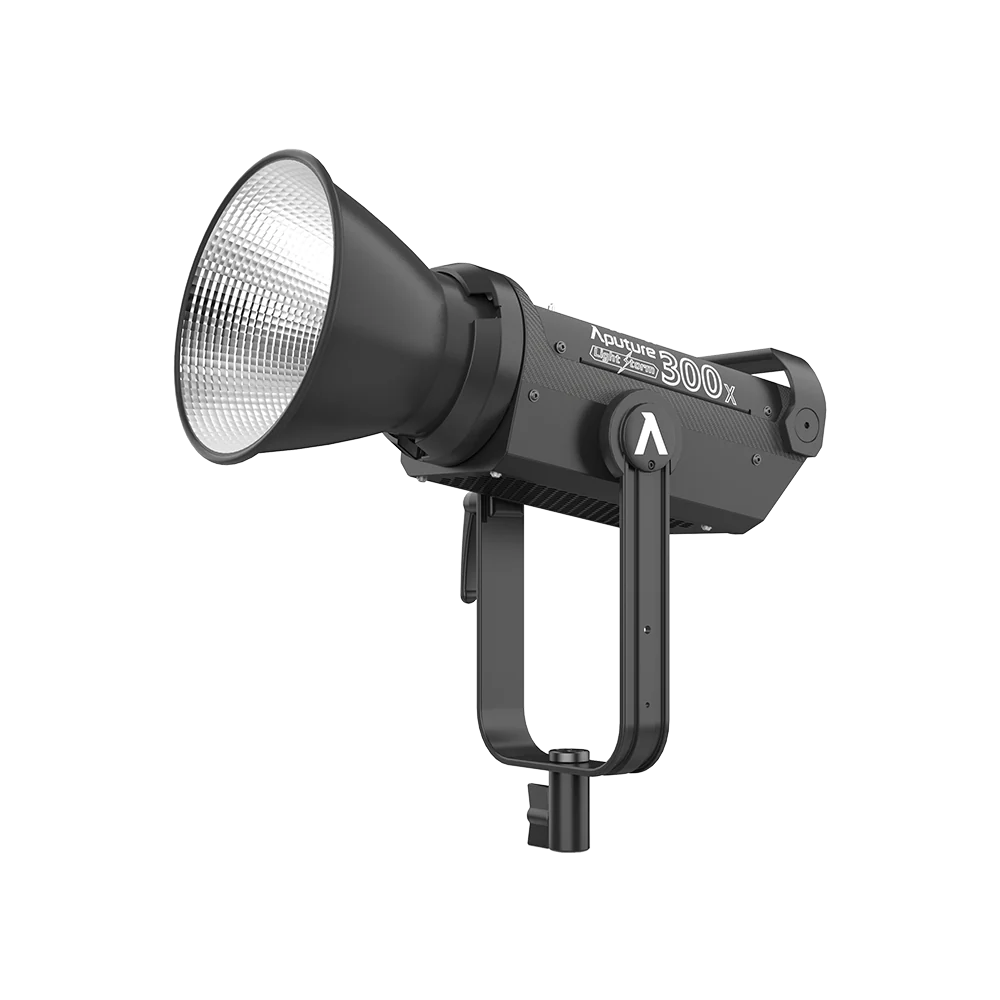
The Aputure LS 300x is a bi-colour Bowens-mount COB LED with a separate controller. It is a smaller alternative to the 600x Pro for interviews and small interiors that need adjustable white light.
The 300x provides quick tungsten-to-daylight adjustment in an existing Bowens kit. Portable and console-controlled setups need the appropriate batteries and an external wireless receiver.
- Bi-Colour COB LEDBowens-mount point source with separate controller.
- 350 W Maximum Input100–240 V AC; suitable 12–16.8 V batteries, one for half output or two for full power. 15 A continuous discharge recommended.
- Colour Temperature2700–6500 K Tunable white with Max Output and Constant Output modes.
- Weight 7.315 kg Listed Net Weight. Not identified as head-only by Aputure. 16 mm Baby receiver; include controller, modifier and cable loads.
- Beam ControlIncluded 55° Hyper-Reflector; compatible Fresnel 2X, Spotlight Mount and Bowens soft modifiers.
- No Published IP RatingThe cited product specifications state no IP code. Protect the head and controller from moisture; do not infer rain protection. Understand IP Ratings.
Key Specifications
| Specification | Details |
|---|---|
| Type | Bi-colour COB LED |
| Maximum electrical consumption | 350W; measured light output is listed below |
| CCT Range | 2700K–6500K |
| CRI/TLCI | 95+ |
| Manufacturer-listed net weight | 7.315kg; this is not identified as the head-only weight |
| Mount | Bowens |
| Control | onboard, Sidus Link Bluetooth Mesh, 2.4GHz remote and standard 5-pin DMX512 |
Output Calculator
Select the published setup and a manufacturer distance, or enter a custom throw where supported. The results describe centre-beam output, not the brightness across the whole beam.
Camera Settings
If the calculator does not load, use the published photometric table or source on this page. JavaScript is required.
F-stop is a planning estimate, not a meter reading. It uses direct, on-axis illuminance and includes only the optics and diffusion named in the selected setup. Meter on set to account for lens transmission, filters, added diffusion, bounce, dimming and ambient light.
How the exposure estimate works
N = √(E × ISO × t / C), where E is illuminance in lux and t = shutter angle ÷ (360 × fps). The default C = 340 is a dome reference; C = 250 is a flat reference. These are calibration constants, not a measured T-stop. A small nonzero digit is tenths of a stop above the displayed full stop.
Distance estimates and comparisons
Published points are used as given. Between published points the calculator fits a curve through the two nearest readings. Outside those points it uses the inverse-square law only when the fixture’s dataset permits it. Distances outside a configuration’s supported range are reported separately. Comparisons use one shared distance and camera setup; equal lux does not imply equal coverage.
View published readings for the selected configuration
Strengths and Limitations
Strengths
- Tungsten/daylight adjustment and a conventional Bowens ecosystem suit compact location setups.
- Single- or dual-battery operation provides clearly different portable operating options.
Limitations
- Single-battery operation is limited to half output, and the allowed battery voltage range excludes high-voltage packs.
- No native CRMX receiver; CCT and output mode affect exposure.
Practical Uses
Use a softbox for a close interview key or a compatible optic for a more defined source. Assess the exposure at the required colour temperature and modifier setting; the daylight-only 300d II is a different output and colour trade-off.
| Setup | How to use this fixture |
|---|---|
| Interview key | Use a softbox or bounce at the actual subject distance. Start in the required output mode, then set the white balance and intensity; a mid-range-CCT peak is not the exposure available at every colour setting. |
| Matching practicals | Use CCT adjustment for a warm room, then judge the mix on camera. The 300x does not offer the same tint-control system as newer multi-emitter STORM lights. |
| Battery location | One suitable battery is a reduced-output arrangement; use the specified pair when full-power battery operation is needed. Establish that configuration before placing a large diffusion frame. |
Output and Colour
The 300x has Max Output and Constant Output modes. Max Output peaks around the middle of the CCT range; Constant Output reduces brightness changes during CCT adjustments. Bare-head and Hyper-Reflector readings differ, as do tungsten and daylight output.
LS 300x Output and Power
| CCT / configuration | 1m | 3m | 5m |
|---|---|---|---|
| 3,200K, bare | 5,100 lux | 580 lux | 220 lux |
| 3,200K, Hyper-Reflector | 16,200 lux | 1,300 lux | 450 lux |
| 5,500K, bare | 6,300 lux | 700 lux | 250 lux |
| 5,500K, Hyper-Reflector | 20,500 lux | 1,700 lux | 550 lux |
Sources: LS 300x | Aputure; Aputure Light Storm LS 300x specifications.
Max Output follows the maximum available brightness at each CCT; Constant Output is intended to reduce brightness changes during white-light transitions. For a cue from warm to cool, choose that behaviour before recording levels. Changing the mode afterwards can alter the relationship between a programmed percentage and the final exposure.
The 300x is marked discontinued on Aputure’s current product page, with the STORM 400x named as its successor. That affects a new-versus-used purchasing decision, but does not establish the condition or remaining service life of a particular 300x.
Power and Batteries
Maximum AC input is 350W. The supported battery range is 12–16.8V, with at least 15A continuous discharge. One suitable battery permits up to half output; two suitable batteries allow full-power operation. High-voltage packs are outside that specified range.
The controller’s V-mount or Gold-mount version determines physical battery compatibility. Include the charger, battery pair, controller clamp and head cable in a portable package. Capacity in Wh determines an energy budget, while the discharge rating determines whether the load can be supplied.
Control, Cooling and Camera Operation
| Control path | Hardware and operating notes |
|---|---|
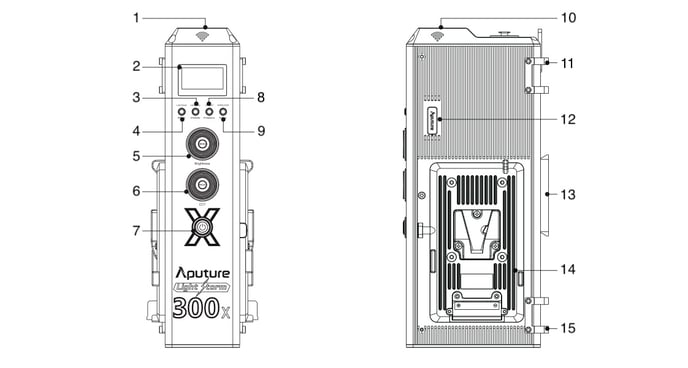
| Onboard | Intensity, CCT, effects and Max/Constant Output settings on the controller. |
| App / handheld remote | Sidus Link Bluetooth Mesh and the supported 2.4GHz remote are separate control paths. |
| Console | Standard 5-pin DMX512. Use an external CRMX receiver for wireless console control; Bluetooth does not replace that receiver. |
The all-in-one control box is designed for silent operation, while the head has its own cooling requirements. Listen at the microphone position with the lamp warmed up, particularly if the key is close to a seated interview subject.
For a fade, test the low end and the CCT transition as separate operations. Save the actual output mode with the console cue or app preset. A static daylight test cannot establish the appearance of a warm fade through zero.
Modifiers, Rigging and the Working Package
Compatible accessory profiles · Aputure Fresnel 2X · Aputure Spotlight Max Projection Attachment (19°, 36° and 50°) · amaran Spotlight SE Projection Kit, 19° and 36°
The Bowens mount supports Aputure’s listed Fresnel 2X, Spotlight and soft-light accessories. The kit also includes a separate controller, Lightning Clamp and head cable. A fitted softbox changes balance and the available tilt clearance.
| Package part | Specify with the lamp |
|---|---|
| Head and yoke | Actual softbox/Fresnel fit and the required tilt clearance |
| Controller | Correct battery-mount version, Lightning Clamp and AC lead |
| Head cable | Supplied 3m 5-pin cable, or a documented compatible replacement |
| Wireless DMX | External receiver and its own power arrangement |
| Light control | Compatible Bowens softbox, Fresnel 2X or named projection optic |
A large softbox shifts the balance forward and occupies space beyond the lamp body. Fit it before positioning the stand tight to furniture or a ceiling. Support the controller and route the head cable so a tilt adjustment does not pull on the connector.
Alternatives and Related Fixtures
| Fixture | When to compare it |
|---|---|
| Aputure Light Storm LS 300d II | Choose the daylight model if variable CCT is unnecessary; compare the same optic rather than nominal watts. |
| Nanlite Forza 300B II | Compare the Forza's tint adjustment, battery arrangements and matched Fresnel package. |
| Aputure Light Storm LS 600x Pro | Move to the 600x Pro when the exposure requires it, allowing for heavier components and larger battery demands. |
What People Are Saying
Field Feedback at a Glance
Digital Camera World’s review includes affiliate links.
What worked
- Hall liked the solid metal yoke and the way it held the head. Phil Hall, Digital Camera World.
- He found the fans quiet during his review. Test the room and mic position for your own sound setup. Phil Hall, Digital Camera World.
- He found the stand clamp and remote useful for changing settings without reaching the head. Phil Hall, Digital Camera World.
Drawbacks to plan for
- Hall noted that the 350 W maximum draw was higher than some lights in the same class. Phil Hall, Digital Camera World.
- He considered the kit relatively expensive against the alternatives available when he tested it. Phil Hall, Digital Camera World.
- The headline 56,000 lux at 1 m in his review needs the optional Fresnel 2X. Don’t budget that output for the bare head. Phil Hall, Digital Camera World.
Gerald Undone
Gerald Undone’s LS 300x review discusses three considerations for filmmakers choosing a bi-colour fixture. Watch video.
Reddit, r/Filmmakers
A filmmaker tested the STORM 400x against the LS 300x and LS 600x, then took the 400x with the original Spotlight to the music-video shoot. View discussion.
Videos
Gerald Undone’s LS 300x review focuses on three points prospective users should understand.
Rental and Used-fixture Checks
Before You Book
- Confirm the controller's battery-mount version and test both battery positions.
- Check the handbrake, cable-relief hook and head cable under the intended modifier load.
- Save the required Max/Constant Output setting and verify the programmed CCT transition.
Documentation and Specifications
- Aputure Light Storm LS 300x specifications
- LS 300x | Aputure
- LS 300x operating modes and battery requirements
- Aputure STORM 1200x
Browse Aputure lights · COB lights · all equipment.