
Last Updated 17 hours ago
Overview
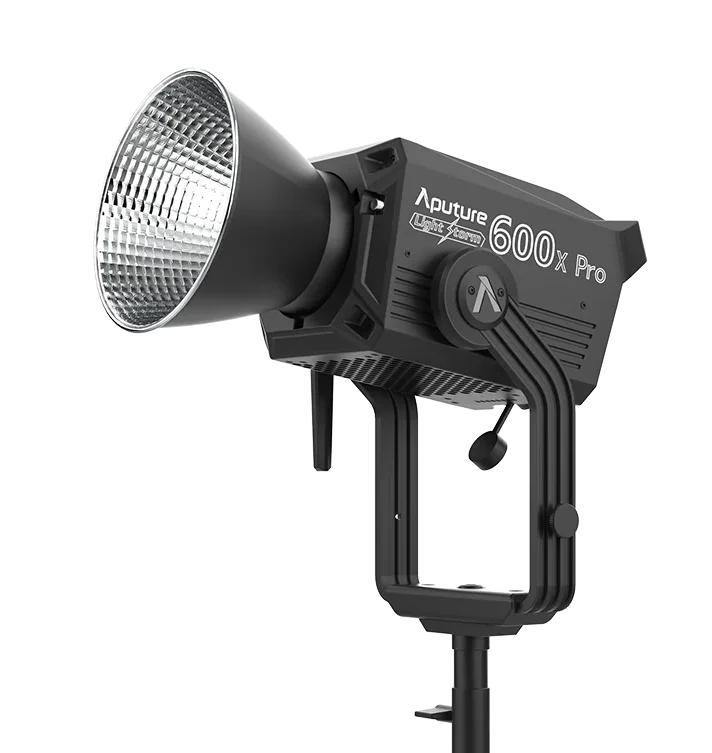


The Aputure Light Storm LS 600x Pro is a 600W bi-colour Bowens-mount LED for interviews and narrative interiors. It has a 2700K–6500K range, a separate controller and built-in CRMX. Its established modifier range and wired network controls suit owner-operator and console-controlled kits. The complete package is substantial, and daylight output is lower than the LS 600d Pro.
- Bi-Colour COB LED600 W light-engine class with Bowens modifier mount.
- 720 W Maximum Input100–240 V AC; separate controller. Battery output depends on pack voltage and discharge capability.
- Colour Temperature2700–6500 K Tunable white; no full-colour mixing or green–magenta adjustment.
- Weight 5.16 kg Head with Yoke. Separate 4.89 kg controller; 16 mm baby / 28 mm junior stand interface. Add modifier and cable weight.
- Beam ControlSupplied Hyper-Reflector; optional F10 Fresnel adjusts 15°–45°. Bowens softboxes or projection optics change coverage.
- No Assigned IP RatingAputure lists dust and water resistance, not an IP code. Observe the manual’s wet-use warnings. Weather Resistance vs IP Ratings.
Jump to Output Calculator ↓ · Compare output
Key Specifications
| Specification | Details |
|---|---|
| Fixture / accessory mount | Light Storm LS 600x Pro; 600W bi-colour COB; Bowens |
| CCT / dimming | 2700K–6500K; 0–100% with 0.1% onboard adjustment increments |
| Manufacturer colour ratings | CRI ≥96; TLCI ≥98; SSI tungsten ≥85, D56 ≥74 |
| Maximum electrical input | 720W; AC 100–240V, 50/60Hz; 48V DC input |
| Battery mounting | Two V-Mount or Gold Mount packs, depending on controller version |
| Control | Onboard, Sidus Link, 2.4GHz remote, 5-pin DMX, CRMX, Art-Net and sACN via etherCON |
| Head with yoke / controller | 5.16kg (11.37lb) / 4.89kg (10.78lb) |
| Stand interface | 16mm baby / 28mm junior |
| Cooling / operating temperature | Smart, High, Medium, Silent; −20°C to 45°C |
| Weather protection | Dust and water resistant; no assigned IP rating |
Output Calculator
Select the published setup and a manufacturer distance, or enter a custom throw where supported. The results describe centre-beam output, not the brightness across the whole beam.
Camera Settings
If the calculator does not load, use the published photometric table or source on this page. JavaScript is required.
F-stop is a planning estimate, not a meter reading. It uses direct, on-axis illuminance and includes only the optics and diffusion named in the selected setup. Meter on set to account for lens transmission, filters, added diffusion, bounce, dimming and ambient light.
How the exposure estimate works
N = √(E × ISO × t / C), where E is illuminance in lux and t = shutter angle ÷ (360 × fps). The default C = 340 is a dome reference; C = 250 is a flat reference. These are calibration constants, not a measured T-stop. A small nonzero digit is tenths of a stop above the displayed full stop.
Distance estimates and comparisons
Published points are used as given. Between published points the calculator fits a curve through the two nearest readings. Outside those points it uses the inverse-square law only when the fixture’s dataset permits it. Distances outside a configuration’s supported range are reported separately. Comparisons use one shared distance and camera setup; equal lux does not imply equal coverage.
View published readings for the selected configuration
Manufacturer ratings: Aputure product specifications. Independent measurements and their test conditions are listed separately below.
Weather Protection in Use. Aputure’s IP guidance explicitly places the LS 600x Pro in its non-IP-rated, dust-and-water-resistant group. Its manual warns against immersion and use in wet conditions; the technical page separately provides a rain tilt diagram and excludes water-ingress failures from warranty. Weather-resistant construction is not unrestricted wet-location approval. Follow the instructions for the actual fixture, cable connections and supply, and seek manufacturer guidance where conditions conflict with the manual.
Strengths and Limitations
- Choose it for: a tunable-white key with established Bowens modifiers, built-in CRMX and wired network control.
- Choose another class of light for: saturated colour, green/magenta correction, a much smaller travel kit, or an IP-rated exterior package.
- Evaluate the complete package: the controller, stand, modifier and batteries affect transport and setup as much as the lamp head.
Practical Uses
Interview or narrative soft key. Put a suitable softbox just above eye level and to one side, then feather it across the subject to control the near cheek. Use negative fill to hold contrast and a grid or flags to keep the source off the background. Adjust CCT to the window light or practicals you want to retain.
A DP’s First Feature Advice post describes using a 600x with a softbox to supplement daylight at a dinner table, with a Nova P600c providing warm bar light. The frames and discussion show the fixture working as one part of a motivated lighting setup.
Window source or hard accent. Use the reflector or F10 for a directional patch of light, then shape it with flags. Establish the exposure against available daylight before committing to heavy diffusion. In a large room or against strong sun, the required area and exposure may exceed what one 600x can supply.
Warm bounce. At 3200K the published 3m reflector reading is 4,010 lux, versus 5,610 lux at 5600K. Budget for the reduction when moving between warm and daylight setups. For bounce, control the illuminated surface and the light leaving it; barn doors on the head alone cannot shape the entire resulting soft source.
Portrait with controlled spill. In the “Echoes” lighting discussion, the creator used a high, downward-angled 600x and softbox with painted acrylic. They suggested adding a grid or increasing the distance from the background to reduce spill.
Fire, television or lightning motivation. The built-in effects vary intensity and CCT. Place the source where the fictional light would originate and shape it to the scene. Saturated colour work calls for filtration or a colour-mixing fixture.
Output and Colour
The supplied Hyper-Reflector concentrates light into a relatively narrow beam. The following Aputure averaged photometrics distinguish the bare head from that reflector. All readings are illuminance in lux; a centre reading does not describe edge-to-edge coverage.
| CCT / configuration | 1m | 3m | 5m |
|---|---|---|---|
| 3200K, bare | 11,630 | 1,364 | 524 |
| 5600K, bare | 16,060 | 1,880 | 728 |
| 3200K, Hyper-Reflector | 45,300 | 4,010 | 1,426 |
| 5600K, Hyper-Reflector | 63,900 | 5,610 | 1,996 |
With the optional F10 Fresnel, Aputure lists 7,070 lux at 3m in 45° flood and 18,510 lux in 15° spot, both at 5600K. The increase in the spot reading comes with reduced coverage. For a diffusion frame, beam spread and evenness matter alongside the centre value.
Max Output gives the highest level available at the selected CCT. Constant Output holds the level more consistently during CCT changes. Use Constant Output for a warm-to-cool cue and set exposure after selecting the mode. The menu settings also offer Linear, Exponential, Logarithmic and S-Curve dimming.
Independent Output and Colour Tests
In Newsshooter’s review, Erik Naso tested a review unit using a Sekonic C-700-U. He measured one metre from the front of the COB.
| Measurement | 3200K setting | 5600K setting |
|---|---|---|
| Bare-head illuminance | 13,400 lux | 18,600 lux |
| Hyper-Reflector illuminance | 49,600 lux | 68,400 lux |
| Measured CCT | 3064K | 5397K |
| Average CRI | 97.8 | 96.8 |
The differences between dialled and measured CCT show why matching through the working modifier matters. The 600x provides warm-to-cool adjustment but no green/magenta trim. CRI, TLCI and SSI describe different aspects of colour performance; a high CRI does not establish a spectral match with daylight or another LED.
A 2022 test by Phil Rhodes for RedShark used a UPRTek CV600 at 2m with the 600x in Constant Output mode. His review unit returned a TLCI of 75 at 2700K and 90 at 2900K.
Power and Batteries
Maximum AC input is 720W, including the controller. Battery capacity in Wh describes stored energy; the continuous-discharge rating determines the power a pack can supply.
| Supply | Published requirements |
|---|---|
| AC | 100–240V, 50/60Hz; maximum 720W. Supplied powerCON TRUE1 TOP cable. |
| Two batteries, half output | Aputure’s product table lists 14.4V/15A, 26V/8.5A or 28.8V/7.5A packs. |
| Two batteries, full output | The product table lists 26V/18A or 28.8V/16A packs. |
| External block / power station | 48V DC, 15A through the controller’s 3-pin XLR input, for a 720W load. |
Full Battery Power documentation differs. The product table gives the ratings above, while Aputure’s power instructions and manual describe a Full Battery Power menu option using two packs rated for at least 360W continuous each, specifying 30A at 14.4V or 15A at 26V. These published requirements are not identical. Full-output use of a particular pair, especially 14.4V packs, needs confirmation for the controller, firmware and battery model from Aputure or the battery supplier.
The technical reference specifies batteries of at least 180Wh. Two 180Wh packs store 360Wh, giving an energy-only calculation of 30 minutes at 720W before losses and cut-off. Actual runtime and output also depend on the packs’ discharge capability.
AC charging is available below certain dimmer settings: up to 70% with Linear or Exponential curves, 30% with Logarithmic and 55% with S-Curve. Those thresholds are brightness settings, not battery charge percentages. Aputure’s charging instructions describe the procedure.
Control, Cooling and Camera Operation
Use Sidus Link for Bluetooth-mesh control, or a CRMX transmitter with the built-in LumenRadio receiver for wireless DMX. Wired DMX uses 5-pin XLR; Art-Net and sACN use etherCON. The manual specifies one selected remote mode at a time among Bluetooth, 2.4GHz, CRMX and Ethernet.
DMX Profiles
The official DMX specification identifies these as 8-bit profiles. Channel numbers below are relative to the fixture’s start address.
| Profile | Channel assignments |
|---|---|
| Lighting, 2 channels | 1: intensity; 2: CCT. Both use DMX 0–255; CCT covers 2700K–6500K. |
| Effects, 5 channels | 1: intensity; 2: CCT; 3: effect; 4: effect frequency; 5: trigger / loop. |
| Lighting & Effects, 6 channels | 1: intensity; 2: CCT; 3: lighting/effects selector; 4: effect; 5: frequency; 6: trigger / loop. |
In the six-channel profile, channel 3 values 0–127 select Lighting and 128–255 select Effects. An unexpected effect can therefore be a profile or channel-value problem. The 0.1% onboard increment does not turn these DMX profiles into 16-bit dimming. Match the console personality to the fixture profile; use the complete chart for effect ranges and trigger behaviour.
DMX-loss choices include immediate blackout, fade to black, hold last setting, and hold for two minutes then fade. Choose the required behaviour before rehearsing a cue. Studio Mode controls whether the fixture comes on when power is restored, which matters in a switched studio installation.
Cooling and High-Speed Photography
The fixture offers Smart, High, Medium and Silent modes. Aputure’s cooling instructions direct the operator to Smart or High if an overheat warning appears; thermal protection can shut the light down. Both head and controller contain fans, so moving the controller away from dialogue microphones can help.
Phil Rhodes’s 600-series review reports passive operation up to 10% power. The controller can remain a separate noise source, so sound checks need to include both head and controller at the intended level.
Frequency Selection changes the light frequency in 100Hz steps. For high-speed or unusual shutter settings, make the camera test at the intended frame rate, shutter, dimming level and output mode, then adjust frequency if banding appears. The camera settings belong with any claim about flicker performance.
Modifiers, Rigging and the Working Package
Compatible accessory profiles · Aputure CF10 Fresnel and Barn Doors Kit · Aputure Quick Dome 90 Softbox · Aputure Spotlight Max Projection Attachment (19°, 36° and 50°)
Aputure’s current 600x Pro compatibility list names the following accessories. Projection attachments are separated by generation so that a generic Bowens fitting is not mistaken for a complete compatibility specification.
| Accessory | Compatibility and use |
|---|---|
| LS 600 Series Hyper-Reflector | Included. Concentrated beam for throw; leave enough distance to fill a larger bounce or diffusion surface. |
| Light Dome 150 / Light Dome III / Lantern 90 | Listed compatible. Dome-style sources suit controlled soft keys; the Lantern gives broader room coverage and needs spill control. |
| F10 Fresnel and F10 Barn Doors | Listed compatible. 15°–45° beam adjustment; fit the F10-specific barn doors to shape spill. |
| Original Spotlight Mount | The current list includes 19°, 26° and 36° lens kits. Older launch-era reviews may describe different compatibility information. |
| Spotlight Mount II | Listed 19°, 26°, 36° and 50° kits. Aputure specifies this generation for Bowens / ProLock fixtures up to 800W. |
| Spotlight Max | Listed 19°, 36° and 50° kits. Choose lens coverage for the projection distance and pattern size. |
| Head cable | Use the LS 600 Series 5-pin cable. Aputure explicitly places the 7-pin cable for the 1200d / 600c in its “Do Not Use” group for this fixture. |
Size, Support and Kit Contents
| Component | Aputure dimensions / weight |
|---|---|
| Head with yoke | 30.2 × 43.6 × 24.8cm; 5.16kg |
| Controller | 32.3 × 17.9 × 14.2cm; 4.89kg |
| Rolling case / complete kit | 62.5 × 43.5 × 39cm; published kit-with-case weight 19.07kg |
The dual 16mm baby / 28mm junior mount gives stand options, but the modifier and centre of gravity determine the working support requirement. For a Light Dome 150, Graham Sheldon recommends a rolling combo stand in his field review. Install the modifier before balancing the yoke, and support the controller independently of its cable.
The standard kit includes the head, controller, reflector, 7.5m head cable, 6m AC cable, RC1+ remote, Lightning Clamp and rolling case. Stand, stand weights, modifiers, batteries and CRMX transmitter are additional package items. Aputure classifies the 600x as dust and water resistant without an IP rating.
Alternatives and Related Fixtures
| Fixture | Decision compared with the 600x Pro |
|---|---|
| Aputure STORM 700x | A close current-generation comparison: 2500K–10,000K, green/magenta adjustment, ProLock Bowens and IP65. Published daylight SSI is 87 versus the 600x’s 74. Maximum draw rises to 880W from 720W. |
| Aputure LS 600d Pro | More daylight punch when variable CCT is unnecessary. Include correction-gel losses when comparing a warm setup; do not compare only the unfiltered daylight reading. |
| Aputure LS 300x | A smaller bi-colour package, rated at 350W maximum input. A practical step down for close interiors or lighter travel when the output requirement permits. |
| Nanlite Forza 720B | Large bi-colour Bowens alternative with 800W rated input. NANLINK and wired DMX/RDM are available; wireless DMX uses an external receiver. Compare complete kits, optical attachments and local service. |
| Aputure STORM 1200x | A larger step up: 2500K–10,000K, green/magenta adjustment, IP65 and 1550W maximum input. Appropriate when the job justifies the larger output, electrical and support package. |
Manufacturer comparison references: STORM 700x, LS 300x, Forza 720B and STORM 1200x. The Newsshooter review includes a measured 600d/600x daylight comparison.
What People Are Saying
Field Feedback at a Glance
What worked
- The disk-brake yoke cleared the reflector as Naso tilted the head. Erik Naso, Newsshooter.
- Dedicated brightness and color temperature dials let him adjust either without digging through menus. Erik Naso, Newsshooter.
- His extended CRI readings were 96.71 and 95.34 at the 3,200 K and 5,600 K settings. Erik Naso, Newsshooter.
Drawbacks to plan for
- Naso found the controller fan louder than the fan in the head. Erik Naso, Newsshooter.
- The AC plug exits the bottom of the controller, so he laid it on its side when he couldn’t clamp it to a stand. Erik Naso, Newsshooter.
- At close range the supplied tight reflector can make a bright spot on diffusion. Check the whole surface before setting exposure. Erik Naso, Newsshooter.
Soft-source package and transport: Graham Sheldon, CineD, November 2021. After several weeks with the 600x and Light Dome 150, Sheldon values the speed of CCT changes and the yoke’s holding ability. His reservations concern transport size and the soft case’s suitability for heavy impacts; he recommends the combination for larger locations or studio use. Read the field review.
Controller noise and reflector hotspot: Erik Naso, Newsshooter, November 2021; updated March 2023. Naso finds the head fans unobtrusive but the controller audible in a very quiet room. He also reports uneven intensity when the Hyper-Reflector is placed close to diffusion. Read the review and test method.
Repeated rental use: Reddit, February 2024. The author of “Mid-Range LED Recommendations?” describes renting the 600x regularly for interviews and B-roll, with occasional music videos and indie films, and is considering buying one used. Read the rental-to-purchase discussion.
Controller damage: Reddit, January 2024. A 600x Pro user reports a dropped controller followed by a blank display and no light output, while the internal fan still runs. The post does not establish a repair outcome. It describes impact damage, not proof of a recurring electrical fault, and is relevant when inspecting a used controller. View the original damage report.
Used-kit value and regional service: codenamecueball, Reddit, June 2026. This contributor suggests a used 600x or Forza 720B for mobile work because of the carrying cases, while preferring Nanlite’s local repair support in the UK. That is one person’s regional service assessment, not a documented 600x failure rate. Read the buying and repair discussion.
Videos
Gaffer & Gear 162: Aputure 600X. A detailed technical review with sections on reflector limitations, cooling, Fresnel and Spotlight attachments, DMX testing and measurements. Useful starting points: limitations at 6:20, DMX at 18:01 and measurements at 20:46.
Curtis Judd: Aputure LS 600X PRO LED Light, What makes it PRO? A second reviewer’s examination of the fixture and its production features.
Rental and Used-Fixture Checks
Before You Book
- Complete kit: match the head and controller, inspect the 5-pin head cable, and include the AC cable, reflector and clamp in the price comparison.
- Mechanical condition: load the yoke and Bowens lock with the intended modifier; inspect cable strain relief, connectors and the controller’s underside and fan grille for impact damage.
- Light and sound: run to operating temperature, compare low-level fades and CCT with the working package, and listen to both head and controller.
- Power and control: test the intended battery pair under load, verify the DMX personality or CRMX link, and include local parts and repair support in a used purchase decision.
Documentation and Specifications
- Product specifications, kit contents and firmware downloads
- Product manual (PDF)
- DMX specification: 2-, 5- and 6-channel profiles (PDF)
- Photometrics and technical specifications
- AC, batteries, charging and Full Battery Power
- Output modes, cooling and camera-frequency settings
- Accessory compatibility by fixture and generation
- Weather resistance and IP-rating guidance