
Last Updated 2 days ago
Overview


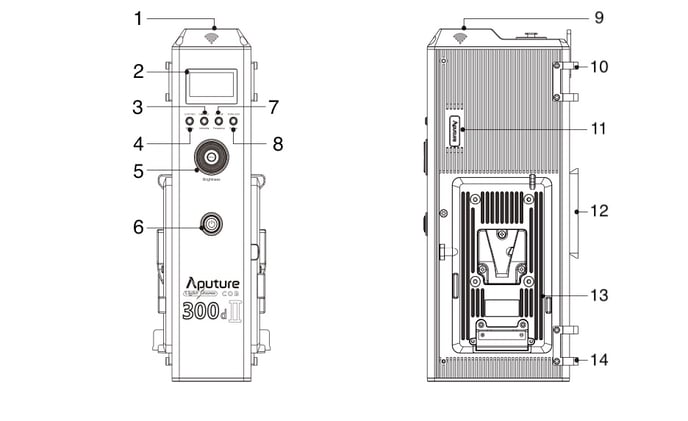
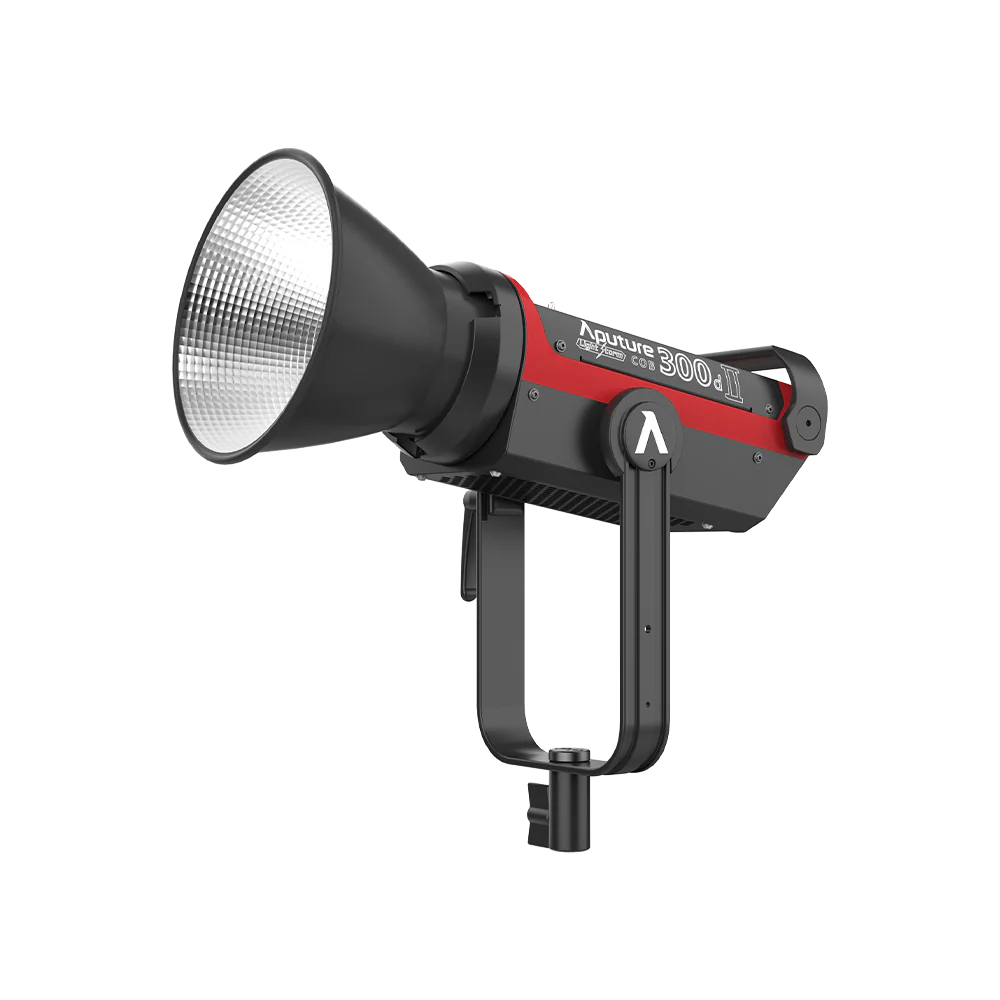
The Aputure LS 300d II is a fixed-daylight Bowens-mount COB LED with a separate controller and direct Sidus Link Bluetooth control. It is the second-generation 300d, with its own yoke, power and accessory requirements.
The 300d II is a fixed-daylight source for bounce, softboxes and compatible focusing optics. Its compact head connects to a separate controller with battery mounting.
- Fixture Type Fixed-daylight COB LED with a Bowens accessory mount.
- Power 350 W maximum electrical consumption; 100–240 V AC. Separate combined controller/power supply; battery plate depends on version.
- Colour Temperature5,600 K ±200 K daylight; gels are needed for warmer colour matching.
- Weight and Mount 3.2 kg head with yoke; 2.04 kg control box before batteries. Bowens front mount; support controller separately.
- Beam Control Included 55° reflector; optional Fresnel 2X focuses from 12°–40°. Compatible softboxes enlarge the source.
- IP Rating No numeric IP rating verified for this model. Do not assume rain or dust protection for the head, controller or connections. Read the IP rating guide.
Jump to Output Calculator ↓ · Compare output
Key Specifications
| Specification | Details |
|---|---|
| Type / CCT | Daylight COB LED; 5600K ±200K |
| Maximum electrical input | 350W |
| CRI / TLCI | ≥96 / ≥96 |
| Head with yoke / control box | 3.2kg / 2.04kg |
| Mount | Native Bowens |
| Control | Onboard, wired DMX512, Bluetooth Sidus Link and 2.4GHz remote |
| Power | 100–240V AC; battery options depend on selected V-mount/Gold-mount version |
Output Calculator
Select the published setup and a manufacturer distance, or enter a custom throw where supported. The results describe centre-beam output, not the brightness across the whole beam.
Camera Settings
If the calculator does not load, use the published photometric table or source on this page. JavaScript is required.
F-stop is a planning estimate, not a meter reading. It uses direct, on-axis illuminance and includes only the optics and diffusion named in the selected setup. Meter on set to account for lens transmission, filters, added diffusion, bounce, dimming and ambient light.
How the exposure estimate works
N = √(E × ISO × t / C), where E is illuminance in lux and t = shutter angle ÷ (360 × fps). The default C = 340 is a dome reference; C = 250 is a flat reference. These are calibration constants, not a measured T-stop. A small nonzero digit is tenths of a stop above the displayed full stop.
Distance estimates and comparisons
Published points are used as given. Between published points the calculator fits a curve through the two nearest readings. Outside those points it uses the inverse-square law only when the fixture’s dataset permits it. Distances outside a configuration’s supported range are reported separately. Comparisons use one shared distance and camera setup; equal lux does not imply equal coverage.
View published readings for the selected configuration
Strengths and Limitations
Strengths
- A relatively compact daylight head can be configured for bounce, softbox or a focusing Fresnel.
- The fanless control box can remain near the operator while the head is raised.
Limitations
- The head is fixed at 5,600 K. Start with Rosco 3411 three-quarter CTO for 3,200 K tungsten and meter after the gel, or choose a bi-colour light for adjustable colour temperature.
- A Bluetooth connection is not a CRMX receiver, and high-voltage camera batteries are outside the specified battery range.
Practical Uses
Use it for interview keys through diffusion, bounce fill or a compatible projected source. For a used unit, check the controller, head cable, mounting hardware and battery configuration as a complete package.
| Setup | How to use this fixture |
|---|---|
| Daylight key | Use a softbox or bounce when softness matters. The Fresnel spot figure describes a concentrated beam and should not be used as a soft-key exposure estimate. |
| Controlled pool or background accent | Use the Fresnel 2X or a supported projection package. Choose beam coverage for the set area, then set level. |
| Small location package | The fanless controller can stay near the operator, with the head placed higher. Keep the head’s fan noise in the sound assessment. |
Output and Colour
The fixed-daylight 300d II's manufacturer readings below cover the bare source, Hyper-Reflector and Fresnel 2X. Fresnel spot and flood are separate beam settings: the 9,500-lux spot reading at 3m is not the 3,500-lux reflector reading. For a soft key, judge the source after the actual softbox or bounce, not from the spot figure.
| 5,600K configuration | 1m | 3m | 5m |
|---|---|---|---|
| Bare | 11,000 lux | 1,300 lux | 550 lux |
| Hyper-Reflector | 45,000 lux | 3,500 lux | 1,200 lux |
| Fresnel 2X, flood | 38,000 lux | 5,000 lux | 1,900 lux |
| Fresnel 2X, spot | 80,000 lux | 9,500 lux | 3,500 lux |
Sources: LS 300d II | Aputure; Aputure Light Storm LS 300d II specifications.
Aputure lists 1,300 lux bare, 3,500 lux with the Hyper-Reflector and 9,500 lux at Fresnel 2X spot, all at 3m. The narrower optics concentrate output over a smaller area.
For a warmer source, use CTO and match its strength to the target colour temperature. Include that transmission loss when deciding whether this fixture has enough reserve through a bounce or diffusion setup. A 300x trades fixed-white simplicity for faster colour-temperature changes.
Power and Batteries
Maximum electrical input is 350W from 100–240V AC. The supported battery range is 12–16.8V with at least 15A continuous discharge. The controller version and single- or dual-battery configuration determine the applicable battery operating arrangement.
Treat the controller, battery pair and charger as part of the working package. Higher-voltage camera packs must not be substituted just because the plate fits. For an existing rental unit, demonstrate the intended battery configuration at the required level before leaving the prep bench.
Control, Cooling and Camera Operation
| Control path | Hardware and operating notes |
|---|---|
| Onboard | Local controller for intensity and supported effects; fixed daylight has no CCT dial. |
| App / remote | Sidus Link Bluetooth Mesh and supported 2.4GHz handheld remote. |
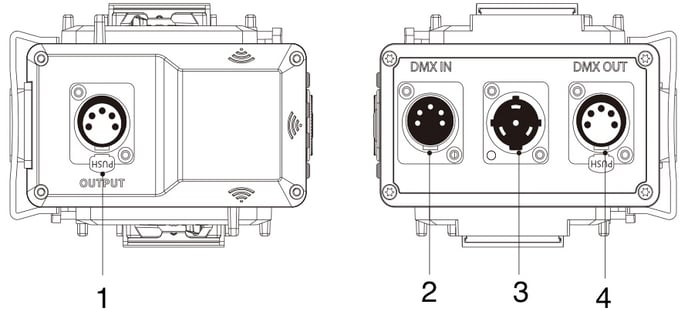
| Console | Wired 5-pin DMX512; external receiver for CRMX wireless operation. |
The controller is passively cooled; the lamp head uses a fan. The head cable allows the controller to remain accessible when the lamp is raised or positioned away from the microphone.
A low-level fade should be tested at the intended frame rate and shutter. Keep the chosen dimming curve and control settings with the lighting notes, especially when mixing 300d II units with newer Aputure generations.
Modifiers, Rigging and the Working Package
Compatible accessory profiles · Aputure Fresnel 2X · Aputure Spotlight Max Projection Attachment (19°, 36° and 50°) · amaran Spotlight SE Projection Kit, 19° and 36°
Aputure lists the head with yoke at 3.2kg, the control box at 2.04kg and Lightning Clamp at 0.67kg. Keep these separate from modifier and battery loads. Use the current compatibility chart for projection attachments and avoid assuming that every newer high-power optic belongs on the same Bowens head.
| Component | Published weight or package requirement |
|---|---|
| Head with yoke | 3.2kg |
| Control box | 2.04kg before batteries |
| Lightning Clamp | 0.67kg |
| Optics | Compatible Hyper-Reflector, Fresnel 2X or supported projector |
| Power and control | AC/head cables, correct battery version and external CRMX receiver if needed |
Inspect the yoke handbrake and cable-relief hook with the intended modifier attached. A lamp that holds position bare may behave differently with a long projector or deep softbox. The controller and its batteries need their own support and strain relief.
Alternatives and Related Fixtures
| Fixture | When to compare it |
|---|---|
| Aputure Light Storm LS 300x | Choose variable white when gel changes would slow the setup. |
| Aputure Light Storm LS 600d Pro | Compare a larger daylight source for more distant bounce or diffusion, with its full controller and electrical load. |
What People Are Saying
Field Feedback at a Glance
What worked
- Sheldon used the Lantern to give talent a daylight key in a scene lit with several different fixtures. Graham Sheldon, CineD.
- Trepod says his 300d II kept working through rough use on set. Tyler Trepod’s field review.
- He liked the Lightning Clamp for mounting the control box securely on the stand. Tyler Trepod’s field review.
Drawbacks to plan for
- Trepod sometimes had to re-pair the light in Sidus Link on set. That describes his experience in 2023. Tyler Trepod’s field review.
- He reached for a 600d Pro when he needed more light through dense diffusion. Tyler Trepod’s field review.
- At full output and right next to the sound mixer’s microphone, he could hear the head fan. Tyler Trepod’s field review.
Newsshooter, Hands-on Report
Newsshooter’s launch report describes a short hands-on evaluation, including configuration details and first impressions. The authors had limited production time with the unit before publication. Read article.
Reddit, R/Videography
In a purchase discussion, a contributor favours the 300d II’s metal construction and built-in battery plate. View discussion.
Videos
Aputure LS 300d II video overview.
Rental and Used-fixture Checks
Before You Book
- Inspect the yoke handbrake, receiver and Lightning Clamp quick-release.
- Check head-fan sound separately from the silent controller and test dimming at the intended shutter.
- Confirm the battery version and exact Fresnel or projector listed on the order.
Documentation and Specifications
- Aputure Light Storm LS 300d II specifications
- LS 300d II | Aputure
- Aputure Light Storm LS 300d II accessory compatibility
- Nanlite Forza 300B II
- Forza 500 II
Browse Aputure lights · COB lights · all equipment.