
Last Updated 13 hours ago
Overview
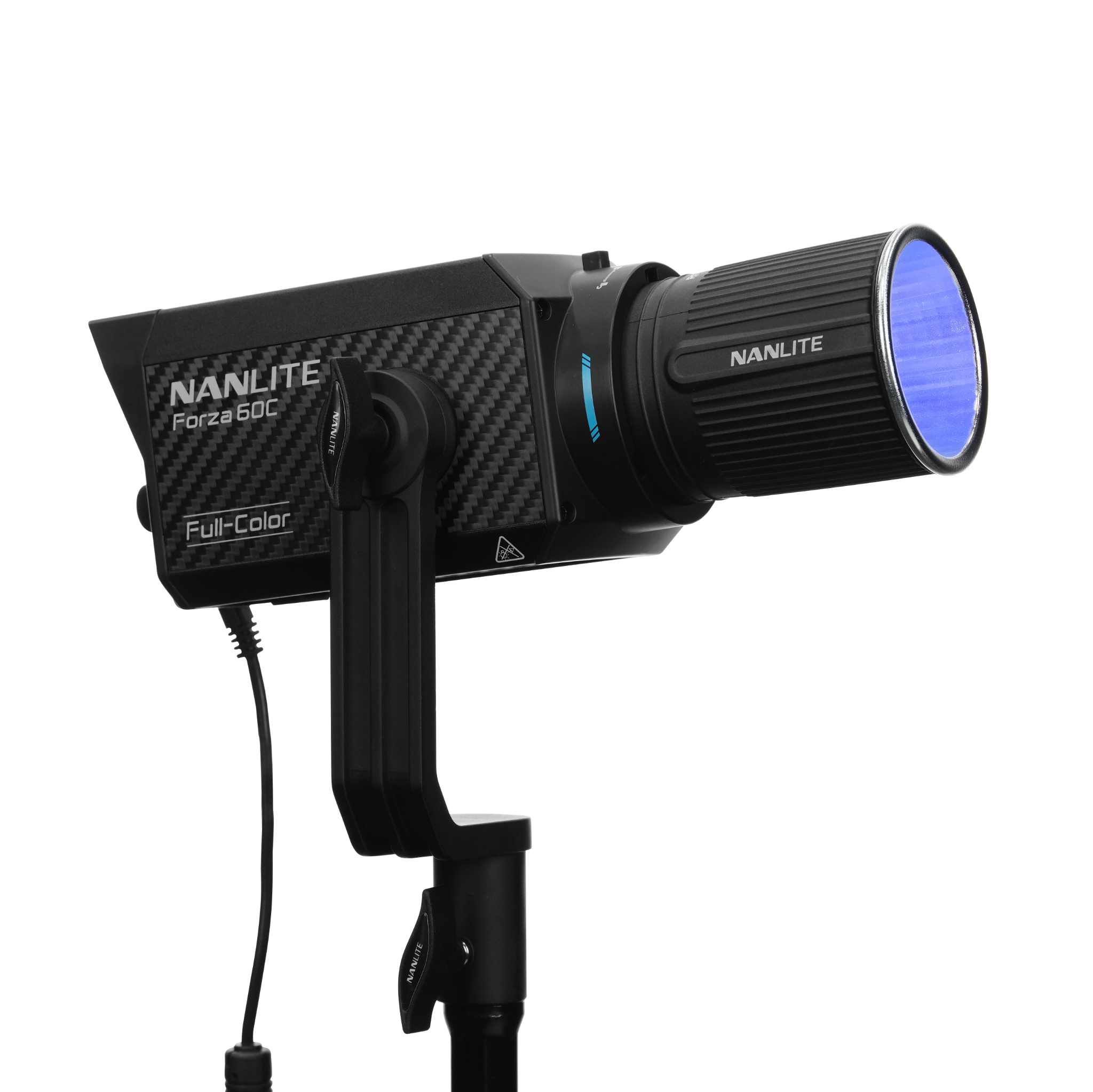
The Nanlite Forza 60C is a compact full-colour LED spotlight with a six-emitter RGBLAC engine. It combines a very broad CCT range with tint correction and saturated-colour control for small location setups, accents, product work and close keys.
The native FM mount is smaller than Bowens, and the external power supply or battery grip is part of the working setup. The Forza 60C should also be distinguished from the later Forza 60CR: the original 60C does not gain built-in CRMX just because the names are similar.
Key specifications
| Specification | Details |
|---|---|
| Engine | RGBLAC: red, green, blue, lime, amber, cyan |
| Rated power | 88W, manufacturer specification |
| CCT / tint | 1,800–20,000K with ±100 G/M |
| CRI / TLCI | 96 / 95 averages |
| SSI | 81 at 3,200K; 71 at 5,600K |
| Mount | FM; standard Bowens needs the supported adapter |
| AC supply | 100–240V, 50/60Hz |
| Head DC / battery specification | 15V / 6A maximum DC input |
| Weight | 1.08kg |
| Dimensions | 22.4 × 11.0 × 8.8cm |
| Maximum ambient temperature | 45°C |
| Control | Onboard, NANLINK Bluetooth, 2.4G, DMX/RDM |
| Built-in CRMX | Not listed; an external compatible receiver is a separate system |
| Dimming | 0–100% |
Strengths and limitations
Strengths
- The compact FM head keeps dedicated small optics and a travel kit manageable.
- RGBLAC gives a broad white range, tint and saturated colours.
- Wired DMX/RDM and NANLINK support more than local control.
Limitations
- A Bowens adapter adds bulk and does not guarantee support for a heavy modifier.
- Saturated colours have different output from white-light settings.
- The original model has no integrated CRMX receiver; small-head DMX adapters must be included where required.
Practical uses
The 60C is useful as a close full-colour key, a small reflection source, a coloured accent or a hidden effect. Its combination of compactness and broad colour control is the attraction. It is less suitable when distance or heavy diffusion consumes the limited output budget.
Compare the Forza 300B II and daylight-only Forza 500 II by actual CCT, modifier, coverage and control requirements. Similar family names do not mean identical power, colour or accessory behaviour.
| Setup | Working approach |
|---|---|
| Interview key | Use a compact FM softbox close to the subject and control spill; retain enough distance for comfortable framing. |
| Shaped accent | Use a manufacturer-approved Fresnel or projector for a controlled highlight, edge or background pattern. |
| Colour effect | Check the actual hue and intensity through the camera, especially on reflective products and skin. |
Output and colour
The following readings separate the bare head, supplied reflector and optional Fresnel. All are at 5,600K. A concentrated centre reading is not a measurement of even coverage.
| Distance | Bare | Supplied reflector | FL-11 spot |
|---|---|---|---|
| 1m | 5,709 lux | 12,810 lux | 37,520 lux |
| 2m | 1,425 lux | 2,946 lux | 8,780 lux |
| 3m | 646 lux | 1,283 lux | 3,804 lux |
RGBLAC uses six physical emitter colours. The user’s RGBW or HSI controls are an interface to that engine, not a literal inventory of its LEDs. CCT and green/magenta adjustment are useful for matching a room, while x,y or hue-based modes serve colour work.
White-light metrics and white output do not establish the exposure of saturated colours. The manufacturer’s table, for example, gives very different red, green and blue readings. Test the actual colour at the real distance before deciding that a small full-colour head can carry a scene.
Power and batteries
The Forza 60C uses an external AC adapter or a supported battery-grip arrangement. It has no internal rechargeable battery. Confirm the exact grip and required battery count in the selected kit; compatible-looking NP-F or V-mount packs still need sufficient output capability.
Its 15V DC input should not be treated as permission to attach an arbitrary battery or supply. Match voltage, connector and continuous current to the manufacturer’s requirements. For handheld work, add the grip, battery and reflector to the balance and weight assessment.
Control, cooling and camera operation
The manual limits output to 25% with the fan off. Set the required sound mode before metering exposure.
The head uses active cooling, so a battery grip or small housing does not establish silent operation. Listen from the microphone position with the actual light level and ambient temperature.
Bluetooth NANLINK control and the 2.4G remote system serve different connection arrangements. DMX/RDM provides a wired workflow; the smaller locking port requires the appropriate adapter cable, which should be specified separately. Use the matching DMX reference for the actual fixture mode.
The original Forza 60C does not list a built-in CRMX receiver. An external receiver and its power connection, if used, are additional pieces. The separate 60CR model addresses built-in CRMX; do not substitute its specification for a 60C.
Modifiers, rigging and the working package
The native FM interface takes compact supported modifiers such as the FL-11 and FM projection accessories. A supplied Bowens adapter provides a route to appropriate full-size modifiers, but attaching a large softbox changes the mechanical load and handling.
Choose the tool for the desired distribution: a Fresnel for variable beam control, a projector for a defined shape or pattern, a softbox for a larger apparent source, and a lantern for distributed light. Include the accessory and any adapter in the working weight.
The head weight is 1.08kg. Add cables, reflector, adapters, batteries and other accessories before selecting a support. A lightweight head can become a much less compact system once a full-size modifier is attached.
Nanlite does not specify an outdoor ingress rating for the complete setup. Provide a suitably protected arrangement in weather, including the power supply and connections. Leave cooling paths clear.
The manufacturer manual and selected dealer SKU identify the included reflector, power adapter or controller, cables, mounting accessories and case. Do not assume a Fresnel, stand or wireless receiver is included because it appears in a demonstration.
Alternatives and related fixtures
| Fixture | Choose it for |
|---|---|
| Forza 60B II | A simpler white-light-only FM fixture. |
| amaran 150c | A different full-colour Bowens and app ecosystem. |
What people are saying
Matthew Allard: compact colour with interface compromises
Allard’s 2022 review praises the 60C’s full-colour range, battery flexibility, useful output and low fan noise. His reservations concern the interface, the app at publication and the behaviour of then-available optical accessories.
Owner: a small projection source used on every shoot
A 60C owner in this comparison with the amaran 150c describes using the lights frequently for precise pools of light with projection attachments. They like the compact full-colour system, while identifying FM-to-Bowens accessory compatibility as a practical limitation.
Videos
Gaffer & Gear 183: Forza 60C
A review of the original RGBLAC model.
Kyle Meshna: Forza 60C
A creator’s assessment of the compact colour fixture.
Rental and used-fixture checks
Confirm the Forza 60C label, matching power hardware and all control leads. Inspect the emitter cover, FM latch, yoke and connector strain relief, then test the intended modifier, low-level fade and remote-control path. Run at the planned level until warm before assessing fan sound at the microphone.
Documentation and specifications
Manufacturer product specification · User manual · DMX reference.
Product photograph: Nanlite.
Browse Nanlite lights · COB lights · all equipment.