
Last Updated 2 days ago
Overview
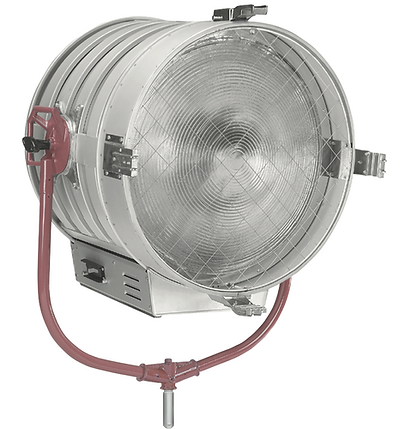
The Mole-Richardson Big Eye Tener, Type 4361, is a 10,000/12,000 W tungsten Fresnel built around a 24¾-inch curved lens. It is a large set-lighting source for substantial hard keys, broad backlight and feeding large bounce or diffusion surfaces from a distance. The rear hand crank changes focus while the large yoke supports a lamphead weighing close to 100 lb before a complete accessory package.
This is specifically the Big Eye 4361. The traditional 20-inch Tener, Type 4371, and compact Baby Tener are different fixtures. Their names, globe classes and maroon housings are not a basis for sharing dimensions, photometrics or accessories.
Key specifications
| Specification | Details |
|---|---|
| Head / lamp class | Type 4361; 10,000 or 12,000 W tungsten-halogen |
| Socket | Mogul bipost with spring-loaded contacts; use the exact approved globe geometry |
| 120 V lamp examples | DTY 10,000 W; GE/KOTO 12,000 W listed in the original sheet |
| 230 V lamp examples | CP83 10,000 W; Q12/4CL 12,000 W listed |
| Lamp colour / position | 3200 K for the listed globes; within 45° of vertical base-down |
| Light-centre length | 13.937 inches in the globe table |
| Lens / stated field angle | 24¾-inch curved Fresnel; 21.8–66.5° field angle |
| Focus | Rear hand crank |
| Mount | 1⅛-inch junior steel yoke pin |
| Head dimensions | 33 × 33 × 29¾ inches, manufacturer order |
| Head weight with cable | 98½ lb / approximately 44.7 kg |
| Maximum rating in archival sheet | 12,000 W; 100 A maximum at the stated 120 V configuration |
| Accessory size | 29-inch scrims, diffuser frames and barn-door system |
| Standard historical tail | 3 ft entertainment cable with earth and 100 A Bates-type connection; verify the actual assembly |
Strengths and limitations
Strengths
- A continuous tungsten source gives direct, visible control of the lighting effect.
- Lamp and accessory choices adapt the source to its job.
Limitations
- Heat and electrical load remain central to placement and circuit planning.
- Dimming changes colour; lamp code, voltage and fixture limits must match.
Practical uses
| Setup | Working approach |
|---|---|
| Controlled key or accent | Choose focus or diffusion for the intended shadow and trim spill with compatible accessories. |
| Warm practical motivation | Meter at the chosen dimmer setting and balance colour through the camera. |
Output and colour
Mole’s Big Eye specification sheet provides two lamp tests: DTY at 10 kW and KOTO at 12 kW, both 120 V and 3200 K. The following are centre readings at the same distances. The increase is the manufacturer’s measured result for these lamps and optics, rather than an assumed percentage calculated from wattage.
| Distance | 10K flood / spot | 12K flood / spot | Flood / spot beam diameter |
|---|---|---|---|
| 20 ft / 6.10 m | 850 / 5,500 fc | 950 / 5,900 fc | 19.0 / 3.0 ft |
| 40 ft / 12.19 m | 212 / 1,375 fc | 238 / 1,475 fc | 38.0 / 6.0 ft |
| 60 ft / 18.29 m | 94 / 611 fc | 105 / 656 fc | 57.0 / 9.0 ft |
A suitable high-capacity tungsten dimmer changes level and warms the light as filament voltage falls. Scrims provide optical reduction without that deliberate colour shift. The original accessory list also includes a shutter and a DMX shutter motor: a mechanical shutter changes the transmitted light while the lamp can remain at its operating voltage.
The listed 29-inch scrim, frame and barn-door system is distinct from the standard 20-inch Tener’s accessories. Mole also identifies extension arms for supporting its specified four-foot diffusion frames. Use only documented compatible hardware and a properly engineered support arrangement; the existence of an accessory drawing does not establish the safety of an improvised assembly.
Power and batteries
A 10 kW lamp at 120 V represents approximately 83.3 A; a 12 kW lamp at that voltage represents 100 A. With the correctly rated 230 V globes, nominal values are approximately 43.5 and 52.2 A respectively. These are calculated lamp loads, not a distribution design or confirmation that any particular used head can be connected to either voltage.
Confirm the lamp, socket geometry, light-centre length, switch, cable and connector ratings together. A plug adapter is not a voltage converter, and the 10/12K label is not permission to fit a globe with a different geometry. Follow the approved burning position and the manufacturer’s fixture instructions. Disconnect, isolate and allow cooling before relamping; the large globe is a fragile component as well as an expensive consumable.
Control, cooling and camera operation
Use the documented control arrangement for this exact lamphead and power system. Check dimming behaviour, camera settings and thermal conditions at the intended working level.
Modifiers, rigging and the working package
The Big Eye supplies a broad adjustable field from a large Fresnel aperture. It is useful when the source needs to work well back from the action, cover more area or illuminate a substantial diffusion surface. The lamp remains a hard-light source relative to a distant subject unless bounce or diffusion enlarges the apparent source sufficiently.
For a window-motivated shaft, consider the required direction, coverage and distance before choosing the spot setting. For a large diffusion frame, flood enough of the material to create the intended source size and check the distribution across it. A high centre reading on a narrow spot does not guarantee that the full frame receives useful, even illumination.
The manufacturer gives 98½ lb including cable before the full front accessory load. This requires support chosen for the entire working assembly and its leverage, with a plan for raising, aiming and securing it. The junior pin alone does not establish a stand’s capacity. Include heavy feeder cable and modifiers in the handling and load assessment.
Keep ventilation unobstructed and follow the head and globe instructions for clearance, orientation and cooling. Large tungsten sources can expose nearby materials to significant heat even when the housing is not touching them. Protect people from hot components and secure accessories appropriately, particularly in overhead or remote positions.
Alternatives and related fixtures
Inspect the large curved Fresnel for cracks, the front safety protection and retaining hardware, the yoke and pin, tilt locks and crank-driven focus carriage. Check the globe support and socket for damage and have the high-current switch, cable, earth and connector assembly inspected. A missing or damaged large lens can erase the apparent savings of a cheap head.
The 20-inch Tener, Baby Tener and Big Eye should be compared as separate optical packages. An HMI offers daylight output with ballast and arc-lamp requirements; a high-output LED may offer lower power and electronic colour control. Compare the actual coverage, working-distance level, support and power package rather than relying on a claimed ’10K equivalent’ or assuming that all large tungsten Fresnels behave alike.
| Fixture | Choose it for |
|---|---|
| ARRI LED L-Series | A colour-adjustable Fresnel with different operating and control hardware. |
| A supported soft-light system | A larger diffused emitting area when a hard source is not required. |
What people are saying
Joseph Brain: the large Tener package
Joseph Brain shows a Big Eye Tener undergoing inspection, testing and cleaning. The demonstration concerns the large 10/12K tungsten family; match lamp, voltage, support and service instructions to the actual Type 4361. View the source.
Videos
Mole-Richardson Big Eye Tener 10K/12K (Type 4361): family guide
A demonstration of the named tungsten family; confirm the actual type plate and lamp.
Rental and used-fixture checks
Check the exact model and revision, complete power package, mounting hardware and control leads. Inspect lamp holders, protective glass and ballast connections. Test the intended operating level, fade and camera settings before rigging.
Documentation and specifications
Manufacturer product page, original specification and performance chart and a working rental inventory containing traditional Mole fixtures. The rental listing is context for continued availability, not the source of the numerical specifications.
Product photograph: Mole-Richardson, official product photograph.
Browse Mole-Richardson lights · tungsten lights · all equipment.