
Last Updated 2 days ago
Overview
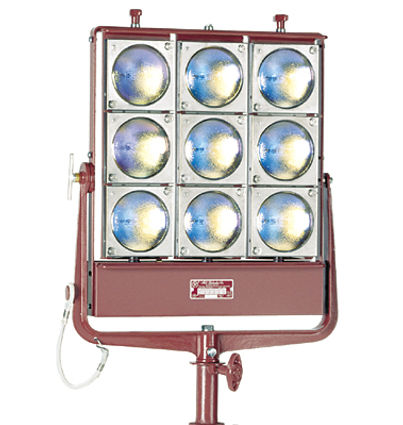
The Mole-Richardson Nine-Light Molefay, Type 5541, is a 5,850 W array of nine 650 W PAR36 lamps. Its pivoting lamp modules can converge beams for a stronger central field or spread them for broader coverage. Individual lamp switches provide stepped output control without reducing filament voltage.
It is often called a ‘nine-light’, but that nickname does not make it the same as a 9 kW Maxi-Brute or a PAR64 array. The 5541’s lamp type also determines colour: dichroic FAY globes provide the documented daylight-booster configuration, while FCX and FCW globes are listed at 3200 K. This is a tungsten-halogen lamp system, not an HMI or an LED panel.
Key specifications
| Specification | Details |
|---|---|
| Manufacturer head | Type 5541 Nine-Light Molefay |
| Lamp count / full power | Nine × 650 W; 5,850 W total |
| Specified supply / maximum current | 120 V AC or DC; 48.8 A maximum |
| Lamp format / contacts | PAR36 sealed-beam quartz globes; ferrule contacts |
| FAY option | 650 W, 120 V dichroic daylight spot; 30-hour listed life |
| FCX option | 650 W, 120 V, 3200 K medium beam; 100-hour listed life |
| FCW option | 650 W, 120 V, 3200 K wide beam; 100-hour listed life |
| Output control | Nine individual lamp switches; converging/diverging module adjustment |
| Mount | Removable 1⅛-inch junior pin |
| Dimensions | 19 × 16⅛ × 4⅜ inches, including switches and globe guards |
| Head weight | 21½ lb / approximately 9.8 kg |
| Listed tail | 3 ft high-current cable with ground and MC257G-type plug; inspect the actual configuration |
| Accessory examples | 5548 light-shield/diffuser holders; 5544 diffuser frame |
| Lamp position | Listed PAR36 globe table permits any burning position |
Strengths and limitations
Strengths
- A continuous tungsten source gives direct, visible control of the lighting effect.
- Lamp and accessory choices adapt the source to its job.
Limitations
- Heat and electrical load remain central to placement and circuit planning.
- Dimming changes colour; lamp code, voltage and fixture limits must match.
Practical uses
FAY is the daylight-booster option described by Mole: its dichroic optical treatment changes the delivered light from the tungsten filament. FCX and FCW are the 3200 K medium and wide alternatives. A nine-light fitted with one type should not be described with another type’s colour, spread or performance figures.
The listed lamp lives also differ substantially: 30 hours for FAY versus 100 hours for FCX and FCW in this sheet. Those are rated catalogue lives, not a guarantee for an individual globe. On a used package, identify all nine lamps and ask whether spares of the required code can be obtained. A mixture of beam patterns or colours can create a visibly uneven result.
The adjustable modules allow a relatively compact fixture to send concentrated light through a window or windshield, or create a wider field for a larger area. The multiple separated sources can produce multiple shadows, especially at short distances. That may be useful for a deliberate look, but it differs from the single-aperture beam of a Fresnel.
When feeding a diffusion frame, spread and aim the lamps to illuminate the intended area evenly. For a harder, more concentrated source, converge the modules and check where their beams overlap. The strongest reading is meaningful only at the distance and aim used; a converged pattern does not stay identical at every point in the set.
| Setup | Working approach |
|---|---|
| Large bounce | Choose the specified lamp pattern and bank arrangement, then meter the useful reflected field. |
| Broad backlight | Plan lamp switching, coverage and electrical distribution together; lamp beam pattern is part of the setup. |
Output and colour
The manufacturer’s chart gives different readings for each globe and for maximum versus minimum array spread. At ten feet, the centre readings below correspond to nine 650 W, 120 V lamps. Minimum spread concentrates the light into a smaller area; maximum spread trades that centre level for width.
| Globe | Maximum spread at 10 ft | Minimum spread at 10 ft | Minimum-spread lit area, W × H |
|---|---|---|---|
| FAY daylight spot | 1,200 fc | 2,900 fc | 4.6 × 3.3 ft |
| FCX 3200 K medium | 880 fc | 2,160 fc | 6.6 × 4.7 ft |
| FCW 3200 K wide | 480 fc | 990 fc | 9.8 × 9.3 ft |
Power and batteries
At full power, nine 650 W lamps total 5,850 W and approximately 48.8 A at 120 V. This is a high-current set-distribution load. The individual switches are not nine independent household-circuit inputs, and switching off some lamps does not make an unsuitable feeder, plug or grounding arrangement acceptable.
Individual switching changes lamp count without intentionally warming the remaining lamps, unlike reducing their operating voltage with a dimmer. It also changes the distribution and shadow pattern. If a dimmer is used, it must be suitable for the entire connected tungsten load, and a warmer colour at reduced level should be expected. Confirm ratings and isolate power before changing globes or adjusting electrical components.
Control, cooling and camera operation
Use the documented control arrangement for this exact lamphead and power system. Check dimming behaviour, camera settings and thermal conditions at the intended working level.
Modifiers, rigging and the working package
The original accessory system includes 5548 light-shield/diffuser holders and a 5544 frame that requires those holders. Use the intended hardware and heat-rated material, keeping adequate spacing and cooling. A generic softbox intended for an LED panel is not a substitute merely because the front of this array is rectangular.
The sheet lists a 21½ lb head and a junior pin. Include lamps, cable and the full accessory load when selecting support and securing a hung fixture. Inspect the pivot mechanisms, yoke, pin, globe retainers and protective guards. Check each lamp switch, contact assembly, cable, connector, strain relief and earth as part of appropriate servicing.
Alternatives and related fixtures
The distinction from a nine-lamp Maxi-Brute is fundamental: this is the PAR36, 650 W-per-lamp, 5,850 W Type 5541. A different array using 1 kW PAR64 lamps has different power, beam, size and lamp requirements. Do not merge their specifications under the generic search term ‘nine-light’.
A large LED array offers electronic level and colour control with different power and shadow behaviour. An HMI PAR offers a different daylight optical system with a ballast and arc-lamp precautions. The Molefay remains a distinct tool when its compact array, adjustable coverage and lamp-switching approach suit the shot; verify globe availability and electrical condition before treating a low purchase price as a complete working package.
| Fixture | Choose it for |
|---|---|
| Nine-light Maxi-Brute | A different lamp and beam system; identify the exact fixture. |
| High-output LED array | A different spectrum, distribution and control package. |
What people are saying
ControlBooth: Molefay terminology
ControlBooth’s community reference distinguishes a Molefay from similarly named lamps and fixtures. The discussion highlights why lamp code and beam pattern matter when identifying a nine-light bank. View the source.
Videos
Mole-Richardson Nine-Light Molefay (Type 5541): family guide
Related array lesson: Maxi-Brutes for night exteriors. A Maxi-Brute is a different lamp and fixture configuration from the Type 5541 Molefay.
Rental and used-fixture checks
Check the exact model and revision, complete power package, mounting hardware and control leads. Inspect lamp holders, protective glass and ballast connections. Test the intended operating level, fade and camera settings before rigging.
Documentation and specifications
Manufacturer product page, original specification and performance chart and a working rental inventory containing traditional Mole fixtures. The rental listing is context for continued availability, not the source of the numerical specifications.
Product photograph: Mole-Richardson, official product photograph.
Browse Mole-Richardson lights · tungsten lights · all equipment.