
Last Updated 2 days ago
Overview
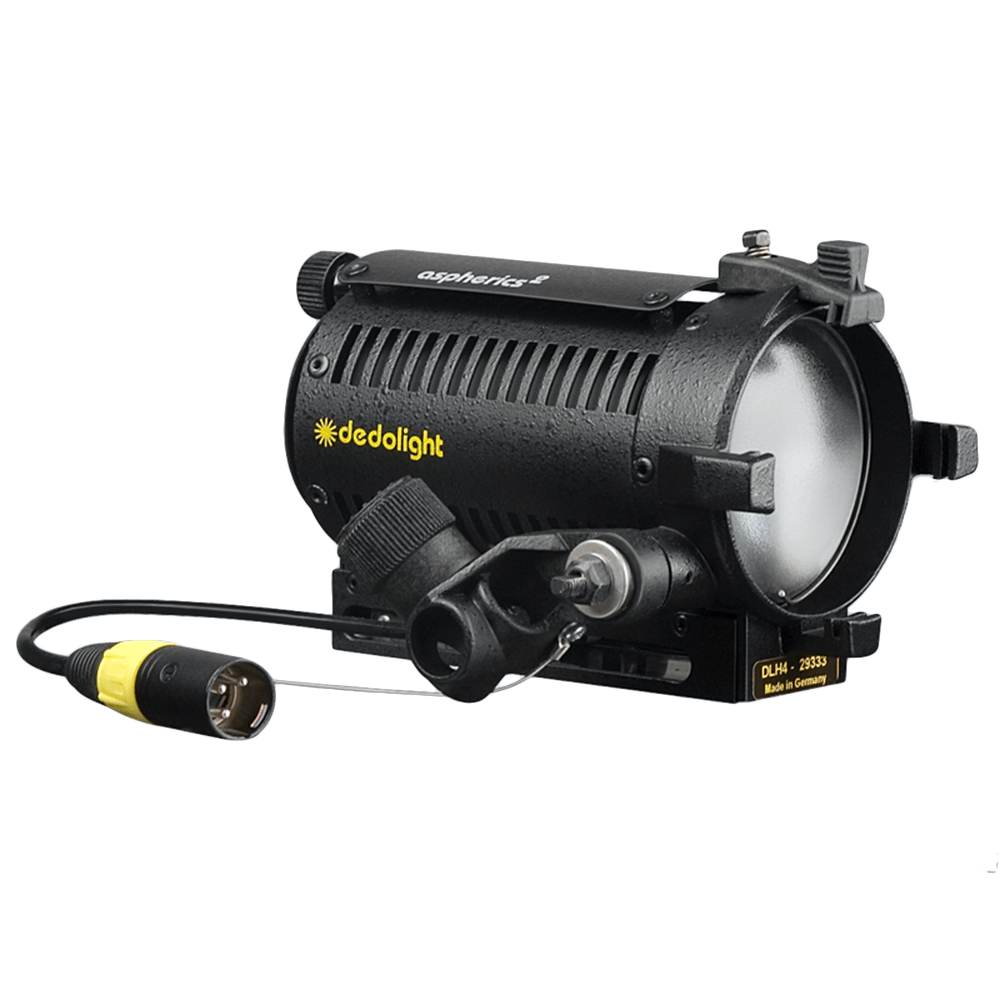
The Dedolight DLH4 is a small low-voltage tungsten-halogen spotlight with the manufacturer’s dual-aspheric Aspherics² optical system. It is useful for precise accents, controlled edges, product details and small pools of light where a much larger fixture would be awkward. With the appropriate imaging attachment, it can also produce focused patterns and cuts.
This is the classic replaceable-lamp DLH4, not an LED Dedo. The head uses approved 12 V or 24 V lamps and requires the correct external power arrangement. A mains plug on a controller does not mean the bare head itself accepts mains voltage, and a three-pin connector is not evidence of compatibility with an arbitrary supply.
Key specifications
| Specification | Details |
|---|---|
| Optical design | Dual-aspheric Aspherics² focusing system; not a conventional Fresnel |
| Maximum lamp configurations | 100 W at 12 V; 150 W at 24 V, as specified for the head |
| Focus angle | Approximately 4.5–48° |
| Published focus-intensity range | 1:25 in the technical data; this is not a 25× optical zoom ratio |
| Head mass | 558 g / approximately 1.2 lb, excluding the complete power package |
| Head dimensions shown | Approximately 171 mm long × 124 mm wide × 127 mm high |
| Mount | 16 mm / 5/8-inch stud fitting |
| Operating position | Any, according to the head’s technical data; power-supply restrictions remain separate |
| Lamp examples | Manufacturer DL100 / DL150 configurations; match globe and supply |
| Control | Mechanical focus; dimming and DMX depend on the selected power supply/controller |
| Power-supply examples | Documented DT12, DT24 and DT24-DMX families; exact model and mains input must match |
| Colour behaviour | Tungsten lamp colour depends on operating voltage; electrical dimming warms the source |
| Accessories | Compatible barn doors, snoots, filters and imaging attachments; check the classic-head interface |
Strengths and limitations
Strengths
- A continuous tungsten source gives direct, visible control of the lighting effect.
- Lamp and accessory choices adapt the source to its job.
Limitations
- Heat and electrical load remain central to placement and circuit planning.
- Dimming changes colour; lamp code, voltage and fixture limits must match.
Practical uses
The DLH4 can pick out a label, create an edge on a face, add a controlled highlight to a background or illuminate a small area without raising the whole room. Its focus range changes coverage substantially, and the compact head can fit into placements that would be impractical for a larger Fresnel.
Barn doors and a snoot control spill, but a genuinely sharp projected pattern requires the appropriate imaging optics. The classic imaging accessory family adds shutters, gobos or an iris according to the attachment. A small spotted beam and a focused image are different optical results; specify the attachment when renting a Dedo for a window pattern or a precise slash.
| Setup | Working approach |
|---|---|
| Controlled key or accent | Choose focus or diffusion for the intended shadow and trim spill with compatible accessories. |
| Warm practical motivation | Meter at the chosen dimmer setting and balance colour through the camera. |
Output and colour
The manufacturer-origin photometric sheet gives the following DLH4 results for a 150 W DL150 lamp, identified as 24.5 V and tested at 24.4 V / 3400 K. These are not automatically the output of a 3200 K setting, a 100 W lamp or a different supply. The narrow spot’s small coverage is part of why its centre reading is high.
| Setting | At 2 m | Lit diameter at 2 m | At 3 m |
|---|---|---|---|
| Flood, 48° | 1,000 lux | 1.8 m | 445 lux |
| Medium, 27° | 4,950 lux | 0.96 m | 2,200 lux |
| Spot, 4.5° | 20,475 lux | 0.16 m | 9,100 lux |
Power and batteries
The head’s documented lamp classes are 12 V / up to 100 W and 24 V / up to 150 W. Use a supply and lamp intended to work together. Dedolight California lists DT12 and DT24 arrangements, including dimming and DMX variants. An older controller can have a region-specific mains input, while another model may have different input capability.
Do not connect a bare low-voltage head directly to mains, or assume that any three-pin XLR power source is suitable. Voltage, pin assignment, current capacity, regulation and the approved cable are all relevant. A 150 W lamp at a nominal 24 V corresponds to about 6.25 A on the low-voltage side; that calculated figure is not the controller’s mains input current.
Control, cooling and camera operation
A dimming controller reduces filament voltage and produces warmer light along with lower output. The bright 3400 K photometric test should not be presented as a fixed 3200 K result or as proof that the head replaces a much larger lamp over the same area. At two metres the published spot covers only about sixteen centimetres.
Check the colour setting, lamp code and focus before making comparisons. The 1:25 focus-intensity description is a manufacturer optical-performance figure, not an electronic zoom, lamp dimming range or a promise of that ratio for every lamp and operating voltage. Test the actual setup through the camera for unusual shutter angles or high-frame-rate work.
Modifiers, rigging and the working package
The small head still contains a hot tungsten-halogen lamp. Keep ventilation clear, allow cooling before relamping and use the appropriate accessory holder. The original Dedolight catalogue specifically discusses increased front-end energy from the Aspherics² generation and the need for suitable larger filter arrangements with heat-absorbing gels, rather than copying older close-front filter practice.
Use compatible classic-head barn doors, filter holders and imagers. LED Dedo accessories or an unrelated projection attachment do not become compatible because the brand or front diameter looks similar. Check the intended imaging lens, pattern holder and mount as part of the rental or purchase, not after arriving at the location.
Alternatives and related fixtures
A miniature Fresnel supplies a different optical field, while an LED Dedo can simplify colour and reduce lamp replacement with different controls and photometrics. A compact LED spotlight may also be easier for batteries. The classic DLH4 remains valuable when its precision beam, small size and existing accessory system fit the shot and a complete healthy power package is available.
| Fixture | Choose it for |
|---|---|
| Dedolight LED systems | Different heads, supplies and optical compatibility; identify the exact system. |
| Small tungsten Fresnel | A different optical, lamp and power arrangement. |
What people are saying
Dedolight: the classic DLH4 system
Dedolight’s DLH4 guide demonstrates focusing, mounting accessories and changing lamps on the classic 100/150 W tungsten head with separate electronics. It is directly useful for identifying the complete head-and-supply arrangement. View the source.
Videos
Dedolight DLH4 (Classic Tungsten): review and operation
A walkthrough or review of the fixture and its working package.
Rental and used-fixture checks
Inspect both optical surfaces, the focus mechanism, lamp socket, housing, yoke/stand fitting and head cable. Look for cracked lenses, a focus carriage that binds, heat-damaged contacts or undocumented connector changes. Verify the exact lamp and supply model, and have damaged electrical parts serviced rather than adapting a random controller.
A low head-only price may omit the controller, cable and imaging accessories that make the system useful. Test the complete package at the intended operating colour and focus after its condition is established. The manufacturer head weight is only 558 g; the controller, accessories, stand and transport case make the full package substantially different.
Documentation and specifications
Official classic DLH4 product and power options, original technical and photometric sheet, hosted archive copy and Dedolight manufacturer catalogue, hosted archive copy.
Product photograph: Dedolight California official product photograph.
Browse Dedolight lights · tungsten lights · all equipment.