
Last Updated 2 days ago
Overview
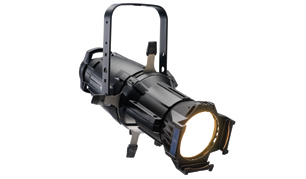
The ETC Source Four is a tungsten ellipsoidal/profile spotlight used for controlled shafts, hard cuts, gobos and projected patterns as well as conventional theatre lighting. It combines an HPL lamp, dichroic reflector, shutter assembly and interchangeable lens tube. On a film set, its main advantage over a Fresnel is the ability to shape or project a sharply defined image.
This is the standard tungsten fixed-focus Source Four, rated for approved HPL lamps up to 750 W. The Source Four Junior, Zoom, LED, HID and Source 4WRD conversion families are different configurations. A fixed-angle lens tube still slides to focus the edge; it does not become a continuous spot-to-flood zoom.
Key specifications
| Specification | Details |
|---|---|
| Fixture type | Tungsten ellipsoidal/profile spotlight |
| Maximum lamp rating | 750 W with approved HPL lamp |
| Approved lamp classes | Manufacturer-listed 375, 575 and 750 W variants; voltage and code must match |
| Optical system | HPL lamp, dichroic reflector, shutters and interchangeable fixed-angle lens tube |
| Listed fixed-angle tubes | 5°, 10°, 14°, 19°, 26°, 36°, 50°, 70° and 90° in the cited data |
| EDLT options in cited sheet | Enhanced Definition tubes in 19°, 26°, 36° and 50° |
| Beam shaping | Four shutters; body/shutter assembly rotation ±25° |
| Image accessories | Correct A/B or glass pattern holder, iris and related accessories |
| Control | External suitable tungsten dimmer; no native RGB or wireless engine |
| 36° configuration mass | 14 lb / 6.4 kg including the cited 2.3 lb C-clamp allowance |
| 36° colour-frame size | 6.25 inches; some other lens/accessory configurations require 7.5 inches |
| Supply | Lamp-dependent regional voltage; 77 V lamps are for the documented Dimmer Doubling system only |
| Version-specific safety data | CE manual: indoor dry-location use, 45°C maximum ambient, 217°C maximum exterior surface |
| CE lit-surface clearance | At least 0.8 m in the cited CE manual; follow the exact unit’s instructions and label |
Strengths and limitations
Strengths
- A continuous tungsten source gives direct, visible control of the lighting effect.
- Lamp and accessory choices adapt the source to its job.
Limitations
- Heat and electrical load remain central to placement and circuit planning.
- Dimming changes colour; lamp code, voltage and fixture limits must match.
Practical uses
Shutters placed in the optical system let the Source Four create a defined rectangle, slash or selective pool with less external flagging than many broad fixtures require. A gobo can add a window, foliage or texture pattern. Sliding the lens tube changes image focus from crisp to deliberately soft, while the selected tube determines nominal coverage.
For a window-motivated look, choose a lens angle for the throw and required image size, then position the lamp and focus the projected plane. A narrow lens gives a smaller field at the same distance; a wide tube covers more area. Changing an ordinary fixed tube’s focus is not the same as changing its field angle with a Zoom model.
The shutters cut the field, while the proper pattern holder locates a metal or glass gobo in the imaging system. Use the correct holder and heat-rated pattern, and keep accessory retainers secured. Lens angle, pattern size and holder compatibility are separate choices; an accessory described as ‘Leko’ is not proof that it fits every profile fixture.
Lamp centring and field adjustment affect uniformity and usable output. Follow ETC’s external adjustment procedure before deciding that a used head or lens has poor performance. Inspect and clean optics as instructed, and distinguish a dirty or misaligned lamp from a limitation of the chosen lens. An EDLT tube is a documented optical option, not the same specification as the ordinary 36° example.
| Setup | Working approach |
|---|---|
| Controlled key or accent | Choose focus or diffusion for the intended shadow and trim spill with compatible accessories. |
| Warm practical motivation | Meter at the chosen dimmer setting and balance colour through the camera. |
Output and colour
ETC’s 36° datasheet uses an HPL 750 W / 115 V, 300-hour lamp adjusted for cosine distribution. These values should not be transferred to a 575 W lamp, a long-life globe or another lens angle. The labelled 36° tube has its own measured beam/field data; the nominal label is not a generic flood setting for the whole family.
| Throw | Field diameter | Centre illuminance |
|---|---|---|
| 15 ft / 4.6 m | 9.2 ft / 2.8 m | 404 fc / 4,348 lux |
| 25 ft / 7.6 m | 15.3 ft / 4.7 m | 145 fc / 1,565 lux |
| 35 ft / 10.7 m | 21.4 ft / 6.5 m | 74 fc / 799 lux |
Use the exact HPL lamp code, voltage and power approved for the fixture. The lamp’s geometry is part of the optical system, not merely a replaceable source of generic watts. The standard body supports the listed lamp classes up to 750 W, while a Source Four Junior or other family member has its own rating.
Short-life and long-life lamps can differ materially. The 36° sheet gives HPL 750/115X a 0.64 candela multiplier relative to the reference 750/115 lamp. At the chart’s 25 ft throw, 145 fc × 0.64 is about 93 fc by calculation, not the original reference reading. The listed colour also changes from 3250 K to 3050 K. A higher rated service life is not a free output upgrade.
Power and batteries
A 750 W lamp rated for 120 V has a nominal operating load of approximately 6.25 A. Match the supply, lamp and external tungsten dimmer, and include the rest of the circuit’s load. The fixture does not regulate arbitrary mains voltages into the installed lamp’s correct voltage.
The 77 V lamps in ETC’s tables are specifically for its Dimmer Doubling arrangement, not normal direct connection to a 120 V outlet. Conventional dimming makes the tungsten light warmer as voltage falls. The old tungsten body does not contain a DMX personality; console control belongs to the external dimmer. A Source 4WRD or other LED retrofit must be identified and specified as that system.
Control, cooling and camera operation
Use the documented control arrangement for this exact lamphead and power system. Check dimming behaviour, camera settings and thermal conditions at the intended working level.
Modifiers, rigging and the working package
The dichroic reflector reduces infrared energy in the forward beam; it does not make the housing, lamp base or projected light harmless. Use heat-rated colour media and the correct accessory arrangement. The CE manual specifies indoor dry-location use, maximum ambient 45°C, maximum exterior surface 217°C and at least 0.8 m to a lit surface. Apply the instructions for the actual regional fixture rather than borrowing limits from another model.
Inspect the lens tube, reflector, shutters, lamp socket, rear adjustment, barrel lock, yoke, clamp or stand adapter, safety attachment and colour-frame retainer. Keep required protective screens and lenses in place. Have damaged cables, earth connections or overheated contacts serviced, and disconnect and cool the head before lamp or internal work.
Alternatives and related fixtures
An HMI Source Four adaptation, an LED Source Four and a standard HPL tungsten fixture can look similar from the front but have different power, heat, colour and operating requirements. A Fresnel gives simpler adjustable coverage without the same projected-image control. The tungsten Source Four remains useful when precise shutters or patterns are the reason for choosing it and the correct lamp, lens and support package are available.
| Fixture | Choose it for |
|---|---|
| Source Four Zoom | Variable-angle optics with a different lens assembly. |
| LED ellipsoidal fixture | A separate light engine and control system; identify the exact model. |
What people are saying
lxtech: Source Four features and alignment
In lxtech’s Source Four tour, Bobblehead Fred introduces the ellipsoidal fixture’s main features. The companion bench-focus guide explains why alignment is part of preparing a clean, useful projection beam. View the source.
Videos
ETC Source Four (Tungsten, Fixed-Focus): review and operation
A walkthrough or review of the fixture and its working package.
Rental and used-fixture checks
Check the exact model and revision, complete power package, mounting hardware and control leads. Inspect lamp holders, protective glass and ballast connections. Test the intended operating level, fade and camera settings before rigging.
Documentation and specifications
Official ETC Source Four overview, 36° datasheet and lamp multipliers, post-2004 standard user manual and CE user manual. Pre-September-2004 fixtures have separate assembly documentation.
Product photograph: ETC official product photograph.
Browse tungsten lights · all equipment.