
Last Updated 15 hours ago
Overview
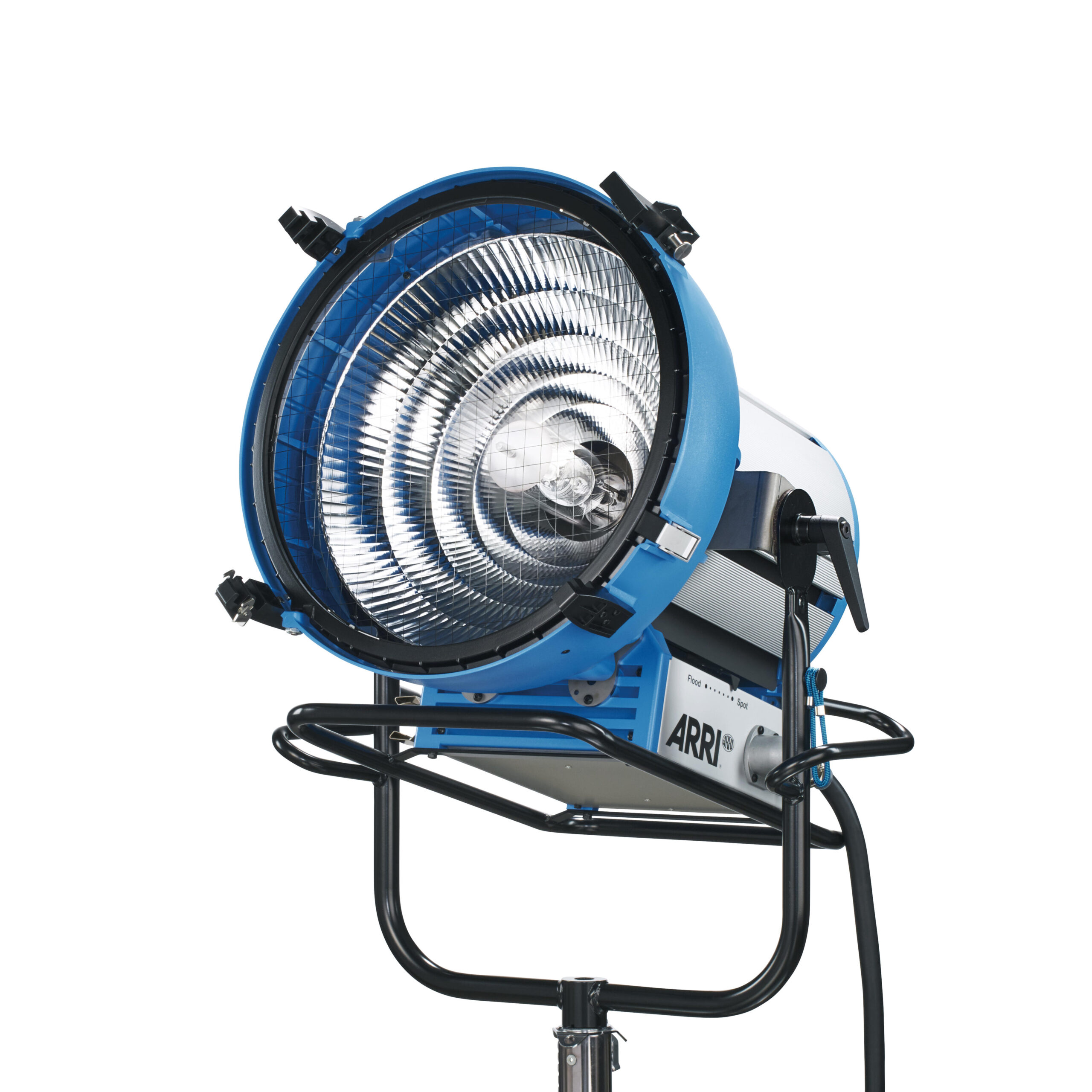
The ARRI M90 is a large daylight discharge head for approved 6000 W or 9000 W single-ended lamps. Its MAX reflector provides an adjustable hard beam without a PAR spread-lens set. It is useful for sunlight effects through large windows, long throws, substantial bounces and lighting from outside the immediate shooting area.
The M90 sits between the M40 and ARRIMAX in the M-Series, but its lamp, ballast, cable, rigging and power requirements must be specified as its own package. A 6K operating configuration and a 9K operating configuration do not have the same output or input-power requirement.
Key specifications
| Specification | Details |
|---|---|
| Lamp classes | Approved 6000 W/SE or 9000 W/SE metal-halide lamps |
| Lamp base | GX38 in the current model specifications |
| Reflector / focus | MAX faceted reflector; 15–49° |
| Nominal colour | Approximately 5600 K; lamp and operating condition dependent |
| Head weight | Approximately 40 kg |
| Packed weight | Approximately 47 kg |
| Dimensions including flange | 832 × 713 × 720 mm |
| Mount | 28 mm junior spigot |
| Ballast families listed | EB MAX 6/9 and EB 6/9; exact compatibility/configuration must match |
| Accessory diameters | 571 mm / 584 mm |
| Protection | Class I protective earth; IP23 |
| Maximum ambient / surface | 40°C / 200°C |
| Tilt | Up to 90° upward or downward |
| Clearances | 10 m to illuminated surfaces; 2 m around the head |
Strengths and limitations
Strengths
- A hard daylight source supports throw, bounce and large diffusion.
- Matched ballast options support production control.
Limitations
- Lamp, reflector or lens and ballast must be specified as a complete system.
- High-speed performance depends on the actual lamp, ballast mode and camera test.
Practical uses
| Setup | Working approach |
|---|---|
| Window or exterior push | Choose beam coverage and throw before calculating the required circuit and rig. |
| Large diffusion | Meter the useful lit area after diffusion and allow for transmission loss. |
Output and colour
The model datasheet identifies its photometric test as a 9000 W lamp configuration. The following values use the M-Series poster for consistent diameters; a rounded or repeated diameter in an older sheet should not be transferred to the wrong distance. These are not 6000 W readings.
| Focus | At 10 m: centre / diameter | At 20 m: centre / diameter |
|---|---|---|
| Spot, 15° | 51,000 lux / 2.61 m | 12,750 lux / 5.22 m |
| Medium, 30° | 14,450 lux / 5.2 m | 3,610 lux / 10.35 m |
| Flood, 49° | 7,590 lux / 8.3 m | 1,900 lux / 16.6 m |
Power and batteries
The M90 accepts the approved lamp families identified by ARRI. Confirm the correct lamp, ballast and operating setting as one configuration. The smaller lamp option is not a menu simulation of a 9K lamp, and the 9K photometric table cannot simply be advertised for a kit supplied with a 6K globe.
A nominal lamp voltage such as the 120 V mentioned for a 6K lamp is not the mains voltage required by the complete system. The ballast regulates and ignites the discharge lamp. Direct mains connection, ordinary phase dimming or a random same-base lamp are not substitutes for the approved system.
Specify distribution from the actual ballast nameplate. The ARRI Basic ballast poster lists an EB 6/9 version with 180–250 V mains input; the lamp’s wattage alone does not give the complete line current or apparent-power requirement. Include the ballast mode, protective earth, local connector and permitted cable arrangement in the plan.
ARRI describes cable-loss compensation for the paired M90 and EB MAX 6/9 system. This is a feature of that identified combination, not permission for arbitrary cable lengths, altered conductors or damaged connectors. Use approved head cables and the manufacturer’s limits, and inspect long runs before the lamp is struck.
Control, cooling and camera operation
High-frame-rate performance depends on the chosen ballast, lamp and operating mode. An M90 head can appear in a kit with different ballast generations, so identify the complete rental package before promising high-speed results. Test the actual camera frame rate, shutter and lamp after it has stabilised.
Use the documented discharge-lamp control range rather than treating it like an LED that dims to black. Scrims, focus, diffusion or another suitable method can change level and coverage without pretending a low ballast setting is spectrally identical to full lamp power. Record the lamp and ballast conditions with any comparison measurement.
Modifiers, rigging and the working package
The adjustable MAX reflector makes the M90 useful when a crew needs to change coverage from a position far from the action. A hard beam can establish an exterior daylight direction through windows or feed a large bounce while keeping the head away from the subject. The field and the bounce/diffusion losses determine the resulting exposure.
The head’s concentrated output is not itself a soft source. A large diffusion or bounce changes apparent source size and spill, while a narrow spot may illuminate only part of a modifier. Check uniformity over the working surface rather than relying only on a centre meter reading.
The specified ten-metre distance to illuminated surfaces and two-metre clearance around the head are substantial. The M90 also has a 40°C ambient limit, different from the 45°C limit of several smaller M-Series heads. Keep ventilation clear, account for nearby materials and use the actual label/manual for the unit.
The required UV-protection glass and safety enclosure must remain intact. Never bypass a front-door interlock or operate cracked protection glass. Disconnect and cool the system before lamp work according to the instructions; high ignition voltage, hot glass and high-current contacts require competent handling.
A roughly 40 kg head with accessories and cable needs purpose-suitable support and secondary retention. A 28 mm spigot identifies an interface, not the load capacity of every stand that accepts it. Consider leverage, wind, working height, access and the extra loading of a lightbank or other large accessory.
Alternatives and related fixtures
Inspect the reflector, front protection, lamp clamp/socket, focus drive, door/interlock, twin tilt locks, spigot and head cable. Check ballast history, lamp hours/condition and connector contact damage. Establish electrical condition before an output test, then measure with an identified lamp and focus setting.
The full cost and logistics include ballast, cable, distribution, approved lamp, rigging and transport. A modern high-output LED or another daylight reflector head may suit a different power or colour requirement. Compare usable illumination over the needed field and the whole system, rather than selecting on a single wattage-equivalence slogan.
| Fixture | Choose it for |
|---|---|
| ARRI M-Series | Compare the exact lamp class, reflector and compatible ballast. |
| High-output LED spotlight | A different power, dimming and modifier system; compare coverage as well as centre lux. |
What people are saying
Shane Hurlbut: M90 and large LED comparison
Shane Hurlbut describes the M90 as a long-standing source for window pushes and large bounces, then compares it with a Nanlux Evoke 5000B. The lesson examines practical differences in beam, shadows and electrical demands. View the source.
Videos
ARRI M90: review and operation
A walkthrough or review of the fixture and its working package.
Rental and used-fixture checks
Check the exact model and revision, complete power package, mounting hardware and control leads. Inspect lamp holders, protective glass and ballast connections. Test the intended operating level, fade and camera settings before rigging.
Documentation and specifications
Official M90 page, 9000 W photometric datasheet, operating instructions, M-Series poster and Basic ballast data.
Product photograph: ARRI official product photograph.
Browse Arri lights · HMI lights · all equipment.