
Last Updated 2 days ago
Overview
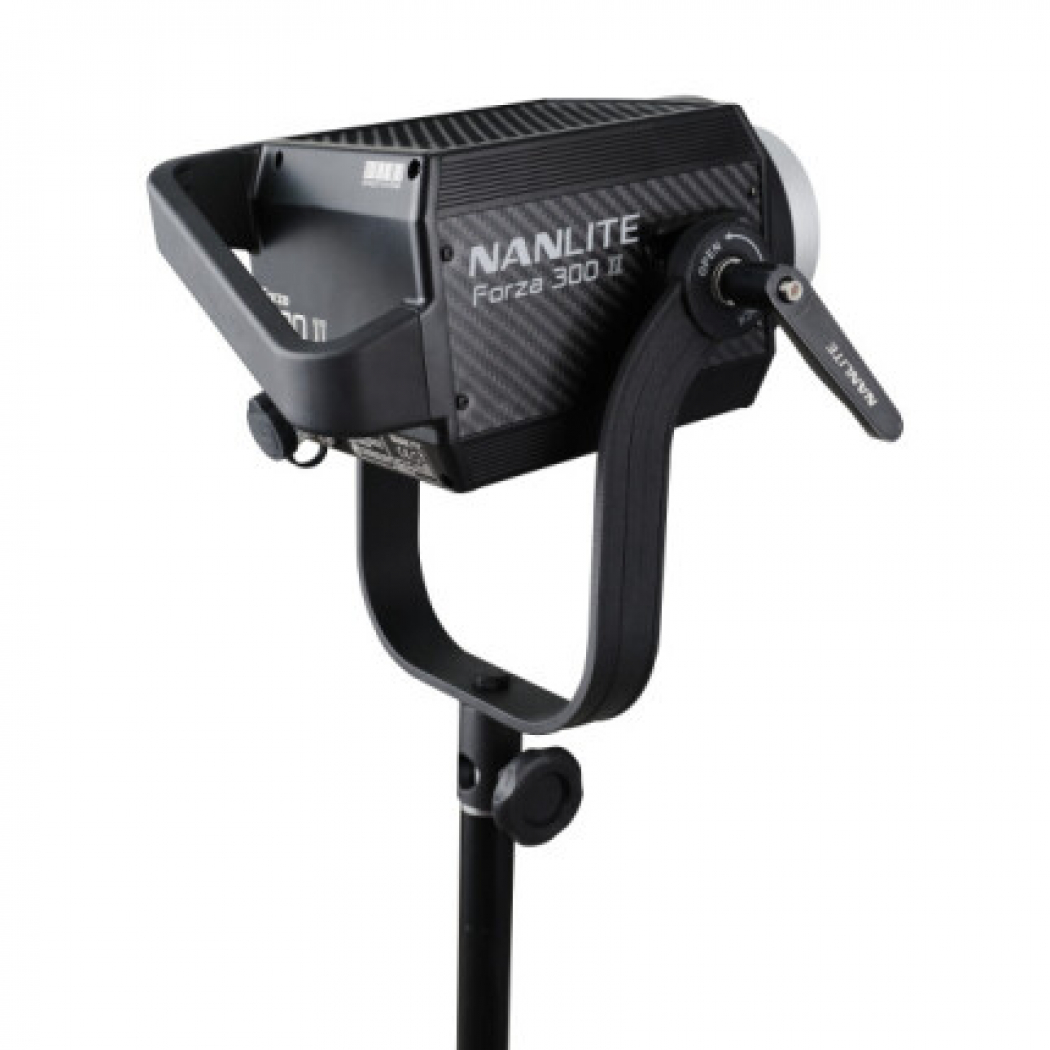
The Nanlite Forza 300 II is a 350 W daylight COB spotlight with a native Bowens mount and a separate power/control unit. It is a practical class of source for controlled hard light, bounce, softbox keys and optional Fresnel or projection work in location and studio packages.
This is the second-generation daylight 300, distinct from the bi-colour Forza 300B II. Its nominal white point is 5600 K, but the added green/magenta adjustment can help match other sources. That tint control does not make it a variable-CCT or RGB fixture.
Key specifications
| Specification | Details |
|---|---|
| Fixture class | COB LED spotlight |
| Rated power | 350 W |
| CCT / tint | 5600 K; green/magenta adjustment ±80 in the fixture scale |
| Manufacturer colour metrics | CRI 96; TLCI 97; average TM-30 Rf 94 / Rg 102 |
| Dimming | 0–100% |
| AC supply | 100–240 V, 50/60 Hz through the specified power system |
| DC / battery interface | 14.4–14.8 V V-mount batteries, 12 A specification; do not use 26 V packs |
| Accessory mount | Bowens |
| Head dimensions | Head 330 × 228 × 123 mm; controller 156 × 139 × 232 mm |
| Component weights | Head 2.88 kg; controller 2.45 kg; cables, clamp and reflector additional |
| Control | Onboard, 2.4 GHz, Bluetooth/NANLINK, wired DMX/RDM |
| Integrated CRMX | Not listed for this model |
Strengths and limitations
Strengths
- The Bowens head supports a broad modifier system and a separately positioned controller.
- Fixed daylight simplifies matching and exposure decisions.
- Wired DMX/RDM and NANLINK support more than local control.
Limitations
- The controller, cables and battery hardware add substantially to the head-only weight.
- Warm white needs correction gel, with an associated output loss.
- The original model has no integrated CRMX receiver; small-head DMX adapters must be included where required.
Practical uses
The 300 II is useful when a small COB struggles through diffusion or needs to work farther from a subject. A Bowens softbox makes a directional soft key, while a bounce changes the source shape and allows placement around set architecture. The head itself remains a small hard emitter until a modifier or illuminated surface changes its apparent area.
The FL-20G Fresnel provides a controllable beam for accents and harder directions. A PJ-BM projector is the appropriate family for defined cuts, gobos or optical patterns. Confirm attachment compatibility and its support requirements; a projector is a substantial addition to the head’s size and balance.
Keeping the controller below the head reduces the mass that has to sit at the light position. The cable still needs a supported route and enough slack for aiming. Include the controller clamp, head cable and mains cable in the setup footprint rather than treating the head’s dimensions as the entire installation.
| Setup | Working approach |
|---|---|
| Interview key | Choose a softbox or bounce large enough for the desired wrap, then measure after that modifier. |
| Shaped accent | Use a manufacturer-approved Fresnel or projector for a controlled highlight, edge or background pattern. |
| Portable location | Select the supported battery arrangement and cooling mode before deciding the working level. |
Output and colour
The figures below come from Nanlite’s model-specific technical photometric table, at 5600 K. They are centre illuminance for the named optical setup, not total lumens, edge coverage or a prediction for a different softbox. Optional attachments are identified separately from the supplied reflector.
A focused attachment concentrates light into a smaller field. Its higher centre value does not establish that it illuminates a larger area or produces more total light. Measure the working area after diffusion, flags and colour/tint choices are in place.
| Configuration at 5600 K | 1 m | 3 m |
|---|---|---|
| Bare head | 14,270 lux | 1,713 lux |
| Reflector | 69,400 lux | 6,321 lux |
| FL-20G Fresnel, 10° spot | 197,000 lux | 17,430 lux |
| FL-20G Fresnel, 45° flood | 39,160 lux | 4,576 lux |
The documented CCT range and colour scores are listed above for this exact model. CRI, TLCI and TM-30 describe different aspects of colour reproduction; they do not make two lights with the same Kelvin setting spectrally identical. Check skin, textiles and product colours through the intended camera when mixing sources.
The fixture offers 0–100% dimming and built-in intensity effects. For a repeatable setup, record the output level, fan mode, optical attachment and colour or tint setting that the model provides. Check a fade and the camera’s intended frame rate/shutter combination before relying on a very low level or a fast effect.
Power and batteries
The controller accepts 100–240 V AC, 50/60 Hz. The manual allows two suitable 14.8 V V-mount batteries for 100% maximum output; one battery limits the maximum to 45%. It explicitly prohibits 26 V batteries on this model. Do not transfer the battery-voltage range of a Forza 500 II or another superficially similar controller to the 300 II.
Battery watt-hours describe stored energy; maximum discharge describes whether the pack can sustain the load. Both matter, as do the approved lead and connector. For planning, identify the power source and operating level rather than quoting one runtime for every colour, fan mode and battery condition.
Use the specified supply and interconnects, provide strain relief and keep the electronics ventilated. The quoted head mass excludes the complete cable, power and grip package. Check the label on the actual regional supply before circuit planning or substituting any component.
Control, cooling and camera operation
Control options include the onboard interface, Nanlite’s 2.4 GHz remote ecosystem, Bluetooth/NANLINK and wired DMX/RDM. NANLINK radio control is a different connection from LumenRadio CRMX; the manufacturer specifications do not list an integrated CRMX receiver.
The 300 II controller provides DMX input and output for a conventional wired chain. Set the address and matching personality, terminate the final fixture in a wired run and test signal-loss behaviour before a cue-dependent take.
USB firmware updating and app features depend on the installed version. Match the manual and console profile to that version. On a used fixture, confirm app connection, wired control and firmware access rather than judging the control package only by a working local dimmer.
Modifiers, rigging and the working package
Four modes: Smart, Full Speed, Low Speed and Off. The manual limits output to 50% in Low Speed and 15% with the fan off; Smart and Full Speed permit 100%.
A fan-off choice trades available level for silence. Test it with the actual microphone and keep the thermal paths clear. Choose a different placement or operating level if the required output cannot be maintained in the selected cooling mode.
Check the COB window, accessory lock, yoke, tilt handle, connectors and supply lead. Try the intended reflector or optical attachment, inspect the beam for unexpected colour or uniformity problems, and confirm the mount locks positively. Protect the open head and electronics from moisture and conditions outside the matching manual; no general outdoor waterproof rating is established by the manufacturer specifications.
Alternatives and related fixtures
The Forza 300B II adds variable white and has different photometric results. The Forza 500 II is a higher-load daylight option with its own battery specifications. Choose between them using the actual modifier, distance and power arrangement, not only the number in the model name.
| Fixture | Choose it for |
|---|---|
| Forza 300B II | Variable white in the 300-class controller package. |
| amaran 300c | A different full-colour Bowens and app ecosystem. |
What people are saying
Gaffer & Gear: separate results for daylight and bi-colour
Gaffer & Gear’s paired review tests the 300 II bare, with its reflector, Fresnel and projection attachment, then checks DMX and low-level dimming. Its daylight tests are indexed separately from the 300B II results, making it useful for choosing an optic for this specific head.
Videos
Gaffer & Gear 212: Forza 300 II and 300B II
Model-specific chapters cover optics, DMX, dimming and colour measurements.
Rental and used-fixture checks
Confirm the Forza 300 II label, matching power hardware and all control leads. Inspect the emitter cover, Bowens latch, yoke and connector strain relief, then test the intended modifier, low-level fade and remote-control path. Run at the planned level until warm before assessing fan sound at the microphone.
Documentation and specifications
official product specifications and photometry and manufacturer operating manual.
Product photograph: Foto Erhardt product photograph
Browse Nanlite lights · COB lights · all equipment.