
Last Updated 2 days ago
Overview
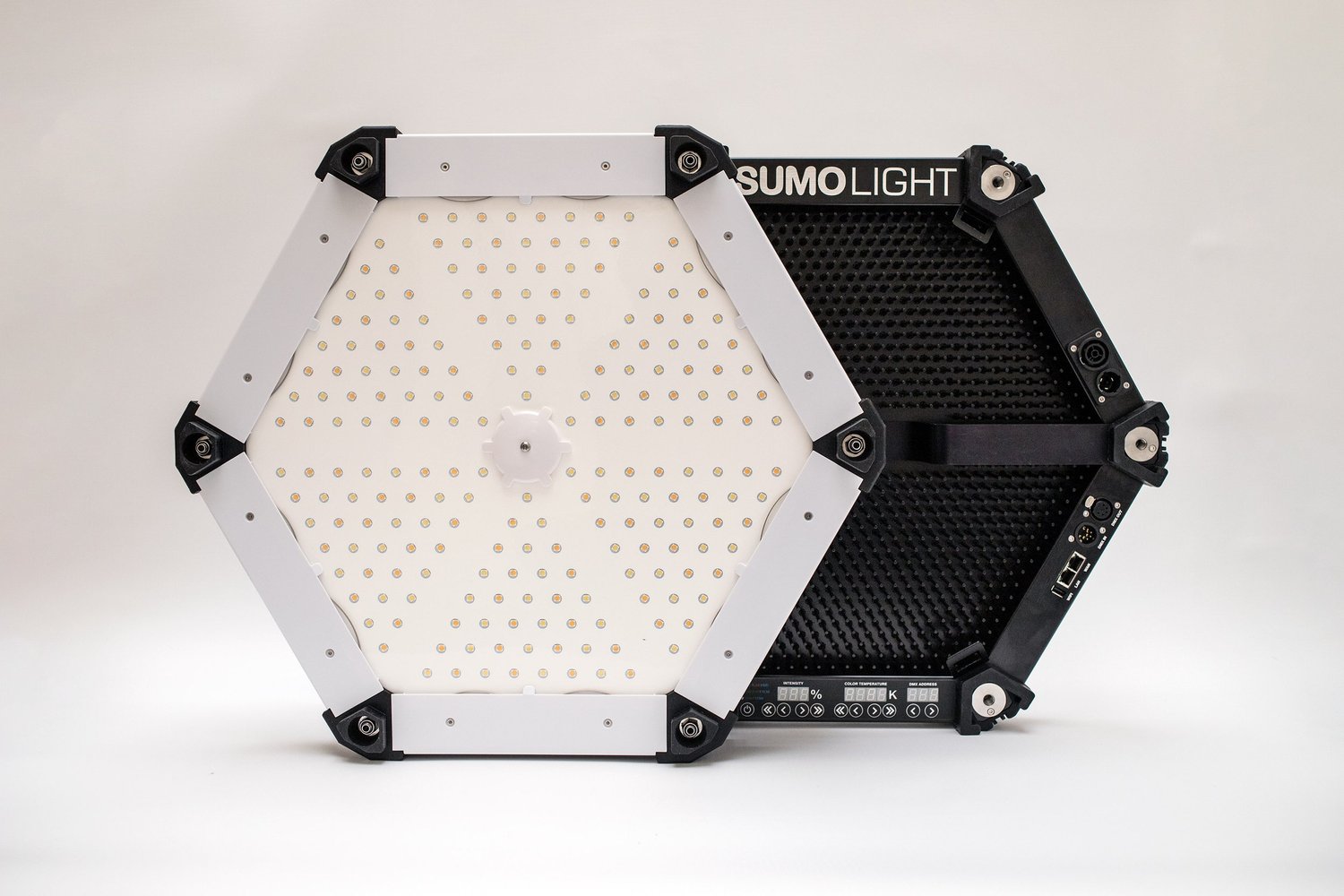
The SUMOLIGHT SUMOSPACE+ is a modular bi-colour LED fixture with an internal power supply, passive cooling and interchangeable optics. It can work as a wide source, a concentrated beam or the engine for a spacelight/soft-light modifier arrangement.
The plus sign matters. The original SUMOSPACE uses a different external power-supply arrangement, while the manufacturer’s PLUS flyer explicitly identifies an internal PSU and a 6 kg fixture. Mixed archival downloads and conflicting power lines on the current page make exact-model identification essential.
Key specifications
| Specification | Details |
|---|---|
| Fixture class | Modular bi-colour LED source, SUMOSPACE+ with internal PSU |
| White range | 2800–6500 K |
| Manufacturer colour metrics | CRI 95; TLCI 99 |
| Dimming | 0–100% |
| Bare / optional optics | 120° without interchangeable optics; 20°, 30° and 60° lens options |
| Identified output claim | Up to 16,000 lux at 3 m with 20° lens; CCT not identified in the manufacturer flyer |
| Fixture size / weight | 561 × 500 × 94 mm; 6 kg |
| Cooling | Passive; no fans or moving cooling parts in the PLUS flyer |
| Control | DMX, RDM, LAN/Wi-Fi, Art-Net and sACN in current specifications |
| Mounting | SUMOSNAP quick-release system; approved stand, truss and multi-head accessories |
| Environmental limits | IP20; −20 to 40°C ambient in the current page |
| Electrical protection | IEC Class I in current specifications; use the correct grounded supply system |
| Published power discrepancy | Current page: 400 W headline / 480 W maximum; PLUS flyer: 500 W maximum. Verify actual label. |
Strengths and limitations
Strengths
- A broad emitting face suits soft keys and controlled reflections.
- Model-specific controls allow repeatable white or colour settings.
Limitations
- Diffusion and grids change both the exposure and the useful coverage.
- The controller, supply and rigging are part of the complete package.
Practical uses
With suitable diffusion, reflector, target and skirt accessories, the head can form an overhead ambient or soft source. Black skirt covers and the target arrangement control where light escapes. The source’s final apparent size is the illuminated modifier, not simply the hexagonal LED face.
With narrower optics it can provide a more concentrated direction or reach. These are different optical configurations of the same system; the exposure, field and supported load need to be checked after the change rather than assumed from the bare head.
Passive cooling is useful around dialogue microphones and quiet stages. It does not eliminate heat: keep the specified ventilation and clearance, allow cooling before handling and choose a safe location for the complete power and modifier arrangement.
| Setup | Working approach |
|---|---|
| Interview key | Set source size and distance for the required wrap, then add a grid or flags. |
| Product reflection | Watch the actual reflection while adjusting orientation and diffusion. |
Output and colour
The PLUS flyer identifies up to 16,000 lux at three metres with the 20° lens. It does not identify the CCT for that figure, so this article does not relabel it as a verified 3200 K or 5600 K measurement. It is a manufacturer claim for a specified narrow optical setup, not a bare-head or diffused spacelight result.
The native wide field is listed at 120°, with interchangeable 20°, 30° and 60° optics. Choosing a narrower field concentrates output and reduces coverage. A high centre reading with the 20° lens cannot describe the illumination available from a skirt, lantern or wide bare head.
Fit the intended lens and modifier, establish the working distance and assess the full area being lit. A spacelight setup needs useful downlight and surrounding coverage; a high-density directional setup needs a different beam and spill strategy.
SUMOSPACE+ provides variable white from 2800 to 6500 K with a 0–100% dimming range. It is a bi-colour system rather than a full-colour RGB fixture. A saturated-colour cue requires the appropriate filter or another light with that colour capability.
SUMOLIGHT publishes CRI 95 and TLCI 99. Those are separate manufacturer metrics, not a promise of identical rendering with every other fixture at the same Kelvin value. Check practical-source matching, skin tones, textiles and reflective products through the production camera.
The manufacturer describes flicker-free operation at all frame rates. Treat that as a performance claim to check at the intended shutter, intensity and camera mode, especially for unusual high-speed capture or sensitive low-level effects.
Power and batteries
Match the lamp or head, supply voltage and power hardware to the specifications above. Include cables and any separate ballast or controller when planning the complete system.
Control, cooling and camera operation
The current specifications list DMX, RDM, LAN, Wi-Fi, Art-Net and sACN. Configure the actual firmware and control interface for the intended console, address and universe. Network and wireless-network control do not, by themselves, establish an integrated LumenRadio CRMX receiver.
The archived web-interface/configuration guide is useful for understanding the system’s network workflow, but its revision and power architecture must be checked against the actual light. Record operating mode, white point, intensity and control settings when matching several heads or repeating a setup.
Test a low fade, blackout, cue recovery and loss of the intended data route. For an array, plan network topology and cable routing along with power; mechanical joining does not automatically patch several fixtures as one address.
Modifiers, rigging and the working package
The PLUS flyer identifies a built-in SUMOSNAP quick-release arrangement for a 16 mm spigot. SUMOLIGHT also lists approved truss/junior-pin and Super3/Super7 system options. Use the correct retained hardware for the exact head and orientation rather than assuming the quick-release interface fits every third-party support.
Every PLUS head contributes approximately 6 kg before its modifier, mount, cables or array structure. A multi-head system creates a larger load and more leverage than one head. Follow the documented assembly, support ratings and secondary-retention provisions for the chosen configuration.
The current head is specified IP20, with −20 to 40°C ambient operation. It is not a rain-rated fixture. Protect the electrical system and keep cooling surfaces clear; the absence of a fan does not establish unrestricted weather use or permission to enclose the head.
Alternatives and related fixtures
| Fixture | Choose it for |
|---|---|
| Original SUMOSPACE | An earlier electrical and power arrangement; identify the plate. |
| COB with a spacelight modifier | A different source, rigging depth and distribution. |
What people are saying
Newsshooter: SUMOSNAP handling
Newsshooter’s demonstration presents SUMOSNAP as a quick-release rigging system for SUMOLIGHT fixtures. It shows the support concept; load ratings apply to the specified hardware and complete approved arrangement. View the source.
Videos
SUMOLIGHT SUMOSPACE+: family guide
SUMOSNAP rigging-system demonstration; confirm SUMOSPACE+ power and head specifications separately.
Rental and used-fixture checks
Check the full SUMOSPACE/SUMOSPACE+ model label, PSU architecture and revision before comparing a used listing. An original head without its correct external PSU is a different incomplete package from a PLUS fixture with an internal power fault.
Inspect optics, lens slots, SUMOSNAP retention, housing, electrical connectors and mounting accessories. Test white tuning, dimming, local operation and the intended DMX/network path. Confirm that reflector, target, skirts, lenses and case are present where the planned application needs them.
A large soft panel such as the Creamsource Vortex8 serves a different optical and colour role. Choose SUMOSPACE+ when its modular lens/modifier system and passive operation fit the job, with the exact electrical package verified.
Documentation and specifications
The PLUS flyer says that no external ballast is required and lists 500 W maximum consumption. The current product page simultaneously uses a 400 W headline and a 480 W maximum-input line. Those figures are not treated as a single independently verified draw. Plan supply capacity from the label and current instructions for the actual unit, not the lowest promotional number.
The current page also prints “DC Input Voltage: 400 V.” That line must not be read as an ordinary mains-input instruction. The archived original SUMOSPACE quick-start guide documents a separate PSU accepting 100–240 V AC and feeding a 400 V DC head. It describes a different power architecture from the internal-PSU PLUS unit.
The checked PLUS flyer does not resolve the regional mains-input range in its own technical text, so an AC range from the original external PSU is not assigned to PLUS here. Identify the full model, serial/revision, supplied mains connection and matching electrical documentation before operation or replacement of a power component.
Keep the PLUS and original head cables, supply hardware and service instructions separate. The older webpage/configuration manual also contains high-voltage diagnostic information; it is not a substitute for the correct PLUS electrical installation instructions.
current manufacturer product page, SUMOSPACE+ internal-PSU flyer, original SUMOSPACE quick-start guide for architecture comparison and archived webpage/configuration guide. Conflicting electrical lines are identified rather than silently merged.
Product photograph: SUMOLIGHT official SUMOSPACE+ product photograph.
Browse SUMOLIGHT lights · LED panels · all equipment.