
Last Updated 1 day ago
Overview
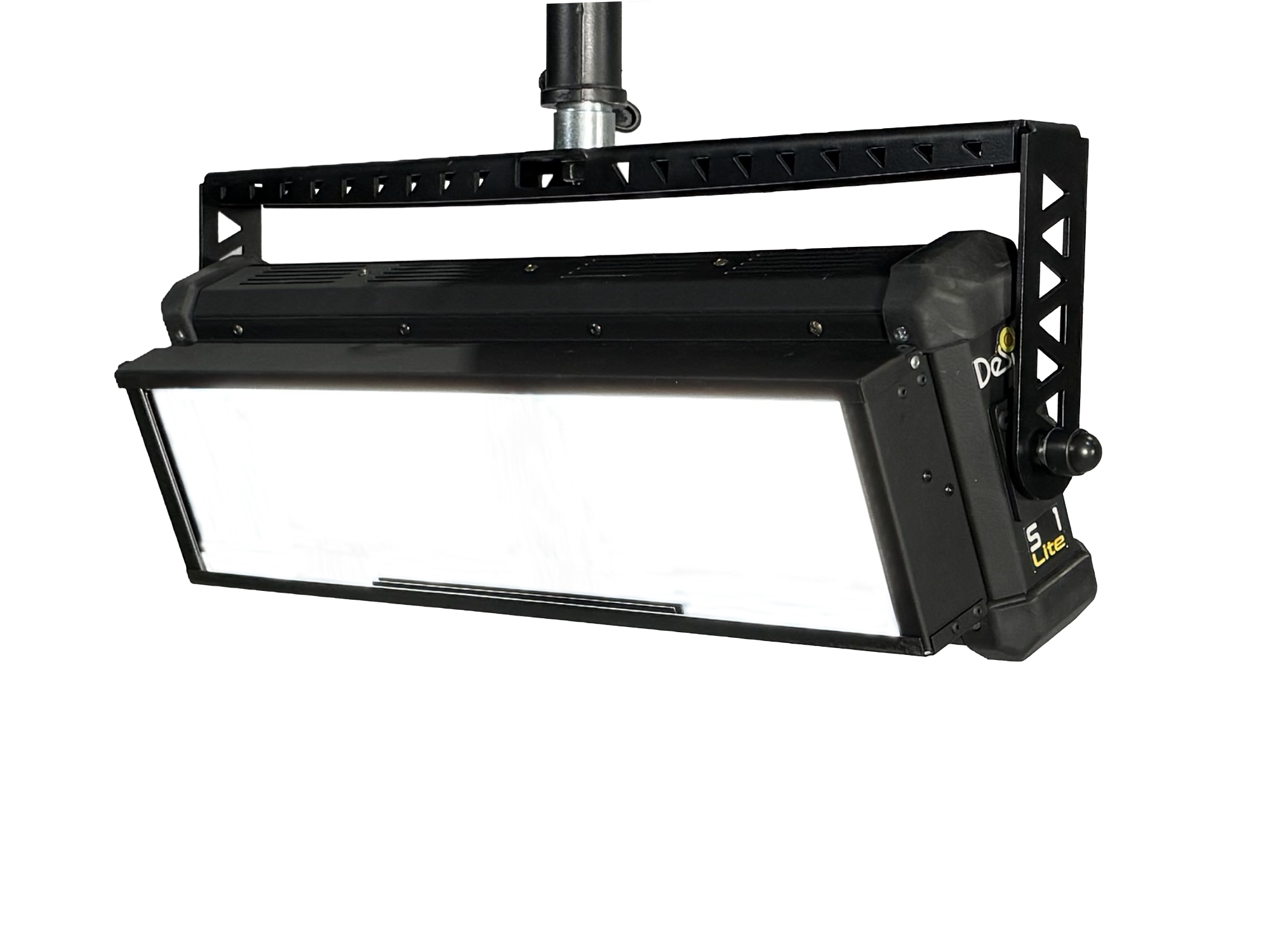
The De Sisti SoftLED 1 Lite is a compact 45W studio softlight offered in fixed-white and Vari-White versions. It suits a close presenter key, radio-studio camera position or gentle interview fill where a small emitting surface can be kept nearby.
Manufacturer product photograph. Select the image to enlarge.
The SoftLED 1 Lite is a close-working source. Keep the actual panel dimensions and distance in mind when judging softness; adding diffusion also costs usable level.
Key specifications
| Specification | Details |
|---|---|
| Source / LED power | 45W LED softlight |
| Wall-power consumption | 55W in the T/D and VW sheets |
| Colour versions | T 3,200K or D 5,600K fixed-white; separate VW version 2,800–6,600K |
| AC supply | 90–250V, 50/60Hz |
| Controls | Local controls and 5-pin DMX; channel count depends on T/D or VW version |
| Dimming | T/D and VW use different dimmer/CCT personalities |
| Colour-rendering reference | CRI >93 in the current SoftLED Lite sheets |
| Cooling | Temperature-managed heat dissipation; see cooling notes |
| Weight with yoke | 6.5kg MO in the current T/D and VW sheets |
| Protection | IP20 standard version |
Source: model-specific manufacturer datasheet. The T, D and VW are separate versions. T/D LED power is 45W; the VW sheet specifies 45W. Vari-White datasheet.
Strengths and limitations
Strengths
- A broad emitting surface supports close soft keys without adding a separate softbox.
- Direct local control and a wired DMX route suit a permanent studio or a repeatable rental setup.
- A self-contained AC package reduces the number of separate boxes at the lighting position.
Limitations
- A soft panel cannot reproduce the tight, focusable beam of a Fresnel or profile.
- Lower engine power limits throw and the amount of diffusion that can be added.
- The listed standard version needs a protected operating position; do not transfer a different version’s weather rating to this head.
Practical uses
| Setup | Working approach |
|---|---|
| Presenter key | Bring the emitting surface close enough to create the intended softness, then feather it across the face. A grid or flag can hold the background level down. |
| Two-person interview | Check both seats and the centre position before setting the ratio. A wide panel is useful only if the faces sit within a consistent portion of its field. |
| Fill or toplight | Set the fill from the camera position. Keep spill away from the background and check eyes, glasses and the top of the frame for reflections. |
During a relight, keep a record of position, tilt, focus or accessory setting and dimmer level. That makes a repeat setup more useful than a Kelvin value or console percentage on its own.
Output and colour
The SoftLED 1 Lite should be assessed at the working distance and with its intended accessories. A honeycomb, intensifier or additional diffusion changes both coverage and the usable level on a face.
A T or D head has a fixed white point; a VW head adds adjustable white from 2,800–6,600K. That does not make the VW version a full-colour effects light. Match the order code and console personality to the required colour control.
The manufacturer photometric charts provide the source measurements. Compare beam and field angles separately and keep CCT, distance and front accessories with any recorded lux value.
For high-speed work, test the actual camera, shutter and dimmer level. Check low-level fades and a short recorded clip before relying on a general flicker-free claim.
Power and batteries
The fixed-white model’s LED engine is rated at 45W. The input reference is 55W in the T/D and VW sheets. The standard supply accepts 90–250V, 50/60Hz; the version-specific datasheets are linked below.
Do not assume that an AC studio head accepts a camera battery. For mobile operation, use the manufacturer-approved supply arrangement for that exact version; an AC inverter also needs adequate continuous rating and runtime.
Power pass-through is limited by the connectors, cable, circuit and manufacturer instructions. Plan the total downstream load rather than daisy-chaining by the number of heads alone.
Controls, dimming and cooling
Use the personality for the exact T/D or VW version. The fixed-white head needs intensity control, while VW also needs CCT. Check 8-bit versus 16-bit operation, blackout and a slow fade before assigning the fixture to a show file.
The current softlight sheets use both passive-cooling language and references to temperature-managed fans. Confirm the installed hardware and listen to the warmed fixture from the microphone position before specifying it as a silent source.
Modifiers and rigging
Match honeycombs, intensifiers, barndoors and diffusion to the exact panel size. An XL or Lite designation can change the housing and accessory fit even where LED power looks similar.
Use the supplied mounting arrangement and a support rated for the complete head and accessories. Lock the yoke after aiming, secure cables without loading the connectors and add an independent safety when the unit is suspended. Keep access to the accessory latch and controls.
Related guides: lighting types and accessories and modifiers.
Alternatives and related fixtures
| Fixture | When to choose it |
|---|---|
| De Sisti SoftLED 1 | The standard 60W SoftLED 1 for a different housing and accessory package. |
| De Sisti SoftLED 2 Lite | A 120W Lite softlight when the 45W model cannot provide the required level or coverage. |
Browse the De Sisti range or search all lighting equipment.
Videos and industry coverage
De Sisti’s lighting demonstrations show the manufacturer’s Fresnel and colour-light workflows. Check the named model in each demonstration before applying a feature to a rental head.
Rental and used-fixture checks
- Identity: read the full model label, including T, D, VW, VW+C, Lite, HP and any weather-rated suffix. Match the label to the supplied datasheet and console personality.
- Front surface and accessories: look for cracks, yellowing, uneven illumination or a damaged diffusion surface. Fit the actual grid or intensifier and check all retaining points.
- Mechanical condition: load the yoke with the intended accessories, inspect the mounting point and cable strain relief, and confirm that tilt holds without excessive force.
- Electronics: warm the fixture, check colour across the working dimmer range and test local and remote control. Compare neighbouring heads on camera before committing to a matched set.
- Complete package: include power and data leads, adapters, accessories, cases and replacement-part availability in the rental or used-purchase decision.