
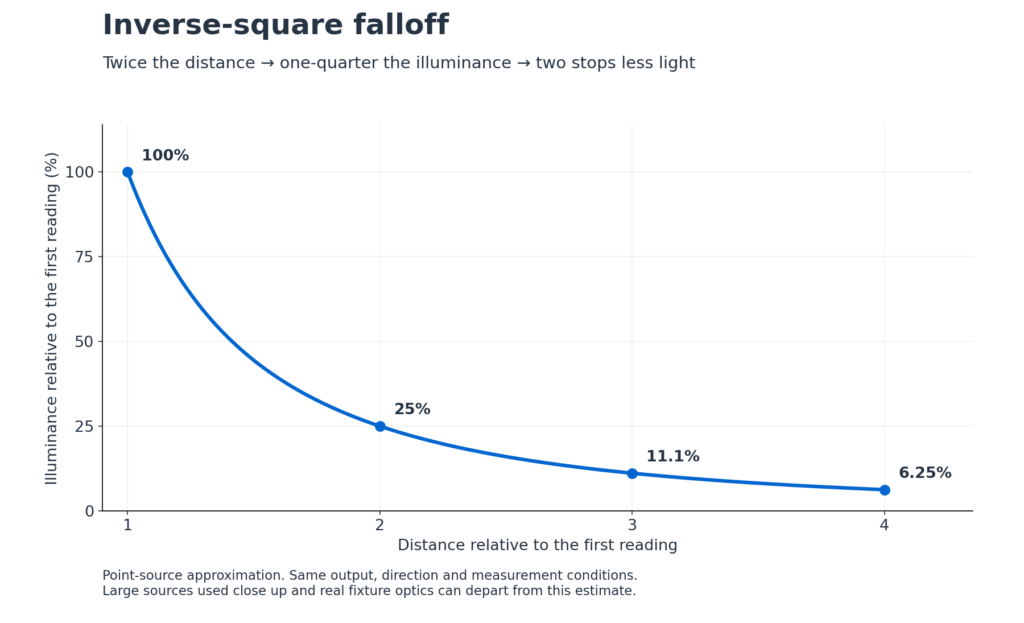
The inverse-square law describes how illuminance changes with distance from a point source when other conditions stay the same. Double the distance and the illuminance falls to one-quarter; halve it and the illuminance rises fourfold.
The calculation
Use E₂ = E₁ × (d₁ ÷ d₂)², with both distances in the same unit. If a source gives 1,000 lux at 2 m, the point-source estimate is 250 lux at 4 m. One-quarter the illuminance is a reduction of two stops.
Where the estimate has limits
Real fixtures have a physical size and optics. A large panel or diffusion frame used nearby may not follow a point-source estimate closely. Beam focus, a change of modifier, reflected light and off-axis measurement can also change the result. Use measured photometric data or a meter where accuracy matters.
Practical example
Moving an actor from 1 m to 2 m from a compact source produces a larger proportional change than moving from 5 m to 6 m. This is why placing a suitable light farther away can make an actor’s small movements easier to accommodate, provided sufficient output remains.
Related terms
Lux · Foot-Candle · Soft Light · Falloff · Stop