
Last Updated 2 hours ago
Overview
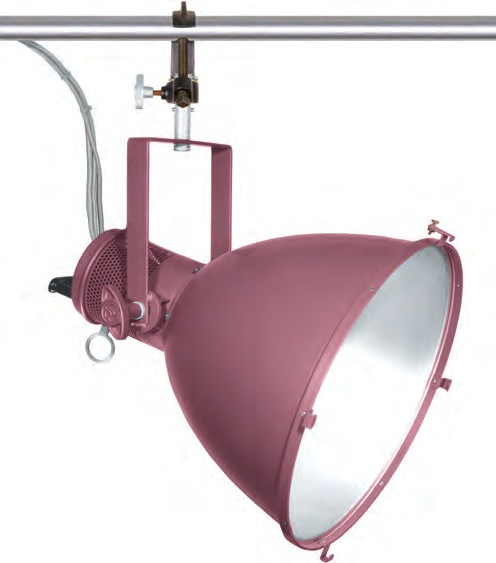
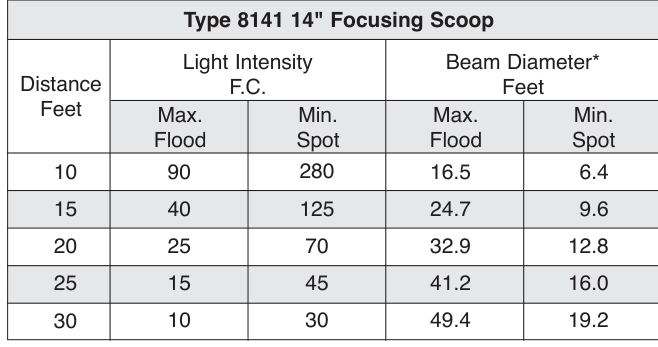
The Type 8141 is a 1 kW tungsten scoop with a 14-inch reflector and a rear focus ring. At a 15 ft throw, pulling the beam from full flood to full spot changes the centre reading from 40 to 125 fc and narrows the field from 24.7 to 9.6 ft.
Key specifications
| Specification | Type 8141 |
|---|---|
| Maximum head load | 1,000 W, 8.3 A at 120 V |
| Reflector | 14-inch Molebrite Alzak aluminium scoop |
| Focus | Hand or pole via rear 1½-inch ring |
| Socket | Medium prefocus, P28s |
| Size with standard diffuser clips | 17⅜ × 16 7/16 × 16¼ in. |
| Head weight with clips | 11 lb |
| Head weight with square holder | 13 lb |
Replacement lamps
| Lamp | Power | Voltage | Rated colour | Finish | Rated life |
|---|---|---|---|---|---|
| EGJ | 1,000 W | 120 V | 3,200 K | Clear | 300 h |
| EGK | 1,000 W | 120 V | 3,200 K | Frosted | 300 h |
| EGF | 750 W | 120 V | 3,200 K | Clear | 300 h |
| EGG | 750 W | 120 V | 3,000 K | Clear | 2000 h |
| EGC | 500 W | 120 V | 3,150 K | Clear | 500 h |
| EGE | 500 W | 120 V | 2,950 K | Clear | 2000 h |
The lamp table identifies EGJ as clear and EGK as frosted. The test caption calls its EGJ-Q1000/4/P frosted. The figures below follow the published chart. Check the finish on the actual globe when matching output.
Strengths and limitations
- The focus ring changes the field width at the same throw. At 15 ft the centre reading runs from 40 to 125 fc.
- The reflector has a gradual edge. For a clean cutoff on scenery, set a flag where it can catch the spill.
Practical uses
For a presenter working in front of a backing, start with the width of the area that needs fill. At 15 ft the flood setting can cover a wide mark, while spot keeps more of the light off the adjacent set. Check spill at the ends of the move.
Output and photometrics
The figures are centre-beam foot-candles. Field diameter is the width at approximately half the centre intensity. Mole tested the EGJ at 120 V. The table shows both ends of the focus range.
| Distance | Flood (fc) | Spot (fc) | Flood field | Spot field |
|---|---|---|---|---|
| 10 ft | 90 | 280 | 16.5 ft | 6.4 ft |
| 15 ft | 40 | 125 | 24.7 ft | 9.6 ft |
| 20 ft | 25 | 70 | 32.9 ft | 12.8 ft |
| 25 ft | 15 | 45 | 41.2 ft | 16 ft |
| 30 ft | 10 | 30 | 49.4 ft | 19.2 ft |
Photometric & exposure calculator
Estimate centre-beam illumination and the corresponding camera aperture from this fixture’s published measurements.
Estimated output
Select a configuration to calculate.
Manufacturer readings are for the stated optic, colour setting and full output, measured at the beam centre. Values between measured distances are interpolated. Point-source values outside those distances are approximate inverse-square estimates; large sources cannot be reliably extrapolated and are limited to their measured range. Exposure uses frame rate, shutter angle, ISO and the selected incident-meter calibration. Only the optics and diffusion explicitly listed in the measurement are included; additional modifiers, bounce, beam edges, ambient light, ND filters and camera exposure-index differences are not accounted for. Confirm critical exposures on set with a meter. Photometric source
Power and controls
The head is rated for 120/240 V AC or DC. The 1,000 W catalogued test lamp draws about 8.3 A at 120 V. Mole supplied the standard head with 36-inch leads and no switch. The optional 25 ft cable had an inline switch. Confirm the plug and lamp voltage on the unit being booked.
Optics and mounting
The standard Type 81485 diffuser clip ring takes material at the front. Mole also lists a Type 8145 square holder and a Type 81449 Molequik frame. For a baby stand, Mole specifies the Type 8143 strap-yoke adapter for a ⅝-inch spud.
Comparable fixture
The companion fixed-focus head has the same reflector diameter and its own field and output table. Mole-Richardson 14-Inch Fixed-Focus Scoop (Type 8142).
Field coverage and further reading
The B&H listing agrees on 125 fc in spot at 15 ft. Its 6.4 ft diameter comes from Mole’s 10 ft row. For a 15 ft throw the manufacturer gives 9.6 ft. B&H Type 8141 listing.
Rental and used-fixture checks
Run the focus through its full travel and check that it holds position after a tilt. Sight across the reflector for dents, then bring the lamp up on a plain wall to check the field.
Documentation
- Original Mole-Richardson specification and photometric sheet
- Mole-Richardson equipment catalogue
- Download the original scoop sheet
Back to contents · Mole-Richardson fixtures · Tungsten lights