
Last Updated 15 hours ago
Overview
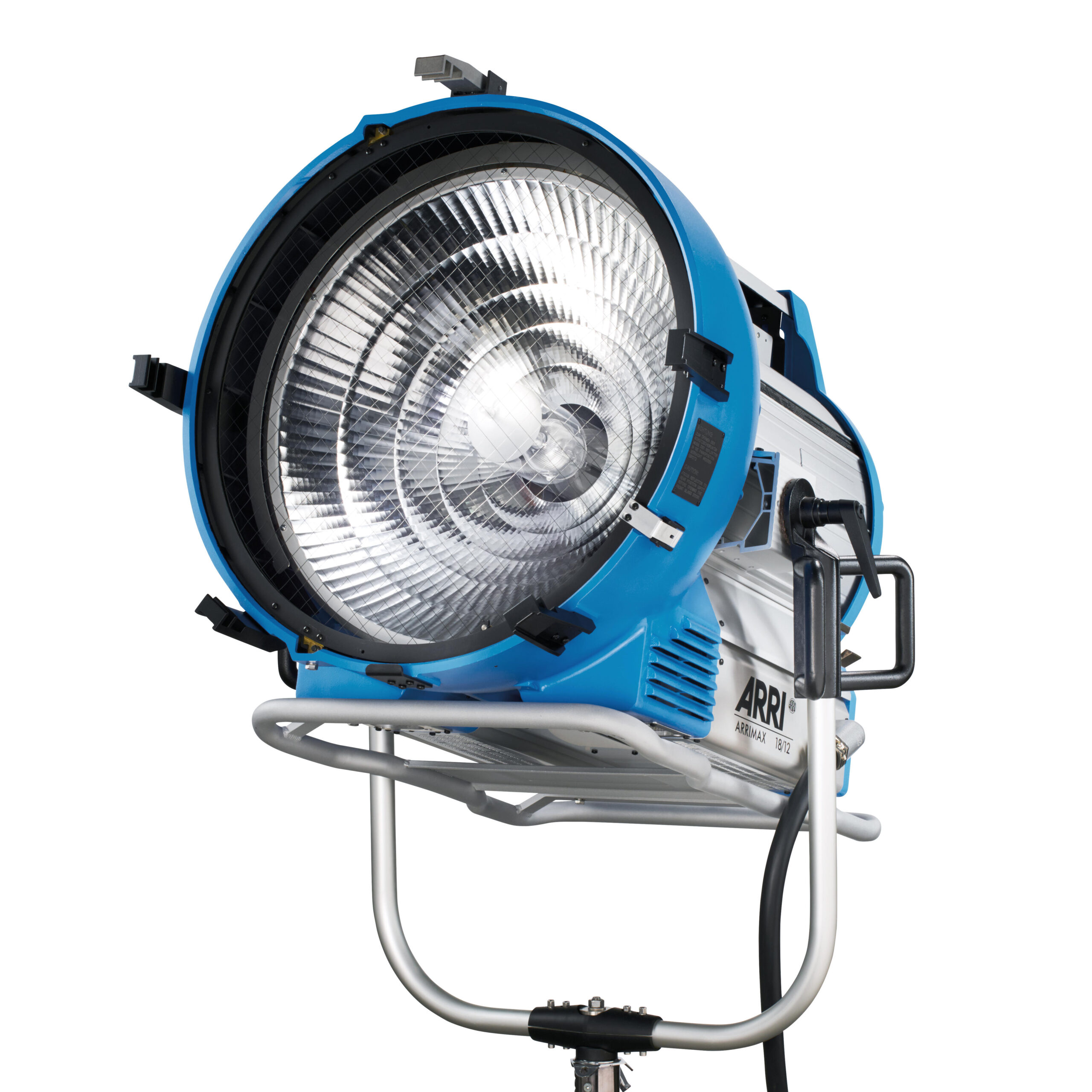
The ARRI ARRIMAX 18/12 is a large daylight discharge head for approved 12000 W or 18000 W lamps. Its faceted MAX reflector creates a continuously adjustable hard beam without the converter-lens set used by a conventional PAR. It is designed for substantial throws, large exterior daylight effects and lighting on the scale of major stages or large locations.
This is a complete professional lighting system with a large head, external ballast, heavy head cable, distribution and appropriate rigging. The 18/12 designation describes approved lamp classes, not household mains compatibility or the input rating of the ballast. Its size, clearances and power infrastructure are part of the fixture choice.
Key specifications
| Specification | Details |
|---|---|
| Lamp classes | Approved 12000 W/SE or 18000 W/SE metal-halide lamps |
| Lamp-base support | GX51 / GX38 as identified in the manufacturer specification; verify the actual approved lamp/head version |
| Standard optical range | 15–50° with the standard reflector and 18000 W reference configuration |
| Optional spot reflector | 8–15°; a separate optical arrangement |
| Head weight | Approximately 70 kg |
| Packed weight | Approximately 86 kg, identified separately from the head |
| Poster dimensions including flange | 1051 × 784 × 942 mm |
| Mount | 28 mm junior spigot; suitable heavy-head support required |
| Listed ballast families | EB MAX 12/18 or EB 12/18, appropriately configured |
| Accessory diameter | 740 mm |
| Protection | Class I protective earth; IP23 |
| Maximum ambient / surface | 45°C / 240°C |
| Tilt limits | 90° upward; 75° downward |
| Clearances | 15 m to illuminated surfaces; 2 m around the head |
Strengths and limitations
Strengths
- A hard daylight source supports throw, bounce and large diffusion.
- Matched ballast options support production control.
Limitations
- Lamp, reflector or lens and ballast must be specified as a complete system.
- High-speed performance depends on the actual lamp, ballast mode and camera test.
Practical uses
A head of this scale can establish a hard daylight direction across a large set or from well outside the immediate shooting area. It may light through a substantial diffusion frame, feed a large bounce or create a distant sun effect. The long throw can help reduce relative exposure changes across the action area, but the actual geometry and focus remain decisive.
The bare head is a hard source. A large bounce or diffusion changes both the apparent source and the available level, and a narrow spot can create uneven coverage on that modifier. Compare the needed working field and uniformity rather than choosing from a maximum centre-lux number.
| Setup | Working approach |
|---|---|
| Window or exterior push | Choose beam coverage and throw before calculating the required circuit and rig. |
| Large diffusion | Meter the useful lit area after diffusion and allow for transmission loss. |
Output and colour
The ARRIMAX datasheet identifies the lamp for this photometric table as 18000 W. These readings use the standard reflector’s 15° spot and 50° flood. They do not represent a 12K lamp or the optional narrower spot reflector.
| Throw | 15° spot: centre / diameter | 50° flood: centre / diameter |
|---|---|---|
| 15 m | 55,300 lux / 3.9 m | 5,700 lux / 12.7 m |
| 20 m | 31,100 lux / 5.3 m | 3,210 lux / 17.0 m |
| 30 m | 13,800 lux / 7.9 m | 1,420 lux / 25.4 m |
Power and batteries
The standard reflector’s stated focus range is 15–50°. ARRI also lists a separate spot reflector for approximately 8–15°. Identify which reflector is fitted to a used or rental head. The standard 15° reference is not proof of the output or coverage of the narrower accessory.
The lack of spread-lens changes simplifies a conventional PAR-style coverage task, but the required UV-protection glass still belongs in the head. “Lens-less” never means operating an exposed discharge arc. Barn doors, scrims and a snoot must be the correct retained accessories for the large front diameter.
The 12K and 18K configurations require the correct approved lamp and ballast setting. Check the lamp-base support and the head’s actual version, using part identification rather than assuming every older lamp of a similar physical size is acceptable. Do not scale an 18K table arithmetically to claim an exact 12K measurement.
The lamp’s nominal operating voltage is separate from the ballast’s mains input. The Basic ballast documentation lists an EB 12/18 version with 190–250 V supply and a 19,400 VA maximum line-power rating. That is a specification for the identified ballast, not a universal figure for every generation or lamp mode.
Specify the actual ballast, supply, connector, protective earth and permitted head-cable arrangement with the electrical department. An 18K lamp label alone is not a complete distribution calculation. Correct high-current connections and cable condition are essential parts of a reliable package.
Control, cooling and camera operation
ARRI’s model literature describes high-speed operation with the appropriate electronic ballast, including AutoScan and high-frequency lamp drive on the identified system. Those claims should not be applied indiscriminately to an old head paired with an unknown ballast or tired lamp.
Confirm ballast generation, compatible lamp, selected operating mode and the intended camera settings. Test the actual frame rate and shutter after the source stabilises. A head’s ability to work in a high-speed package does not guarantee every individual combination is flicker-free at every possible exposure.
Modifiers, rigging and the working package
The ARRIMAX specification calls for fifteen metres to illuminated surfaces, two metres around the luminaire and a downward tilt limit of 75°, rather than the full 90° permitted on several smaller heads. Its exterior can reach the stated 240°C limit. Treat these as real operating constraints when selecting a position or nearby material.
A roughly 70 kg head is only part of the rigging load. Include accessories, cable pull, working height, wind and the geometry of any supporting arm or platform. Use purpose-suitable lifting and support procedures with adequate access and secondary retention. A junior spigot is an interface specification, not a declaration that a small junior stand can carry the package.
Keep the UV protection and interlocks intact. Follow the isolation and cooling procedure before opening or relamping, and have damaged protection glass, lamp contacts or high-voltage parts serviced appropriately. The IP23 head rating does not make the ballast and every power junction unrestricted outdoor equipment.
Alternatives and related fixtures
Inspect reflector identity and condition, front protection, lamp clamp/socket, focus mechanism, door/interlock, yoke, spigot and all cable contacts. Confirm the ballast and cables supplied, not just the head’s serial plate. Lamp condition, servicing and correct configuration can materially change both reliability and measured output.
Compare a complete ARRIMAX package with other high-output daylight or LED systems at the required throw, beam size, power arrangement and colour needs. Newer fixtures may change control and logistics, but a meaningful comparison includes distribution, rigging and modifier losses. The ARRIMAX remains a specialist large-scale daylight tool when that complete system fits the production.
| Fixture | Choose it for |
|---|---|
| ARRI M-Series | Compare the exact lamp class, reflector and compatible ballast. |
| High-output LED spotlight | A different power, dimming and modifier system; compare coverage as well as centre lux. |
What people are saying
Bill Holshevnikoff: ARRIMAX demonstration
Bill Holshevnikoff demonstrates the ARRIMAX 18/12 in his lighting training series. The demonstration gives a view of the large-head working format; lamp, reflector and ballast still need to match the planned configuration. View the source.
Videos
ARRI ARRIMAX 18/12: family guide
A demonstration or system guide; use the exact model’s lamp and ballast documentation.
Rental and used-fixture checks
Check the exact model and revision, complete power package, mounting hardware and control leads. Inspect lamp holders, protective glass and ballast connections. Test the intended operating level, fade and camera settings before rigging.
Documentation and specifications
Official ARRIMAX page, 18000 W reference datasheet, operating manual, M-Series poster and Basic ballast specifications.
Product photograph: ARRI official product photograph.
Browse Arri lights · HMI lights · all equipment.