
Last Updated 14 hours ago
Overview
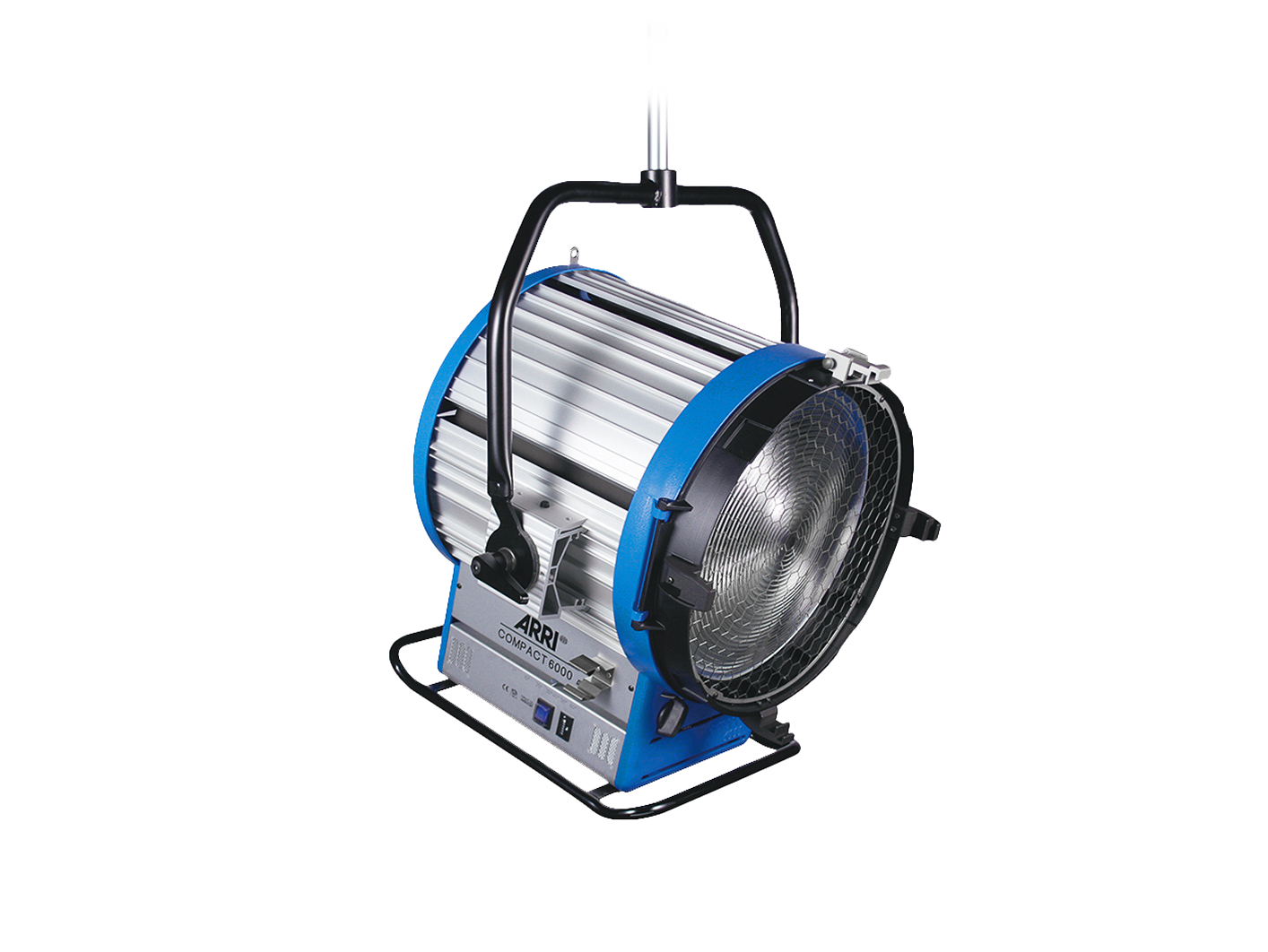
The ARRI Compact 6000 Plus is a 6 kW single-ended daylight Fresnel with a 420 mm front lens. Its adjustable beam is useful for hard sunlight effects, controlled light through windows, large bounces and lighting from a substantial throw. It is a traditional discharge-lamp system: the head, compatible ballast, head cable and suitable electrical distribution form one working package.
ARRI now lists the Compact range in its discontinued daylight archive. Discontinued does not establish the condition or capability of an individual rental or used fixture. The later archive poster and September 2010 instructions list different weights and lamp-base descriptions; those details matter when identifying an older head.
Key specifications
| Specification | Details |
|---|---|
| Fixture type | Single-ended daylight Fresnel; 6000 W lamp class |
| Front lens | 420 mm / 16.6 inches |
| Published focus examples | 5.0° spot, 31.0° medium and 58.0° flood in the archive poster |
| Poster model identification | L1.75720.B, international VEAM configuration |
| Lamp/base identification | 6000 W/SE; archive poster lists GX38, 2010 instructions list G38—verify the actual head and approved lamp |
| Dimensions in archive poster | 790 × 694 × 590 mm / 31.1 × 27.3 × 23.2 inches |
| Head mass in archive poster | Approximately 31 kg; older 2010 instructions state 35 kg |
| Packed mass in archive poster | Approximately 39 kg; not a head-only figure |
| Mount | 28 mm / 1⅛-inch junior spigot |
| Listed ballast families | EB 6/9 and EB 6/12; verify exact ballast revision and head compatibility |
| Accessory sizes listed | 495 mm and 510 mm; match the actual holder and accessory |
| Protection | Class I protective earth; IP23 |
| Operating limits | 45°C maximum ambient; 200°C maximum exterior surface; tilt ±90° |
| Minimum clearances | 12 m to the illuminated surface; 1.5 m around the luminaire in the poster |

Strengths and limitations
Strengths
- A hard daylight source supports throw, bounce and large diffusion.
- Matched ballast options support production control.
Limitations
- Lamp, reflector or lens and ballast must be specified as a complete system.
- High-speed performance depends on the actual lamp, ballast mode and camera test.
Practical uses
A large Fresnel is a useful choice when a production needs adjustable hard light with familiar barn-door and scrim control. It can establish a daylight direction through a window, create a defined edge from a distance or supply a large bounce. Increasing the apparent source size with a bounce or diffusion changes the result and reduces the available illumination at the subject.
Mechanical spot-to-flood adjustment changes coverage without exchanging the converter lenses required by a conventional PAR. Barn doors control spill but are not the imaging shutters of a profile spotlight. For a sharp projected window pattern, specify suitable imaging optics or a separate pattern-making arrangement rather than assuming the Fresnel can focus a gobo.
| Setup | Working approach |
|---|---|
| Window or exterior push | Choose beam coverage and throw before calculating the required circuit and rig. |
| Large diffusion | Meter the useful lit area after diffusion and allow for transmission loss. |
Output and colour
The manufacturer poster provides the following centre readings and beam diameters for the Compact 6000 Plus. These are a specific published configuration, not guaranteed readings for every ageing lamp, reflector or head. The narrow spot concentrates the source into a small area; compare the illuminated diameter as well as the lux figure.
| Setting | At 12 m: centre / diameter | At 15 m: centre / diameter |
|---|---|---|
| Spot, 5.0° | 32,986 lux / 1.05 m | 21,111 lux / 1.31 m |
| Medium, 31.0° | 4,167 lux / 6.66 m | 2,667 lux / 8.32 m |
| Flood, 58.0° | 2,153 lux / 13.30 m | 1,378 lux / 16.63 m |
Power and batteries
Match the lamp or head, supply voltage and power hardware to the specifications above. Include cables and any separate ballast or controller when planning the complete system.
Control, cooling and camera operation
The lamp does not run directly from a wall outlet. Use an approved ballast, correct head cable and distribution sized for that ballast. ARRI lists EB 6/9 and EB 6/12 families for the archived head. The Basic Ballasts technical poster specifies 180–250 V mains for its EB 6/9 version; a low lamp operating voltage is not permission to plug a 6K system into an ordinary 120 V circuit.
Read the actual ballast nameplate for input current, connector, supply and operating limits. A multi-wattage ballast’s maximum input rating may apply to its largest supported lamp, so neither the 6000 W lamp label nor a generic online kit figure is a complete circuit calculation. Include cable, distribution and protective-earth requirements in the rental specification.
The documented Basic ballast modes include 75 Hz flicker-free and 50/60 Hz low-noise operation, with 50–100% nominal lamp-power adjustment. That is not LED-style dimming to black, and it does not establish high-frame-rate performance for every shutter and camera. Identify the ballast, operating frequency and lamp condition, then test the intended camera settings.
Modifiers, rigging and the working package
The 2010 manual identifies the Plus as the successor to the earlier Compact 6000, describing a separated technical cassette, revised igniter connections and a stainless-steel safety mesh. A plain Compact 6000 should not automatically be advertised with every Plus detail.
The same manual lists a 35 kg head and a G38 lamp, while the later archive poster lists approximately 31 kg and GX38. These are meaningful documentation differences. Check the serial-specific instructions, lamp holder, identification plate and approved replacement lamp with the supplier. Do not assume two base descriptions are interchangeable, and weigh the actual rigging package when the head generation is uncertain.
The manual requires the Fresnel lens, safety mesh and reflector to remain installed and prohibits bypassing the lens-door safety switch. Discharge lamps involve high ignition voltage and UV protection as well as heat. Isolate the head as instructed and let the lamp cool before relamping; never operate a damaged or incomplete enclosure.
The specified twelve-metre lit-surface clearance makes this a substantial-distance fixture. Maintain the additional clearances, ventilation and permissible tilt for the actual unit. Use a properly rated stand or overhead suspension, suitable secondary retention and allowance for accessories and cable load. A 31–35 kg head is only one part of the mounted system.
Alternatives and related fixtures
Inspect the lens, mesh, reflector, lamp holder and lock, door latch/interlock, focus travel, stirrup, spigot, cable and ballast connectors. Burned contacts, cracked optics or a binding focus mechanism can turn a low purchase price into an expensive repair. Establish electrical condition with a qualified technician before testing output, and meter with an identified serviceable lamp.
A modern daylight reflector head or high-output LED may change transport, colour control, power and service requirements. Compare a complete package at the needed throw and beam size, including diffusion losses. The Compact’s value is its large conventional Fresnel beam and existing infrastructure, not an unsupported claim that it equals every other fixture carrying a similar wattage label.
| Fixture | Choose it for |
|---|---|
| ARRI M-Series | Compare the exact lamp class, reflector and compatible ballast. |
| High-output LED spotlight | A different power, dimming and modifier system; compare coverage as well as centre lux. |
What people are saying
Michael McInerney: HMI-system instruction
Michael McInerney’s ARRI HMI instructional video demonstrates HMI-system operation. Use it as family context and match the Compact 6000’s actual lamp, ballast, protective glass and electrical instructions to the supplied package. View the source.
Videos
ARRI Compact 6000 Plus: family guide
A demonstration or system guide; use the exact model’s lamp and ballast documentation.
Rental and used-fixture checks
Check the exact model and revision, complete power package, mounting hardware and control leads. Inspect lamp holders, protective glass and ballast connections. Test the intended operating level, fade and camera settings before rigging.
Documentation and specifications
Official discontinued Compact family page, technical and photometric poster, September 2010 Plus instructions and ARRI Basic ballast specifications.
Product photograph: ARRI official Compact 6000 Plus product photograph.
Browse Arri lights · HMI lights · all equipment.