
Last Updated 12 hours ago
Overview
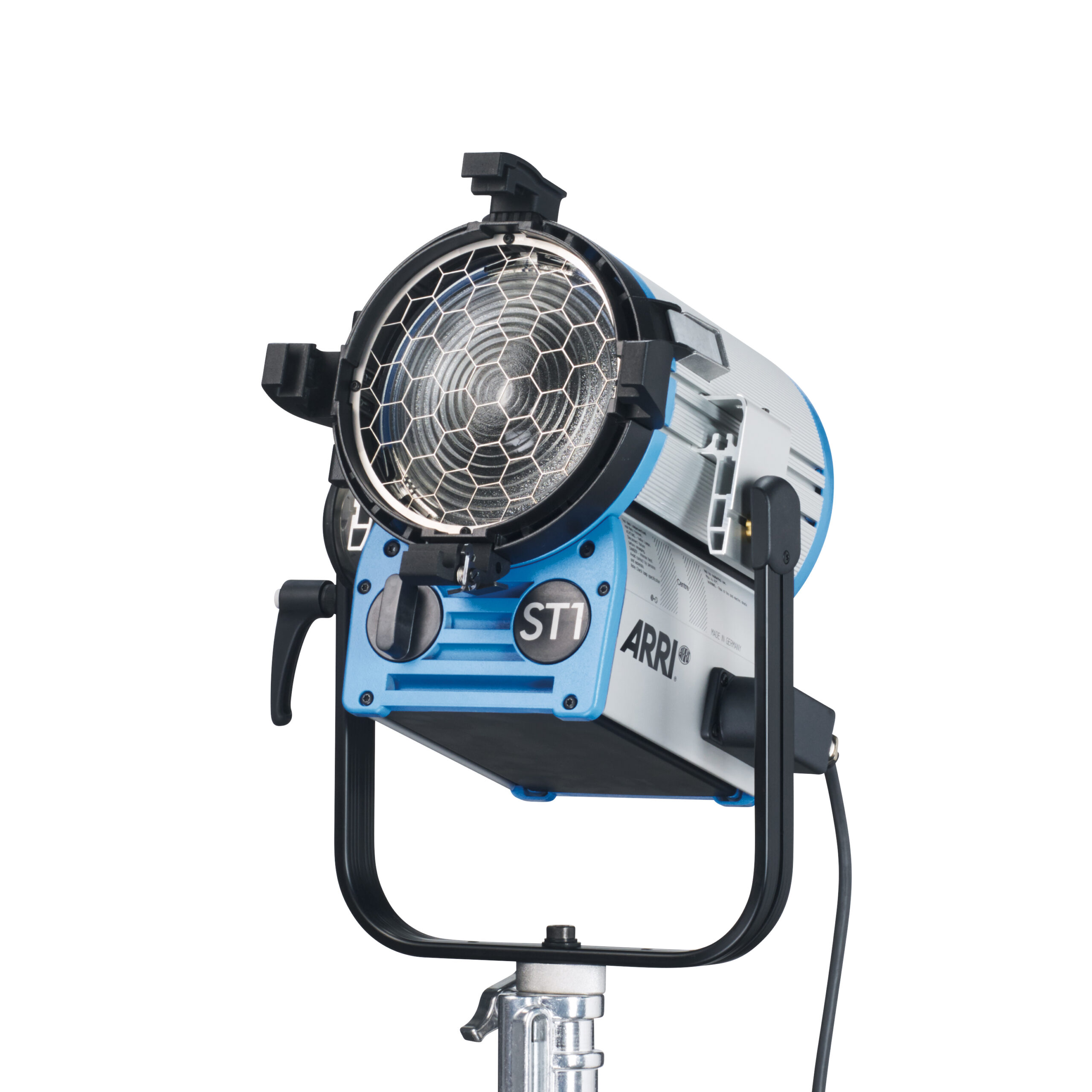
The ARRI True Blue ST1 is a 1,000W tungsten Fresnel built around a 175mm lens for studio keys, backlights and controlled stage coverage. Its larger studio lens and optional pole operation distinguish it from the more compact True Blue T1. It is a conventional lamphead: colour is set by the tungsten lamp and operating voltage, while remote intensity control comes from an external dimmer.
Key specifications
| Specification | Details |
|---|---|
| Fixture type | Tungsten Fresnel |
| Lamp options | 230V CP40 / CP71 1,000W in the current product listing |
| Lamp base | G22 |
| Operating voltage | Version-dependent 120V or 230V lamps; match the fitted lamp to the supply |
| Nominal colour | 3,200K at the lamp’s rated operating voltage; dims warmer |
| Fresnel lens | 175mm |
| Focus range | 8.3°–53° |
| Lamphead / version weight | 6.5kg manual / 8kg pole-operated in the family poster; the product page rounds net weight to 7kg |
| Mounting | 28mm junior spigot |
| Scrim / barndoor | 230mm / 245mm |
| Dimming / control | External tungsten-compatible dimmer; no internal DMX receiver |
| Protection | Class I; IP23 |
| Dimensions (H × W × L) | 398 x 362 x 325 mm excluding pin; product-page reference |
Technical reference: ARRI specifications.
Strengths and limitations
- Strengths: a conventional focusable Fresnel field, a replaceable tungsten lamp and predictable warming during a dimmer cue.
- Trade-offs: substantial heat and electrical consumption for the light produced; no internal colour mixing, wireless receiver or electronic tint adjustment.
Practical uses
| Setup | Working approach |
|---|---|
| Studio key | Use the Fresnel at a suitable distance for an even, directional key. Set focus for the actor’s full working area; use a separately supported diffusion frame when a softer result is required. |
| Backlight from a grid | A pole-operated version allows pan and tilt from below. Confirm the actual yoke and studio latch arrangement before planning a lighting-grid installation. |
| Warm pool or background | Shape a selective area with barn doors and a flag. Scrims reduce level without the pronounced warming that comes from dimming the filament. |
Output and colour
The ARRI family photometric poster gives these nominal values at 5m for the 1,000W nominal configuration. The focus angles describe the poster’s photometric configurations; they can differ from the rounded travel range on the product page.
| Focus / beam | Centre illuminance | Beam diameter |
|---|---|---|
| Spot / 8.4° | 5,988 lux | 0.73m |
| Medium / 30° | 1,560 lux | 2.68m |
| Flood / 53° | 732 lux | 4.99m |
The narrow spot reading describes a smaller field. Use the beam diameter and the required coverage alongside illuminance, especially when feeding a diffusion frame. The poster does not identify every lamp code or test-voltage detail; a differently lamped rental unit needs its own meter check.
Tungsten produces a continuous spectrum, but its colour depends on filament temperature. Electrical dimming lowers output and warms the light. Use scrims, a suitable neutral-density arrangement or a change in distance when maintaining the lamp’s rated colour is more important than dimming from the console.
Correcting tungsten to daylight with full CTB costs a substantial amount of light. Compare the finished corrected source with an HMI or daylight LED at the subject, rather than comparing the uncorrected lamp’s wattage or peak lux.
Power and lamp requirements
Version-dependent 120V or 230V lamps; match the fitted lamp to the supply. Fit a lamp whose voltage, wattage, base and approved operating position match the specific head. A 120V lamp must not be connected to a 230V supply simply because a family listing covers both markets.
These are resistive tungsten loads controlled from a suitable supply and external dimmer, without an HMI ballast. The lamphead does not contain an auto-ranging LED power supply. The connector, cable, dimmer and distribution must be rated for the fitted lamp.
For scale, 1,000W ÷ 120V is approximately 8.3A at rated full power. This is a nominal steady-state calculation for that lamp voltage, not a circuit recommendation; tungsten inrush and dimmer/distribution limits remain part of the installation.
Control, cooling and camera operation
Intensity is controlled by the external dimming system. A DMX dimmer rack can provide console control, but a DMX cable does not connect directly to this lamphead. Focus, tilt and barn-door shaping remain mechanical.
Keep the ventilation path open and leave room for hot air around the head. The fixture itself has no cooling fan; vibration, filament noise or the external dimmer can still be relevant on a quiet stage. Check any visible flicker at the intended shutter and frame rate.
Manual and pole-operated versions differ in the yoke and available pan/tilt operation. Pole operation does not add motorized focus or an internal wireless control system. Confirm the actual model rather than assuming all ST heads in a rental inventory have the same controls.
Modifiers, rigging and the working package
| Item | What to specify |
|---|---|
| Front accessories | 230mm scrims and 245mm barn-door reference for this head. Similar wattage does not guarantee a matching accessory frame. |
| Soft light | Use a heat-rated, explicitly compatible bank or a separately supported bounce/diffusion frame. Include the correct speedring where required. |
| Support and clearance | Choose the support for the head, front accessories and leverage at the required tilt. Keep the supply cable clear throughout movement. |
| Lamp and spares | Include the correct lamp code and voltage, any required adapter, and an appropriate spare for location work. |
ARRI’s family reference specifies a minimum 2.5m to the illuminated surface and 0.5m around the fixture. The current lamphead label and manual control the actual installation. Keep hot-light accessories clear of the lamp and allow cooling before handling or packing.
Alternatives and related fixtures
| Fixture | Why compare it |
|---|---|
| ARRI True Blue T1 | A related head with a different lens, power class or optical design; compare the actual modifier, output and support package. |
| ARRI Orbiter | Colour-tunable LED control and an interchangeable optical system where heat, mains load or rapid colour changes drive the choice. |
| ARRI L7-C Plus | A focusable full-colour LED Fresnel for lower-power studio work and electronic colour control. |
| ARRI True Blue ST2/3 | The larger studio Fresnel accepts approved 2kW/3kW configurations in its 230V version. |
Manufacturer and handling notes
ARRI’s ST-Series presentation shows the studio family and its handling features. When comparing a rental package, the useful distinctions are the actual manual or pole-operated yoke, front accessory sizes and lamp configuration. Manufacturer demonstrations should be read alongside the exact-model tables rather than treated as independent output tests.
Videos
ARRI: introducing the True Blue ST Series. Manufacturer family demonstration covering studio Fresnel handling.
Rental and used-fixture checks
- Check the lamp code, voltage, wattage and lamp-holder configuration against the actual fixture label.
- Inspect the lens or protective glass, mesh, reflector, holder and front latch; reject cracked protection or heat-damaged wiring.
- Run the full focus and tilt range, then check the lock with the intended front accessories fitted.
- For a pole-operated head, test the pan and tilt controls under the conditions in which it will hang.
- Check the cable, connector, earth continuity and external dimmer through the rental house’s normal electrical inspection; include a spare lamp and cooling time in the package.
Documentation and specifications
- ARRI True Blue ST1 specifications and downloads
- ARRI True Blue ST & ST Theater – Overview Poster
- ARRI True Blue T1, 2, 5 and ST 1, 2, 2-3, 5 – Manual
- ARRI True Blue ST1 – Photometric Files (IES) 120V Jun2011
Browse ARRI lights · tungsten lights · all equipment.