
Last Updated 12 hours ago
Overview
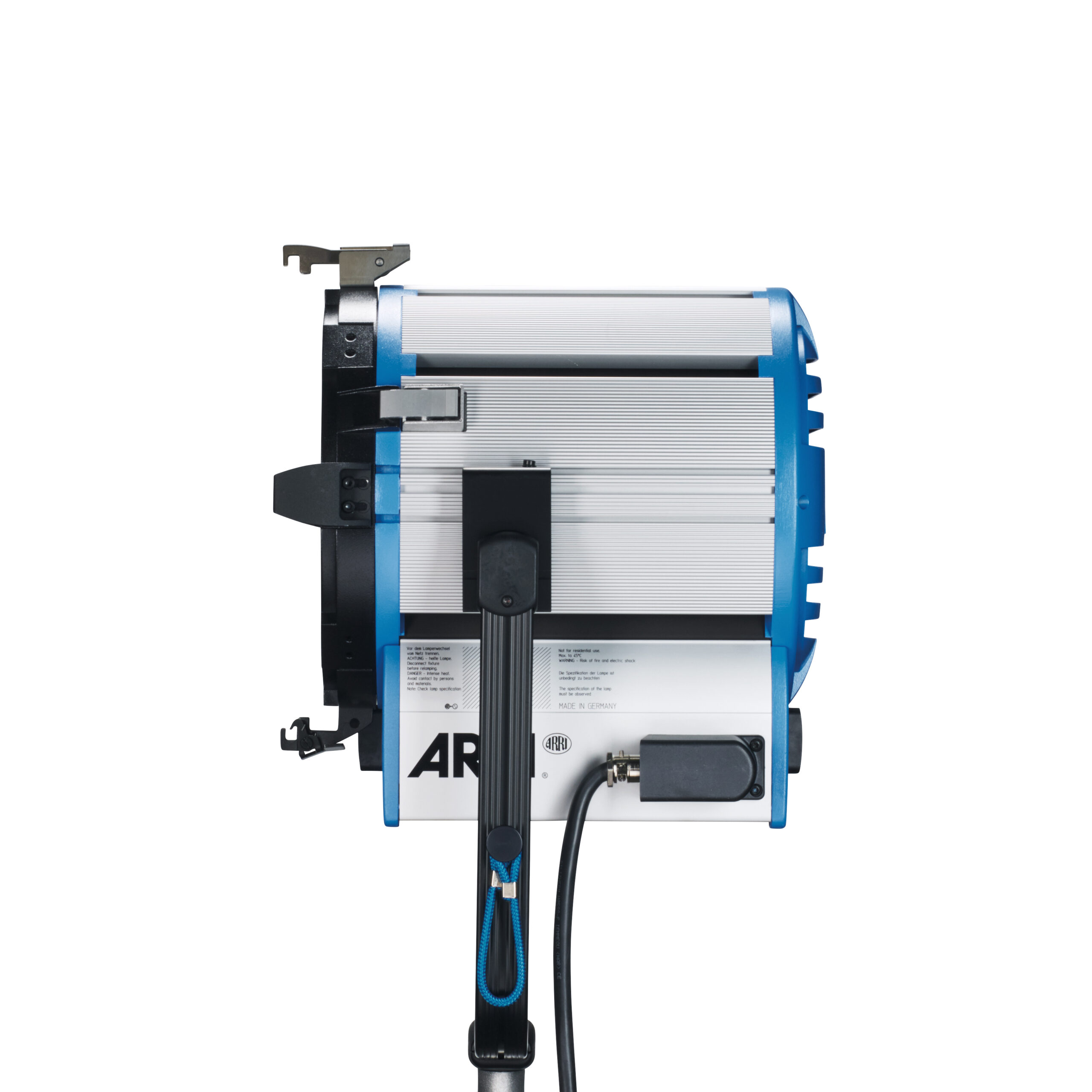
The ARRI True Blue T5 is a 5,000 W tungsten Fresnel designed for larger keys, hard backlight, motivated window light and feeding sizeable bounce or diffusion surfaces. The 250 mm lens and mechanical focus give it a very different role from a small interview lamp: this is a substantial hot-light source with a substantial power requirement.
The True Blue design includes cross-cooling, a sliding stirrup, positive tilt locking and adjustable accessory brackets. This is the T5 location-style lamphead, not the larger ST5 studio model or an LED conversion. Manufacturer figures are separated for manual and pole-operated versions where provided.
Key specifications
| Specification | Details |
|---|---|
| Source / rated lamp power | 5,000 W tungsten-halogen Fresnel |
| Lamp base / catalogue options | G38; CP/29 or CP/85 5,000 W 230 V listed; 120 V versions also noted |
| Lens | 250 mm Fresnel |
| Photometric settings | 15.5° spot, 30° medium, 50.6° flood |
| Control | Mechanical focus; external suitable tungsten dimmer |
| Manual / pole-operated mass | Approximately 12.0 / 15.5 kg respectively |
| Manual dimensions, H × W × L | 540 × 464 × 390 mm, including flange |
| Pole-operated dimensions, H × W × L | 548 × 446 × 390 mm, as listed in the overview |
| Mount | 28 mm / 1-1/8-inch junior spigot |
| Accessory diameters | 330 / 344 mm, depending on accessory |
| Protection | IP23; Class I protective earth |
| Maximum ambient / surface temperature | 45°C ambient; 220°C surface |
| Inclination | Maximum 45° up or down; also observe the approved lamp’s limits |
| Safe distances | 5 m to illuminated surface; 1 m around the luminaire |
Strengths and limitations
Strengths
- A continuous tungsten source gives direct, visible control of the lighting effect.
- Lamp and accessory choices adapt the source to its job.
Limitations
- Heat and electrical load remain central to placement and circuit planning.
- Dimming changes colour; lamp code, voltage and fixture limits must match.
Practical uses
A T5 provides reserve when a smaller Fresnel cannot maintain the required level after a bounce or diffusion frame. It can make a controlled shaft through a window, a broad hard edge over a group, or a warm source positioned well back from the action. Its larger lens and output do not automatically make it soft: apparent source size at the subject remains the deciding factor.
When lighting a diffusion frame, spread the beam to use the intended area of the material and check for a centre hotspot. The highest spot reading is irrelevant if it illuminates only a small patch of a large frame. For a hard-light look, barn doors and external flags let the fixture contribute direction without washing adjacent surfaces.
| Setup | Working approach |
|---|---|
| Controlled key or accent | Choose focus or diffusion for the intended shadow and trim spill with compatible accessories. |
| Warm practical motivation | Meter at the chosen dimmer setting and balance colour through the camera. |
Output and colour
The True Blue T-series technical overview publishes these nominal centre readings and coverage figures. Record the focus setting when comparing the T5 with an LED Fresnel or another 5 kW tungsten head: the narrowest beam reading alone does not describe performance across a set.
| Focus | At 5 m | Diameter at 5 m | At 10 m |
|---|---|---|---|
| Spot, 15.5° | 14,920 lux | 1.36 m | 3,730 lux |
| Medium, 30° | 7,984 lux | 2.68 m | 1,996 lux |
| Flood, 50.6° | 4,632 lux | 4.73 m | 1,158 lux |
Power and batteries
At nominal full lamp power, 5,000 W is approximately 41.7 A at 120 V or 21.7 A at 230 V, calculated as P/V. This belongs on properly planned set distribution with compatible connectors, cable and dimming equipment. Do not assume a head can run from a normal convenience outlet because a seller has fitted an adapter.
The 230 V lamp options in ARRI’s current overview are not a complete identification of every used T5. ARRI also notes 120 V versions. Match the installed G38 globe, rated voltage, wiring assembly and fixture label before operation. Lamp wattage is a maximum operating class, not permission to fit a different base or an unapproved globe.
Electrical dimming is simple with a correctly rated tungsten dimmer, but it changes colour as well as brightness. For a fixed-colour output adjustment, a wire scrim or a change in lighting geometry may be preferable. There is no internal RGB engine or native DMX interface to patch; a console addresses the external dimmer, if one is used.
Control, cooling and camera operation
Use the documented control arrangement for this exact lamphead and power system. Check dimming behaviour, camera settings and thermal conditions at the intended working level.
Modifiers, rigging and the working package
The manufacturer’s accessory families include 330 and 344 mm sizes, four- and eight-leaf barn doors, scrims, snoot and compatible lightbank hardware. Specify the actual T5 interface when ordering: an ST5 or a different manufacturer’s 5 kW head may use another size. Scrim and modifier retention should be checked before the light is raised.
Balance the assembly using the sliding stirrup and secure the tilt lock with the full front load fitted. Include the power cable, barn doors and modifier in support calculations. A manual lamphead weighs about 12 kg, while the overview’s pole-operated figure is about 15.5 kg; neither is the full transport package. A junior spigot requires an appropriate receiver and support system.
A particularly important distinction is the 45° maximum upward or downward inclination in the T5 overview. The T2’s 90° figure must not be copied across to this head. Observe any tighter globe-specific burning-position requirement as well. Tilting a hot lamp beyond its approved orientation is not a way to solve an inconvenient rigging position.
ARRI specifies five metres to the illuminated surface, one metre around the luminaire, a 45°C ambient limit and up to 220°C surface temperature. Keep ventilation open, allow cooling before handling or relamping, and use the correct protective components. IP23 describes the lamphead’s protection classification; it does not remove the need to follow the manual for environmental use.
Alternatives and related fixtures
Inspect the lens, front latch, scrim retainers and protective screen, then the focus travel, yoke attachment, stirrup adjustment and tilt lock. Electrical inspection should include the socket, protective earth, connector condition, cable insulation and strain relief. Have evidence of overheated contacts or improvised wiring assessed before energising the fixture.
A T2 can be a better choice when its output is sufficient and the larger lamp’s distribution, heat or clearances become a burden. A high-output LED spotlight may simplify colour changes and reduce the load, but compare beam coverage and output through the intended accessories. An HMI offers a daylight source with a separate ballast and its own handling requirements. None is an exact replacement solely because a marketing description mentions ‘5 kW’.
| Fixture | Choose it for |
|---|---|
| ARRI LED L-Series | A colour-adjustable Fresnel with different operating and control hardware. |
| A supported soft-light system | A larger diffused emitting area when a hard source is not required. |
| ARRI True Blue ST5 | A studio-oriented 5kW Fresnel with a larger lens and different front accessories. |
| ARRI STUDIO T12 | A larger 10/12kW tungsten Fresnel where a distant key or large bounce needs more exposure. |
What people are saying
ARRI: operating the tungsten Fresnel
ARRI’s training presentation introduces the True Blue T5 and its working format. It provides a practical companion to the exact fixture’s lamp, focus, clearance and accessory specifications. View the source.
Videos
ARRI True Blue T5: family guide
A tungsten-family demonstration; confirm the fixture and lamp configuration shown.
Rental and used-fixture checks
Check the exact model and revision, complete power package, mounting hardware and control leads. Inspect lamp holders, protective glass and ballast connections. Test the intended operating level, fade and camera settings before rigging.
Documentation and specifications
ARRI product information, technical overview and photometrics and operating manual. Read the document for the exact lamphead and regional version in use.
Product photograph: ARRI, via its official product page.
Browse Arri lights · tungsten lights · all equipment.