
Last Updated 2 days ago
Overview
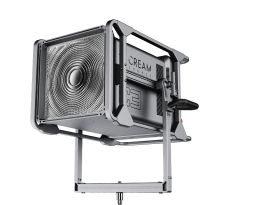
The Creamsource C3 is a 3,000W full-colour LED Fresnel with a fixed square lens and a moving light engine. Motorised focus adjusts the beam from an 18° spot to a 60° flood, with an integrated power supply and an IP65-rated housing.

Creamsource identifies the published specifications as preliminary. Ordering is listed to begin in November 2026; that does not establish local stock or a delivery date. The preliminary head weight is 45kg without its yoke.
Key specifications
| Specification | Details |
|---|---|
| Specification status | Preliminary manufacturer figures |
| Power / LED engine | 3,000W / BCGLARD seven-colour |
| Emitters | Blue, cyan, green, lime, amber, red, deep red |
| White-light range | 2,200–15,000K with tint adjustment |
| Colour modes | CCT, hue/saturation, x,y, gels, calibrated RGBW, effects |
| Focus | Motorised 18° spot–60° flood; manual or DMX operation |
| Typical colour metrics | CRI 98; TLCI 98; TM-30 Rf 96 / Rg 100 |
| Head mass | 45kg excluding yoke |
| Dimensions | 855 × 515 × 500mm |
| Protection | IP65 |
| Data / control | Onboard, 5-pin DMX, TimoTwo CRMX/BLE, dual etherCON, USB, remote option |
| High-speed claim | Over 5,000fps in High Speed mode; camera-sync input |
Strengths and limitations
Strengths
- A dedicated focusing optical system allows beam size to become part of a lighting cue.
- Full-colour operation avoids adding colour gel for many effects and white-light adjustments.
- The integrated cage and square face are designed to support array applications.
Limitations
- The preliminary 45kg head excludes the yoke and accessories.
- A 3,000W fixture needs an appropriate electrical feed; ordinary 120V, 15A power cannot supply full load.
- Pre-production demonstrations do not establish final production noise, mass or sustained output.
Practical uses
| Setup | Working approach |
|---|---|
| Distant hard source | Choose spot or flood according to the required coverage. Check both field uniformity and shadow quality on the set. |
| Large bounce or diffusion | Fill the complete surface before comparing exposure. A strong spot reading is unhelpful if only the centre of a large frame is illuminated. |
| Focus cue | Rehearse the motorised focus move with dimming and colour. A focus change alters both the pool size and its centre exposure. |
Output and colour
| Preliminary focus setting | Distance | Illuminance |
|---|---|---|
| Full spot, 18° | 10m | 10,000 lux |
| Full flood, 60° | 10m | 1,500 lux |
Creamsource publishes these endpoint figures without a CCT label in its preliminary table. Do not silently attach a daylight setting or treat interpolated values from the website’s beam visualiser as measured photometrics. Final output should be checked with the production data sheet and actual fixture.
For saturated colours, judge the result on the production camera and actual set materials. A white-light CRI figure does not describe the exposure or spectral behaviour of every colour cue. Record the chosen colour mode, values and modifier for repeat setups.
Power and batteries
The published 3,000W rating calls for a suitably rated supply and distribution plan. Confirm final input voltage, connector, current and any power-limiting modes on the delivered unit. Those details are not established by the preliminary table used here.
Control, cooling and camera operation
Focus can be operated locally or through DMX alongside level and colour. Include the focus channel and any control settings in the console patch before programming. When matching a Vortex package, confirm colour-space and white-light settings rather than copying an unqualified hue value.
High Speed operation and shutter-synchronised flashing are separate operating choices. Treat the advertised high-speed capability as a mode-specific manufacturer claim and test the final camera configuration. Newsshooter’s IBC interview describes a pre-production liquid-cooling system; final noise performance still needs checking.
Modifiers, rigging and the working package
The square Fresnel, integrated cage and LNX arrangement form a dedicated rigging and optical system. Use final C3 accessory and rigging documentation when specifying barn doors, yoke or an array. Include the head, support, modifier and cable loading when planning the complete assembly.
Alternatives and related fixtures
| Fixture | When to compare it |
|---|---|
| Vortex24 | A large multi-zone hard panel with different shadows and beam control. |
| ARRI Orbiter | A smaller full-colour system built around interchangeable optics; compare the fitted package rather than wattage alone. |
What people are saying
Erik Naso, Newsshooter: IBC first look
Naso’s direct interview with Creamsource’s Jim Amorosino covers the moving-source design and pre-production cooling. The report identifies the displayed unit as preliminary and gives a Q2 2027 delivery target from the interview, separate from the November 2026 ordering date. View the source.
Videos
Creamsource’s Chang’e short film demonstrates the C3 in a production context; it is not an independent measurement test.
Ordering and production-unit checks
- Confirm that the supplier is offering a delivered production fixture rather than an allocation or demonstration unit.
- Check final input requirements, all-up weight, accessory compatibility and software documentation.
- Test focus travel, cue repeatability, sound and thermal behaviour after warm-up.
- Obtain production photometrics with CCT and focus settings before committing to a critical long-throw setup.
Documentation and specifications
Product images and technical illustrations: Creamsource. Paired-model photographs show both optical versions; kit photographs include accessories that vary by package.
Related Creamsource fixtures: Creamsource Vortex24 Soft.
Browse Creamsource lights · all equipment.