
Last Updated 7 hours ago
Overview
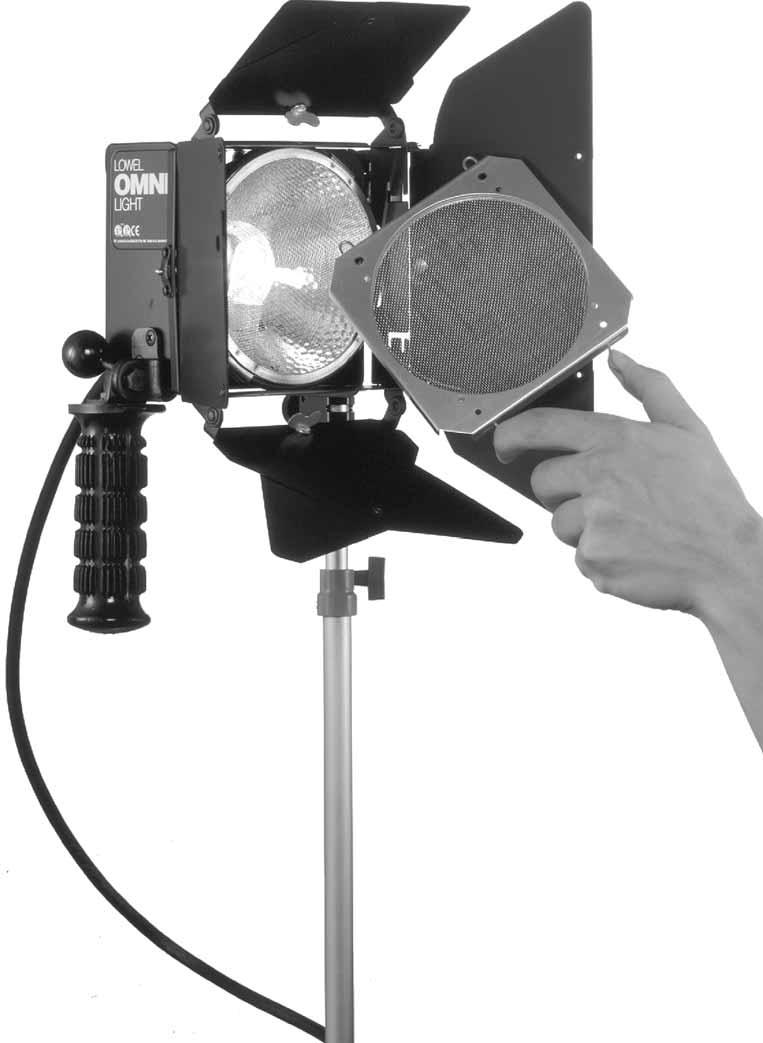
The Lowel Omni-light is a compact focusable open-face tungsten-halogen light for keys, backlight, backgrounds and indirect soft sources. Its interchangeable reflector and small no-yoke body made it a versatile companion to the wider Tota in traditional location kits.
This is the original up-to-500 W Omni, not an LED product and not a Fresnel. The lamp moves relative to the reflector to change the field, and an optional super-spot reflector provides another optical configuration. Correct lamp, reflector, protective front component and supply voltage all matter to the published performance.
Key specifications
| Specification | Details |
|---|---|
| Source / maximum power | Focusable open-face tungsten-halogen; 500 W at the documented mains voltages |
| Normal optical system | Double-parabolic peened reflector; approximately 6:1 focus range with FTK lamp |
| 120 V lamp examples | FTK 500 W; EKB 420 W; approved 300 W option listed |
| Regional / low-voltage options | Specific 230/240 V, 30 V and 12 V lamps require their correct supply and cable |
| Standard FTK colour | 3200 K at rated operation |
| Fixture mass | 1.7 lb / 771 g without cable; 2.6 lb with 16 ft cable |
| Body envelope shown | Approximately 8 × 5½ × 3 inches, depending on handle and accessory position |
| Mount | 5/8-inch or smaller stud, as documented |
| Control | Mechanical focus, inline switch and suitable external tungsten dimmer |
| Tilt mechanism | Constant-tension; travel with accessories is not an unrestricted operating-orientation approval |
| Required front protection | Protective screen or documented protective front accessory arrangement |
| Lamp orientation | Filament horizontal in the instructions |
| Umbrella restriction | Do not use spot focus with the umbrella accessory |
| Optical variants | Normal reflector versus optional super-spot reflector; different output figures |
Strengths and limitations
| Strength | Limitation |
|---|---|
| A continuous tungsten source gives direct, visible control of the lighting effect. | Heat and electrical load remain central to placement and circuit planning. |
| Lamp and accessory choices adapt the source to its job. | Dimming changes colour; lamp code, voltage and fixture limits must match. |
Practical uses
The Omni can provide a hard key, a controlled edge or a small background pool with very little body volume. Flood it to feed a suitable umbrella or bounce, or use the correct reflector configuration for a longer, tighter throw. It is useful when source placement matters more than built-in electronic features.
It does not have the same optical system or cut behaviour as a Fresnel. Barn doors and flags control spill, but a sharp projected pattern requires appropriate projection optics. The source becomes soft when bounce or diffusion enlarges its apparent emitting area at the subject, rather than simply because an umbrella has been placed somewhere in front.
| Setup | Working approach |
|---|---|
| Controlled key or accent | Choose focus or diffusion for the intended shadow and trim spill with compatible accessories. |
| Warm practical motivation | Meter at the chosen dimmer setting and balance colour through the camera. |
Output and colour
The Omni instructions give these readings at ten feet with the stated lamp. The super-spot column is a different accessory-reflector configuration, not the same standard reflector focused a little further.
| Lamp / supply | Flood | Spot | Super-spot |
|---|---|---|---|
| FTK 500 W, 120 V | 75 fc | 475 fc | 920 fc |
| EKB 420 W, 120 V | 66 fc | 390 fc | 753 fc |
| GCY 500 W, 230 V | 75 fc | 295 fc | 490 fc |
Power and batteries
Lowel documents several mains and low-voltage lamps. A battery option requires the correct lamp and cable, not merely plugging an FTK mains globe into a low-voltage connector. The fixture is not a regulated universal input device, and an adapter does not convert lamp voltage.
At 500 W and 120 V, the nominal lamp current is about 4.2 A. Low-voltage configurations can draw much higher current for their wattage, which is why the manual’s maximum-current number should not be presented as ordinary mains consumption. Read the selected lamp row, power source and cable ratings together. Disconnect and cool the unit before relamping or changing the reflector.
Control, cooling and camera operation
Electrical dimming is available with a suitable tungsten dimmer, but output becomes warmer as filament voltage falls. Wire attenuation, geometry or another approved lamp can be preferable when retaining a particular colour balance matters. Lowel’s chart also shows that different approved lamps can have different full-voltage colour and focus behaviour.
Check which reflector is fitted to a used Omni before claiming the high super-spot reading. Reflector condition and lamp seating affect the beam. A replacement part described simply as ‘Omni reflector’ may not be the normal or super-spot version intended for the shot.
Modifiers, rigging and the working package
The operating instructions require protective front components and warn about hot fragments, heat and ultraviolet exposure from close direct use. Keep the lamp away from people and sensitive or flammable materials, preserve ventilation and observe the filament orientation. A damaged or missing screen is a reason to repair the head before use.
Lowel specifically says not to focus the Omni to spot when using its umbrella accessory. Concentrating energy on the material can damage it. Use the proper accessory, spacing and operating setup rather than adapting a fabric modifier designed only for a cool LED. Let the lamp cool before storage, lens handling or reflector work.
Alternatives and related fixtures
Inspect the reflector, lamp contacts, protective screen, front accessory retention, focusing mechanism, stand fitting and tilt tension. Test the switch and correct cable assembly, and have damaged insulation, earth or contacts serviced. Seat an approved lamp fully with the supply disconnected; poor contact can damage both socket and lamp.
A complete healthy Omni is still useful for a small owner-operated tungsten kit, especially when its narrow hard-light role is understood. A Tota covers a wider area, a DP supplies a larger open-face lamp class, and a small Fresnel offers a different field. Modern LED spotlights simplify colour and battery use; an Omni LED conversion needs the replacement system’s own electrical and output documentation.
| Fixture | Choose it for |
|---|---|
| ARRI LED L-Series | A colour-adjustable Fresnel with different operating and control hardware. |
| A supported soft-light system | A larger diffused emitting area when a hard source is not required. |
What people are saying
Tom Morrow: portability and support
In the DV Info discussion, Tom Morrow values Lowel kit portability but prefers stronger support stands for regular production work. View the source.
Videos
Lowel Omni-light (Tungsten): family guide
Lowel kit chapters: Omni 4:57, Tota 15:50, Pro-light 25:00.
Rental and used-fixture checks
Check the exact model and revision, complete power package, mounting hardware and control leads. Inspect lamp holders, protective glass and ballast connections. Test the intended operating level, fade and camera settings before rigging.
Documentation and specifications
Original manufacturer instructions, hosted archive copy, Lowel catalogue with lamp and output tables and Tiffen/Lowel’s guide to using the lighting system. Confirm the actual unit’s revision, installed lamp and electrical condition before use.
Product photograph: Lowel, original manufacturer catalogue photograph.
Browse Lowel lights · tungsten lights · all equipment.