
Last Updated 2 hours ago
Overview
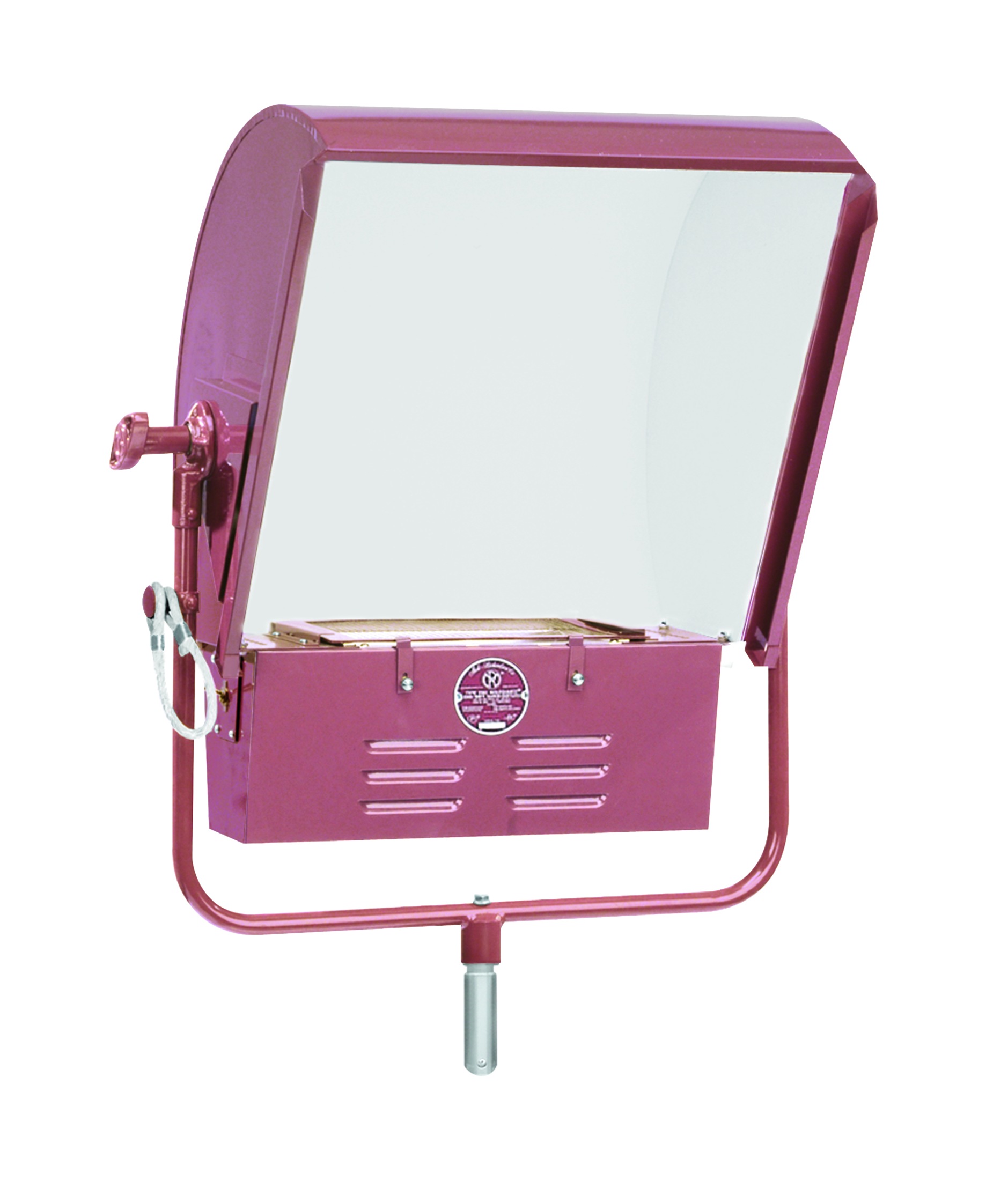
The Type 2551 hides a single 1 kW quartz lamp in a trough and sends the light back through an 18-inch-square opening. At 6 ft it delivers 135 fc at the centre of an 8.4 ft field. The subject sees the reflecting hood as the source.
Key specifications
| Specification | Type 2551 |
|---|---|
| Rated load | 1,000 W maximum, 8.3 A at 120 V |
| Lamp positions | 1 × 1 kW maximum, recessed single contacts |
| Light-emitting aperture | 18 × 18 in. |
| Weight with cable | 24 lb |
| Reflector | Specular aluminium lamp trough and diffuse reflecting hood |
| Mount | Removable 1⅛-inch junior pin |
| Standard cable | 25 ft attached lead |
Replacement lamps
| Lamp | Power | Voltage | Rated colour | Finish | Rated life |
|---|---|---|---|---|---|
| FCM | 1,000 W | 120 V | 3,200 K | Clear | 400 h |
| FHM | 1,000 W | 120 V | 3,200 K | Frosted | 400 h |
| EME | 800 W | 240 V | 3,200 K | Clear | 250 h |
| EMF | 800 W | 240 V | 3,200 K | Frosted | 250 h |
| EJG | 750 W | 120 V | 3,200 K | Clear | 400 h |
| EMD | 750 W | 120 V | 3,200 K | Frosted | 400 h |
| FDF | 500 W | 120 V | 3,200 K | Clear | 400 h |
| FDN | 500 W | 120 V | 3,200 K | Frosted | 400 h |
| FCL | 500 W | 120 V | 3,000 K | Clear | 2000 h |
| FCZ | 500 W | 120 V | 3,000 K | Frosted | 2000 h |
| EHM | 300 W | 120 V | 2,950 K | Clear | 2000 h |
| EHZ | 300 W | 120 V | 2,950 K | Frosted | 2000 h |
Mole specifies T-3 double-ended globes, 4 11/16 in. overall, operated horizontally within 4°. The current and colour temperature depend on the installed lamp. See the FCM lamp lookup.
Strengths and limitations
- The 18 × 18 in. opening gives one continuous reflection on polished surfaces.
- One lamp gives one full-power setting. To reduce exposure while keeping the lamp at rated voltage, add diffusion or move the head and check the new coverage.
Practical uses
For a tabletop or a close interview, watch the reflection of the hood in the product or the subject’s glasses. Moving the whole head a few inches can take that reflection off an unwanted surface while keeping the fill level usable.
Output and photometrics
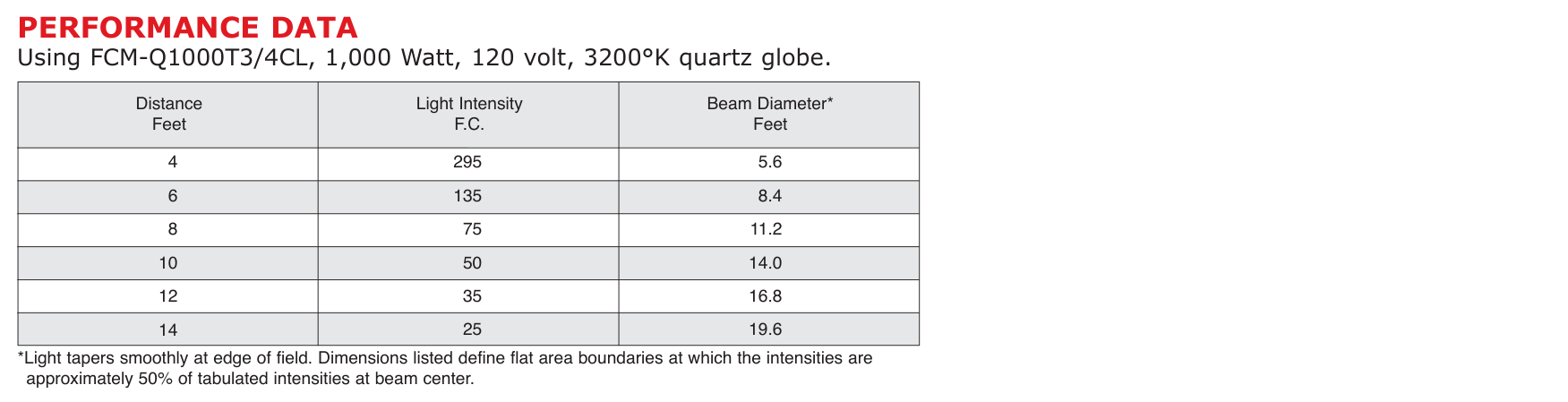
The figures are centre-beam foot-candles. Field diameter is the width at approximately half the centre intensity. The chart covers the full head with 1 × 1,000 W, 120 V FCM lamp.
| Distance | Centre (fc) | Field diameter |
|---|---|---|
| 4 ft | 295 | 5.6 ft |
| 6 ft | 135 | 8.4 ft |
| 8 ft | 75 | 11.2 ft |
| 10 ft | 50 | 14 ft |
| 12 ft | 35 | 16.8 ft |
| 14 ft | 25 | 19.6 ft |
Photometric & exposure calculator
Estimate centre-beam illumination and the corresponding camera aperture from this fixture’s published measurements.
Estimated output
Select a configuration to calculate.
Manufacturer readings are for the stated optic, colour setting and full output, measured at the beam centre. Values between measured distances are interpolated. Point-source values outside those distances are approximate inverse-square estimates; large sources cannot be reliably extrapolated and are limited to their measured range. Exposure uses frame rate, shutter angle, ISO and the selected incident-meter calibration. Only the optics and diffusion explicitly listed in the measurement are included; additional modifiers, bounce, beam edges, ambient light, ND filters and camera exposure-index differences are not accounted for. Confirm critical exposures on set with a meter. Photometric source
Power and controls
The catalogue rates this head for 120/240 V AC or DC. The full-load figure of 8.3 A assumes 120 V lamps on a 120 V supply. One toggle controls the lamp. The 800 W EME and EMF in the lamp table are 240 V globes.
Optics and mounting
The Type 3575 egg crate limits light leaving the hood at an angle. Mole also lists the Type 25530 diffuser frame and Type 25550 two-leaf light shield. Match the accessory to the model number because the three Super-Softlites have different front dimensions.
Comparable fixture
The 2 kW Super-Softlite uses a 24 × 24 in. aperture and 2 lamp positions. Mole-Richardson 2 kW Super-Softlite (Type 2561).
Field coverage and further reading
B&H identifies the one-lamp 2551 and its indirect reflecting system. The 18-inch aperture is also how Mole distinguishes this head from the 24-inch two-lamp version. B&H fixture listing.
Rental and used-fixture checks
Inspect the white hood for discoloration and the trough for dents. Check that the front screen is intact. A mark on the hood can be more visible in a glossy product than on a meter.
Documentation
- Manufacturer’s fixture and accessory page
- Original Mole-Richardson specification and photometric sheet
- Mole-Richardson equipment catalogue
Back to contents · Mole-Richardson fixtures · Tungsten lights