
Last Updated 2 days ago
Overview
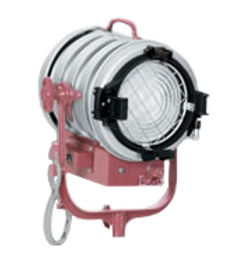
The Mole-Richardson 6-inch Baby Solarspot, Type 3081, is a 1,000 W tungsten Fresnel built for keys, edges and controlled hard light on location or in a studio. It combines a six-inch lens, a ventilated aluminium body and front/rear paddle focus controls with a 5/8-inch baby mounting system.
‘Baby’ describes a familiar family name, not a guarantee of lens size or interchangeable parts. This guide covers the six-inch 3081, rather than the smaller Baby-Baby or a different vintage 1 kW model. The standard Type 55 lens and optional Type 4131 cold lens have different performance charts and should be identified before comparing output.
Key specifications
| Specification | Details |
|---|---|
| Head / maximum lamp power | Type 3081; 1,000 W tungsten-halogen |
| Lamp socket | Medium bipost; approved lamp geometry required |
| 120 V lamp examples | EGT 1,000 W; EGR 750 W; EGN 500 W |
| Light-centre length | 2½ inches in the manufacturer’s lamp table |
| Lamp burning position | Within 45° of vertical base-down for the listed lamps |
| Lens / stated field angle | 6-inch Fresnel; 15–58° in the specification |
| Lens configurations in output chart | Type 55 standard hot lens; Type 4131 accessory cold lens |
| Switch / focus | Trough-mounted toggle; front/rear paddle focus handles |
| Mount | 5/8-inch baby receiver |
| Size, manufacturer order | 10¼ × 11⅝ × 11½ inches |
| Head weight with cable | 12¾ lb / approximately 5.8 kg |
| Typical listed cable | 25 ft, three-conductor #16/3; inspect the actual assembly |
| Scrim / diffuser family | 6⅝-inch accessories |
| Safety component | Protective safety screen described by the manufacturer |
Strengths and limitations
Strengths
- A continuous tungsten source gives direct, visible control of the lighting effect.
- Lamp and accessory choices adapt the source to its job.
Limitations
- Heat and electrical load remain central to placement and circuit planning.
- Dimming changes colour; lamp code, voltage and fixture limits must match.
Practical uses
The six-inch Baby works well as a directional key, a clean backlight or a source aimed into a bounce where a smaller 650 W lamp runs out of level. The focus range lets the same head cover a larger area or concentrate on a smaller feature. It remains a hard-light instrument until diffusion or bounce creates a larger apparent source.
For a product or a textured background, a Fresnel can reveal shape without flooding the entire room. On a face, moving the lamp and changing its angle often matter more than reaching immediately for a softer modifier. Barn doors keep spill under control, while external flags provide cuts positioned for the scene. Do not expect the barn doors to project a sharp window frame.
Inspect the six-inch Fresnel for cracks and identify which lens is installed. Check the front door, hinge, latch and accessory retention, then run the focus carriage through its full travel. The paddle controls should move the assembly positively without excessive play or binding.
Electrical condition matters more than a clean maroon paint finish. Look for overheated contacts, a brittle cable, missing strain relief, a damaged switch or altered earthing, and have defects serviced before operation. Ask for the lamp, barn doors, scrims and proper cable to be listed separately in a used sale. A modern LED spotlight may be a better purchase when colour control and lower operating heat matter more than the traditional Fresnel beam.
| Setup | Working approach |
|---|---|
| Controlled key or accent | Choose focus or diffusion for the intended shadow and trim spill with compatible accessories. |
| Warm practical motivation | Meter at the chosen dimmer setting and balance colour through the camera. |
Output and colour
The original Type 3081 performance chart uses an EGT 1,000 W, 120 V, 3200 K globe. It supplies separate values for the standard and cold lenses. ‘Cold lens’ here identifies the optical configuration; it does not mean an LED conversion or a housing that is safe to touch.
| Distance | Standard Type 55: flood / spot | Accessory Type 4131: flood / spot |
|---|---|---|
| 10 ft / 3.05 m | 180 / 1,720 fc | 130 / 600 fc |
| 20 ft / 6.10 m | 45 / 440 fc | 30 / 165 fc |
| 30 ft / 9.14 m | 20 / 195 fc | 15 / 70 fc |
Power and batteries
The 120 V lamp table lists EGT at 1,000 W, EGR at 750 W and EGN at 500 W. These are optical and electrical choices, not interchangeable labels for any bipost globe. Match the base, light-centre length, voltage, power and permitted burning position to the head and manufacturer’s instructions.
At 1,000 W and 120 V, the nominal lamp load is approximately 8.3 A. The web page’s 120/240 V fixture rating does not make an installed 120 V EGT lamp suitable for 240 V. Check the actual regional lamp and wiring configuration. Count the rest of the package on the same supply and use a properly rated dimmer, connector and distribution arrangement.
Control, cooling and camera operation
Electrical dimming warms a tungsten filament as the level falls. That is useful for some practical-motivated looks and fades, but it changes the colour relationship to daylight or regulated LED fixtures. A wire scrim reduces output without the deliberate colour shift caused by reducing lamp voltage.
The standard output table is a 3200 K lamp test, not a promise of that colour at every dimmer setting or with every substitute globe. Daylight conversion filters consume output and may change the available beam level substantially. Check the final setup after the lens, gel, scrim and diffusion have all been selected.
Modifiers, rigging and the working package
The listed 6⅝-inch family includes full and half scrims, barn doors, snoots and a diffuser frame. The Type 55 and 4131 lens options are particularly important on a used head because the lens changes the beam. An accessory carrying the number 4131 should not be confused with the separate Type 4131 Baby Junior lamphead.
The head weighs 12¾ lb including cable in the original sheet, before the complete working accessory load. Use an appropriate stand, manage the trailing cable and secure accessories properly. Keep the protective screen intact and ventilation unobstructed. Disconnect the supply and allow cooling before changing a lamp, lens or internal part.
Alternatives and related fixtures
| Fixture | Choose it for |
|---|---|
| ARRI LED L-Series | A colour-adjustable Fresnel with different operating and control hardware. |
| A supported soft-light system | A larger diffused emitting area when a hard source is not required. |
What people are saying
Neil Oseman: tungsten Fresnel roles
Neil Oseman’s tungsten-lighting guide uses a Mole-Richardson 1K Baby as a Fresnel example and explains the role of focusable hard sources. It is family context rather than a measured test of every Baby size. View the source.
Videos
Mole-Richardson 6-inch Baby 1K (Type 3081): family guide
Related-model review: the smaller Tweenie 650 W. Its lamp, power and photometry differ from the Baby models.
Rental and used-fixture checks
Check the exact model and revision, complete power package, mounting hardware and control leads. Inspect lamp holders, protective glass and ballast connections. Test the intended operating level, fade and camera settings before rigging.
Documentation and specifications
Manufacturer product page, original specification and performance chart and a working rental inventory containing traditional Mole fixtures. The rental listing is context for continued availability, not the source of the numerical specifications.
Product photograph: Mole-Richardson, official product photograph.
Browse Mole-Richardson lights · tungsten lights · all equipment.