
Last Updated 2 days ago
Overview
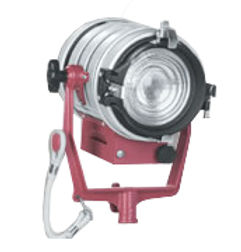
The Mole-Richardson Tweenie II, Type 4821, is a 650 W tungsten Fresnel used for compact keys, backlights, kickers and controlled background illumination. Its maroon body, approximately 4½-inch lens and baby receiver make it a familiar small location head. It provides a focusable hard source with straightforward mechanical controls and replaceable quartz-halogen lamps.
‘Tweenie’ is often used loosely on set, so identify the actual fixture. This is the 4821 Tweenie II Fresnel, not the 650 W Teenie-Mole open-face light, a different older head or a modern LED conversion. The exact lamp, lens, socket and cable condition determine whether an inexpensive used unit is genuinely useful.
Key specifications
| Specification | Details |
|---|---|
| Manufacturer type | 4821 Tweenie II Solarspot |
| Maximum lamp power | 650 W tungsten-halogen |
| Approved 120 V lamp examples | FRK 650 W; FRG 500 W; FKW 300 W, with 1.83-inch light-centre length |
| Other lamp voltages in the archival chart | 230 / 240 V options; select the listed code matching the supply |
| Socket | Two-pin prefocus |
| Lens / stated field angle | 4-15/32-inch Fresnel; 17–70° field angle |
| Focus / control | Front and rear focus knobs; inline switch; suitable external tungsten dimmer |
| Mount | 5/8-inch / 16 mm baby receiver |
| Accessory family | 5-1/8-inch scrims, diffuser frames and snoots listed |
| Construction | Ventilated aluminium channel body with maroon finish |
| Archival sheet mass | 7¼ lb including cable; the web page lists 6¾ lb |
| Dimensions / revisions | Manufacturer web and archival dimensions differ; verify the actual head for case or rig planning |
Strengths and limitations
Strengths
- A continuous tungsten source gives direct, visible control of the lighting effect.
- Lamp and accessory choices adapt the source to its job.
Limitations
- Heat and electrical load remain central to placement and circuit planning.
- Dimming changes colour; lamp code, voltage and fixture limits must match.
Practical uses
The Tweenie II is useful for a shoulder edge, a controlled pool on a background or a modest hard key in a tungsten-lit interior. The Fresnel lens makes the beam easier to shape than an unmodified open-face source, while the small body is manageable on an appropriate baby stand. Front and rear focus controls help when access to one end is obstructed.
Spotting increases centre intensity by concentrating coverage. Flooding is often the better starting point for even illumination of a bounce or diffusion frame, although 650 W gives limited reserve through large or dense materials. A barn door manages spill; a flag or projection system is needed when a scene calls for a more precise cut than the Fresnel geometry can produce.
| Setup | Working approach |
|---|---|
| Controlled key or accent | Choose focus or diffusion for the intended shadow and trim spill with compatible accessories. |
| Warm practical motivation | Meter at the chosen dimmer setting and balance colour through the camera. |
Output and colour
The Type 4821 chart was produced with an FRK 650 W, 120 V, 3200 K quartz lamp. Values below are foot-candles at beam centre. Mole defines the listed beam dimensions at approximately 50% of the centre intensity; that is not necessarily the same boundary as a quoted field angle.
| Distance | Full flood | Minimum spot | Flood / spot diameter |
|---|---|---|---|
| 10 ft / 3.05 m | 78 fc | 660 fc | 11.3 / 1.4 ft |
| 15 ft / 4.57 m | 30 fc | 315 fc | 17.3 / 2.3 ft |
| 20 ft / 6.10 m | 18 fc | 180 fc | 22.7 / 3.0 ft |
A conventional tungsten dimmer offers a smooth fade while making the light warmer at lower voltage. Where the colour must remain consistent, use wire scrims, distance or a lower approved lamp instead. Relamping is a disconnected, cooled-down operation; it is not a method for quick adjustments while the head remains live.
Mole lists a 5-1/8-inch accessory family, including full and half single/double scrims, diffuser frames, snoots and barn doors. Check the actual holder and retainers before buying missing accessories. The 650 W Teenie-Mole’s name and wattage do not establish that its accessories fit the Tweenie II. Conversion gel also reduces output, so daylight-corrected use should be judged after the gel is fitted.
Power and batteries
The archival sheet lists FRK, FRG and FKW options for 120 V operation, with corresponding regional alternatives in its lamp table. The base and 1.83-inch light-centre length matter as well as wattage. Do not substitute a globe merely because its pins enter the socket, and do not use a lamp above the fixture’s 650 W rating.
The 650 W lamp load is approximately 5.4 A at 120 V. A correctly specified 650 W lamp for a higher supply voltage has a lower current, but the fixture does not convert voltage automatically. Check the lamp code, cable, plug and any dimmer as one system. Follow the globe table’s burning-position requirement, including its instruction to keep the filament coil horizontal.
Control, cooling and camera operation
Use the documented control arrangement for this exact lamphead and power system. Check dimming behaviour, camera settings and thermal conditions at the intended working level.
Modifiers, rigging and the working package
This is a hot quartz-halogen fixture. Keep the ventilation channels clear, maintain the clearances required by its instructions and lamp, secure the support and let the head cool before packing or relamping. Use heat-rated accessories; do not enclose the front in fabric intended only for a cool LED source.
The ARRI 650 Plus is a comparable traditional wattage class with different mechanics and accessory sizes. A compact LED spotlight is usually easier for batteries, low heat and colour adjustment. Choose the Tweenie for the beam and workflow it actually supplies, rather than expecting a small used tungsten head to offer those electronic conveniences.
Alternatives and related fixtures
| Fixture | Choose it for |
|---|---|
| ARRI LED L-Series | A colour-adjustable Fresnel with different operating and control hardware. |
| A supported soft-light system | A larger diffused emitting area when a hard source is not required. |
What people are saying
Josh Hall: the Tweenie Fresnel
Josh Hall reviews a Mole-Richardson Tweenie 650 W Fresnel as a used tungsten-light option. Identify the exact Tweenie revision, lamp and accessories when comparing the demonstration with a Type 4821 package. View the source.
Videos
Mole-Richardson Tweenie II 650W (Type 4821): family guide
A demonstration of the named tungsten family; confirm the actual type plate and lamp.
Rental and used-fixture checks
The current manufacturer page and linked archival sheet disagree on weight and dimensions: the page gives 6¾ lb with cable, while the sheet gives 7¼ lb and a different envelope. Those figures should not be silently merged into one supposedly exact specification. Use the model plate and measure the actual example if clearance, case fit or rig load is important.
Inspect the Fresnel, front door, safety components, accessory latch and both focus controls. Check the socket for worn or heat-damaged contacts and the cable for brittleness, failed strain relief or improvised repairs. Have an appropriate electrical inspection confirm the earth and wiring condition. A head that illuminates can still be unsafe or optically poor.
Documentation and specifications
Manufacturer product page, original specification and performance chart and a working rental inventory containing traditional Mole fixtures. The rental listing is context for continued availability, not the source of the numerical specifications.
Product photograph: Mole-Richardson, official product photograph.
Browse Mole-Richardson lights · tungsten lights · all equipment.