
Last Updated 2 days ago
Overview
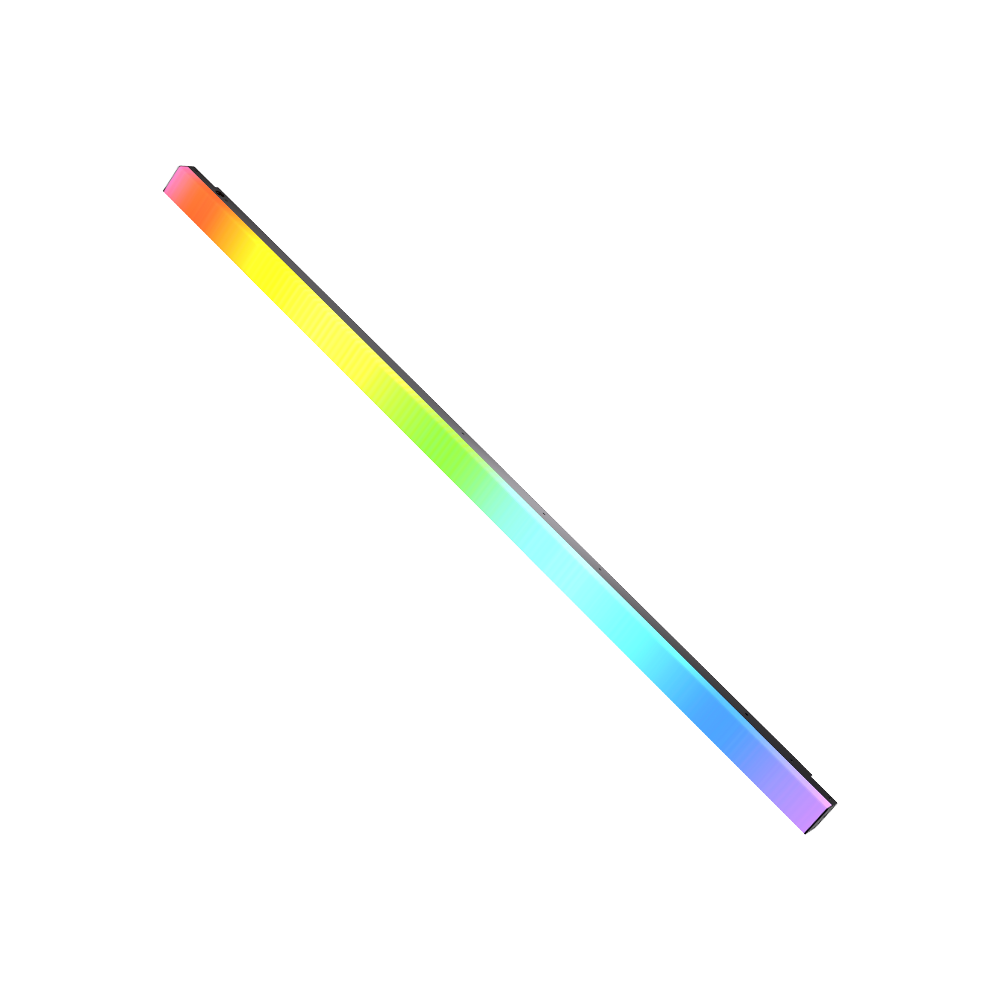
The Aputure INFINIBAR PB12 is a 4ft rectangular pixel bar with an internal battery, a narrow diffused face and a rail-based mounting system. It combines a uniform-light mode with individually controllable pixels for effects, visible set elements and compact lighting arrays.
The PB12 is the four-foot INFINIBAR, providing the longest continuous line and highest pixel count in the original PB3/PB6/PB12 family. It suits visible linear elements, long reflections and close edge-light work where a small bar would leave an obvious gap.
Key specifications
| Specification | Details |
|---|---|
| Nominal length / physical pixels | 4ft / 96; up to 48 controllable pixels over DMX |
| Single-pixel / multi-pixel engine | RGBWW / RGB, as listed by Aputure |
| White-light CCT | 2,000–10,000K |
| Single-pixel CRI / TLCI | 96+ / 98+ |
| Single-pixel SSI | 85 tungsten; 74 D5600 |
| LED output | 27W |
| Maximum fixture / supply consumption | 36.5W / 40W |
| Fixture input | 24V DC |
| Internal battery | 59.2Wh |
| Maximum-output runtime | Approximately 80 minutes, manufacturer figure |
| Beam angle | 120° half-peak |
| Dimensions | 120.4 × 4.5 × 4.3cm |
| Fixture weight | 1.96kg |
| Weather rating | IP20 |
| Operating temperature | −10°C to +45°C |
| Cooling | Passive |
| Control | Onboard, Sidus Link, DMX/RDM, CRMX |
Strengths and limitations
Strengths
- A flat 4ft face with 96 physical pixels suits visible lines and smooth effects.
- Rail mounting and compatible connectors allow joined shapes with a continuous illuminated face.
- Internal battery, passive cooling and CRMX help with concealed placement.
Limitations
- Useful subject illumination depends on distance and mode; single-pixel white specifications do not describe every animated RGB look.
- A joined array needs its own support and power plan; connector hardware and modifiers add to the package.
- IP20 provides no rain protection, and wired DMX needs the specified active adapter.
Practical uses
Its extra length is useful around people and larger objects, but it also changes handling. Plan clearance through doorways, the position of the mounting clamp and the direction of cable pull. Several connected bars form a rig with a different leverage and support problem from one standalone unit.
The PB12 also suits compact interactive colour effects when the source can stay close to the receiving surface. For a travelling effect on a face, test whether the animation reads as the intended movement rather than as individual colour segments. Adding diffusion can blend the effect but uses exposure and space.
| Setup | Working approach |
|---|---|
| A long reflection or visible line | Use the four-foot face where a short bar would leave a gap in a reflection or visible set element; allow space for the complete support. |
| Connected set element | Use approved connectors and align the illuminated faces; conceal or manage power feeds from the camera position. |
| Moving colour interaction | Choose the intended pixel profile and test how the moving effect blends on the subject at the working distance. |
| Background practical | Expose for the glowing face, check clipping and run the intended cue through the production camera. |
Output and colour
The manufacturer publishes the following white-light centre readings. A bar can look bright in frame while delivering relatively little illumination at a distance; visible brightness and exposure on a subject are different questions.
| CCT | At 0.5m | At 1m |
|---|---|---|
| 3200K | 1410 lux | 542 lux |
| 5600K | 1600 lux | 593 lux |
| 10000K | 1510 lux | 563 lux |
Aputure’s current specification explicitly identifies RGBWW for single-pixel operation and RGB for multi-pixel operation. That distinction matters when changing between a white-light setup and a pixel effect: do not assume the white emitters or quoted single-pixel colour metrics apply identically to every multi-pixel look.
If a cue changes from an even white bar to an animated pattern, test both the colour and exposure on the production camera. A DMX profile with more channels offers more control; it does not by itself mean a more accurate white spectrum. Document the profile and operating mode with the cue.
Power and batteries
The listed battery capacity is 59.2Wh, with approximately 80 minutes at maximum output. That is a manufacturer runtime figure, not a guaranteed duration for every aged battery or ambient temperature. Build in a changeover margin when the fixture is difficult to reach.
The USB-C connection is used for supported data and firmware tasks; do not assume it is the normal charging input. The fixture’s power system is 24V DC. Use the correct supply and confirm charge status before hiding the unit in scenery. A light that remains controllable after external power fails may simply be running on its battery.
INFINIBAR connectors can join lights into straight lines and geometric shapes, with power passing through supported connections. A connected structure still needs a deliberate electrical plan. Adding the standalone fixture wattages and dividing a supply rating by that total can overlook line losses and the location of the power feed.
The official multi-light configuration guide provides separate allowances for open chains and closed loops. It also explains how central power injection changes the practical limit. Use its configuration tables for the actual mixture of PB3, PB6 and PB12 units.
Exceeding the supported power arrangement can leave some bars drawing from internal batteries. That can hide a distribution problem during a short prep and reveal it later in a long take or installation. Confirm sustained operation, not just that every bar initially illuminates.
Control, cooling and camera operation
Sidus Link provides Bluetooth-based setup and effects. CRMX receives a compatible wireless DMX system, while wired DMX/RDM requires the appropriate active USB-C-to-DMX adapter. Plan that adapter into the rental list rather than assuming full-size DMX sockets are built into the bar.
Use the current INFINIBAR DMX documentation to select the profile and channel footprint. Pixel count, channel count and number of universes are related but not interchangeable. Patch the actual mode, including dimmer and control channels, before committing to a large array.
The PB12 has 96 physical pixels. Aputure’s overview distinguishes 96 pixels in Sidus Link from 48 controllable pixels over DMX, and the current V2.0 DMX chart lists pixel profiles up to 48. Select the console profile from that chart rather than patching 96 independent DMX pixels from the physical pixel count.
Modifiers, rigging and the working package
The rail system, dedicated clamp, magnetic arrangements and connectors provide several ways to place the bars. Use the specified mounting hardware and account for the complete connected structure. A magnet holding a fixture on a convenient piece of steel is not a substitute for appropriate secondary restraint where a fall could injure someone.
Mixed-size arrays may need the supplied magnetic spacers to align their mounting surfaces. Inspect the complete shape from the camera position as well as from behind; a technically connected array can still have misaligned luminous faces or visible hardware.
IP20 means this is an indoor-style fixture, without a rain-protection claim. Keep it and its power accessories out of wet conditions unless a suitable protected setup is provided. Passive cooling removes a fan from the bar, but the external power system can still make noise.
The rectangular face and linkable construction distinguish INFINIBAR from round tubes such as the Astera Titan Tube. Compare visible shape, mounting, beam distribution and actual control requirements. For general distant illumination, a larger COB or panel is usually a more appropriate starting point than a line of small pixel bars.
Alternatives and related fixtures
| Fixture | Choose it for |
|---|---|
| Aputure INFINIBAR PB3 | Another bar length in the same connection and control family. |
| Aputure INFINIBAR PB6 | Change the length and pixel count to suit the visible shape and available clearance. |
| Astera Titan Tube | A round tube with a different beam, mounting system and power package. |
What people are saying
Graham Sheldon: seamless appearance, with a multi-light cost
Graham Sheldon tested the PB3, PB6 and PB12 and valued their seamless connected appearance. He saw large arrays as particularly useful for rental houses, stages and music or event work, with multi-unit cost a significant consideration for owners.
New Layer: the flat face and sliding rail are the main attractions
In a review covering PB3, PB6 and PB12, New Layer favours the flat luminous face for visible practicals and the rear rail for fine positioning. The review focuses on connected shapes and how the bars differ from conventional tubes.
Videos
Gaffer & Gear 235: INFINIBAR family
A review of the INFINIBAR system and its connected-bar design.
CineD: PB3, PB6 and PB12 review
Graham Sheldon reviews all three original sizes.
Rental and used-fixture checks
Inspect the rail, clamps, connector threads, DC sockets, display and luminous face. Check that the correct magnetic spacers and connector hardware are present for the planned shape. Repeated assembly can leave missing screws or damaged threads that are easy to overlook on an illuminated fixture.
Test uniform white and pixel effects through the intended control route. Check charging and sustained operation from external power, then disconnect power to confirm realistic battery endurance. An under-powered array can appear to work initially because the internal batteries are supplying part of the load.
Documentation and specifications
Official PB12 product page and downloads · INFINIBAR support and firmware · Multi-light power and connection guide.
Product photograph: Aputure.
Browse Aputure lights · LED tubes · all equipment.