
Last Updated 2 days ago
Overview
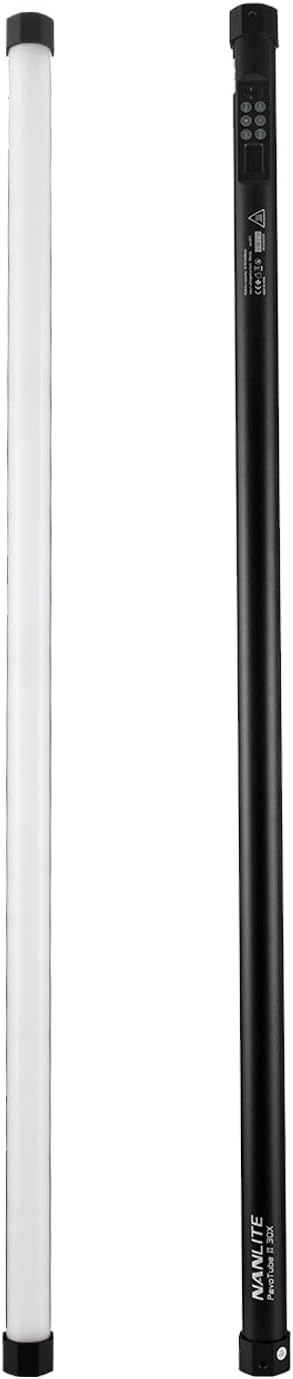
The Nanlite PavoTube II 30X is a roughly four-foot RGBWW LED tube with an internal battery and 16 controllable pixels. It provides white light, coloured accents and spatial effects in a source that can also appear directly in the frame.
The original 30X and the later 30XR are different control variants. The XR adds built-in LumenRadio CRMX. The original 30X has no built-in CRMX receiver.
Key specifications
| Specification | Details |
|---|---|
| Source | RGBWW pixel tube |
| Pixels | 16 |
| Rated power | 70W, manufacturer listing |
| CCT / tint | 2,700–12,000K with green/magenta adjustment |
| CRI / TLCI | 97 / 98 averages |
| Size | Ø43 × 1,145mm |
| Weight | Approximately 1.6kg; global table 1.58kg, Japan listing 1.56kg |
| DC adapter | 15V / 4A |
| AC adapter input | 100–240V, 50/60Hz |
| Battery | Built-in rechargeable pack |
| Nominal recharge | Approximately 2h, manufacturer Japan listing |
| Control | Onboard, Bluetooth NANLINK, 2.4G, wired DMX/RDM |
| Built-in CRMX | No on 30X; added on 30XR |
| Effects | 15 regular effects plus pixel-effect functions |
| Mounting | Three ¼in-20 mounting points; supported tube clips and hardware |
Strengths and limitations
Strengths
- An internal battery removes the power lead for mobile accents and visible practicals.
- The roughly four-foot tube and 16 sections suit visible linear effects.
- Wired DMX/RDM and NANLINK support remote control.
Limitations
- Charging, battery condition and colour-specific power draw affect usable runtime.
- The narrow emitting width gives a different shadow and reflection from a broad panel.
- The original X has no built-in CRMX; that feature belongs to XR.
Practical uses
Sixteen segments let a single tube display multiple colours or a moving effect. That can be useful as a visible set element, a scrolling reflection, an interactive light on a face or a simulated movement across scenery. The full-colour tube and a simple single-colour practical are different tools.
Test the result from the camera position. A smooth-looking effect by eye can read as individual segments in a reflection or at a short shutter time. A gradient inside the tube is also different from how that gradient blends on a surface some distance away.
| Setup | Working approach |
|---|---|
| Visible practical | Plan framing and exposure with the tube in shot so it retains the intended colour and surface detail. |
| Reflected highlight | Rotate and position the tube while watching its reflection; source length and distance determine the highlight shape. |
| Pixel interaction | Set the direction, timing and repeatability of the animation, then test at the actual camera frame rate and shutter. |
Output and colour
The manufacturer groups 30X and 30XR in the same output table. Selected readings are below. The control difference does not justify assigning XR radio hardware to the original model.
| Colour / CCT | At 1m | At 2m | At 3m |
|---|---|---|---|
| 3,200K | 688 lux | 175 lux | 78 lux |
| 5,600K | 746 lux | 189 lux | 84 lux |
| Red | 272 lux | 69 lux | 30 lux |
| Green | 586 lux | 144 lux | 64 lux |
| Blue | 123 lux | 31 lux | 14 lux |
For a recurring studio setup, record tube position, orientation, distance, mode, CCT or colour values, intensity and camera exposure. For a pixel cue, also record the pattern, speed and direction. Saving only a name such as “blue tube” leaves most of the setup undefined.
The 30X is most useful when its battery, shape and pixel control solve a placement or visual problem. Choose the XR when built-in CRMX is a requirement, and compare a different tube family when weather, mounting or a different visible shape matters more.
Power and batteries
The Japan product page quotes approximately two hours to charge and up to 26 hours of operation. That longest-duration claim is not a guarantee of 26 hours at maximum white brightness. The chosen brightness, colour, battery condition and temperature determine the useful shooting duration.
Test the exact look before a long take or inaccessible installation and leave a reserve. A tube’s visible brightness in the frame can need much less output than using it to illuminate a performer. That difference can substantially change battery requirements.
Use the specified adapter and charging arrangement. The 70W rated-power line and 15V/4A adapter specification are retained as the manufacturer publishes them; neither is converted into an invented LED-versus-wall-power breakdown.
Control, cooling and camera operation
NANLINK uses the supported Bluetooth workflow, while the 2.4G remote system is another route. Wired DMX/RDM requires the appropriate cable connection and profile. Include adapters and cables explicitly when assembling a console-controlled package.
Firmware matters for app connection and available behaviour. The original 30X manufacturer page retains update guidance, so check the actual firmware before troubleshooting a supposedly missing feature. Match the selected pixel mode and channel footprint to the console personality.
Modifiers, rigging and the working package
The tube offers threaded points on its ends and rear, plus supported clips and mounting accessories. Use the correct holder and suitable restraint where a fall would be hazardous. A tube balanced on furniture is not a secure lighting position.
A fabric barndoor/grid assembly can reduce spill; a multi-tube frame can build a larger apparent source. Confirm compatibility with the II 30X dimensions. A round tube’s long and short axes produce different shadow behaviour, so orientation is part of the lighting decision.
Do not assume an exposed tube or its connectors are rainproof because other professional tube products carry weather ratings. Follow the documented operating conditions and use a specifically supported protective housing where required. The battery does not remove environmental limits.
A tube is convenient for hiding along a set edge, lighting from a shelf or supplying a nearby coloured hit. Its output falls quickly with distance. If the job is a strong daylight push or a large distant bounce, a larger COB or panel is a more suitable starting point.
Alternatives and related fixtures
The manufacturer’s dedicated 30X FAQ identifies CRMX as the key addition on the XR, with the other listed lighting performance shared. A 30X can be used in a wired DMX workflow, but that is not a built-in wireless DMX receiver.
The PavoTube II 30C is a separate model family. Do not assume its dimensions, battery behaviour, pixel functions or accessories apply just because both names contain “30.” Record the full model on the equipment list.
| Fixture | Choose it for |
|---|---|
| PavoTube II 30XR | The corresponding XR model adds integrated CRMX. |
| Astera Titan Tube | A separate battery-tube control and accessory ecosystem; compare source length, output and the complete working kit. |
| PavoSlim 120C | A broader rectangular source when a tube’s narrow face is not the required reflection or shadow shape. |
What people are saying
Graham Sheldon: stronger controls and a useful upgrade
Sheldon’s field review of the 15X and 30X likes the reorganised buttons, extra mounting points, Bluetooth control and pixel functions. He found NANLINK quicker for effects than the tube menus. His reservations include first-party accessories and the firmware-update process on the review samples.
Videos
Gaffer & Gear 161: PavoTube II 30X
A technical review of the original four-foot X model.
Rental and used-fixture checks
Check the 30X label, battery runtime at the intended setting, supplied adapter and DC cable. Inspect the diffuser, end caps, buttons, mounting threads and clamps. Verify every required pixel mode and control channel; include the correct DMX adapter and independent retention for an overhead rig.
Documentation and specifications
Global X/XR specifications and output · Dedicated 30X manufacturer listing and FAQ · Manufacturer Japanese manual.
Product photograph: Nanlite.
Browse Nanlite lights · LED tubes · all equipment.