
Last Updated 2 days ago
Overview
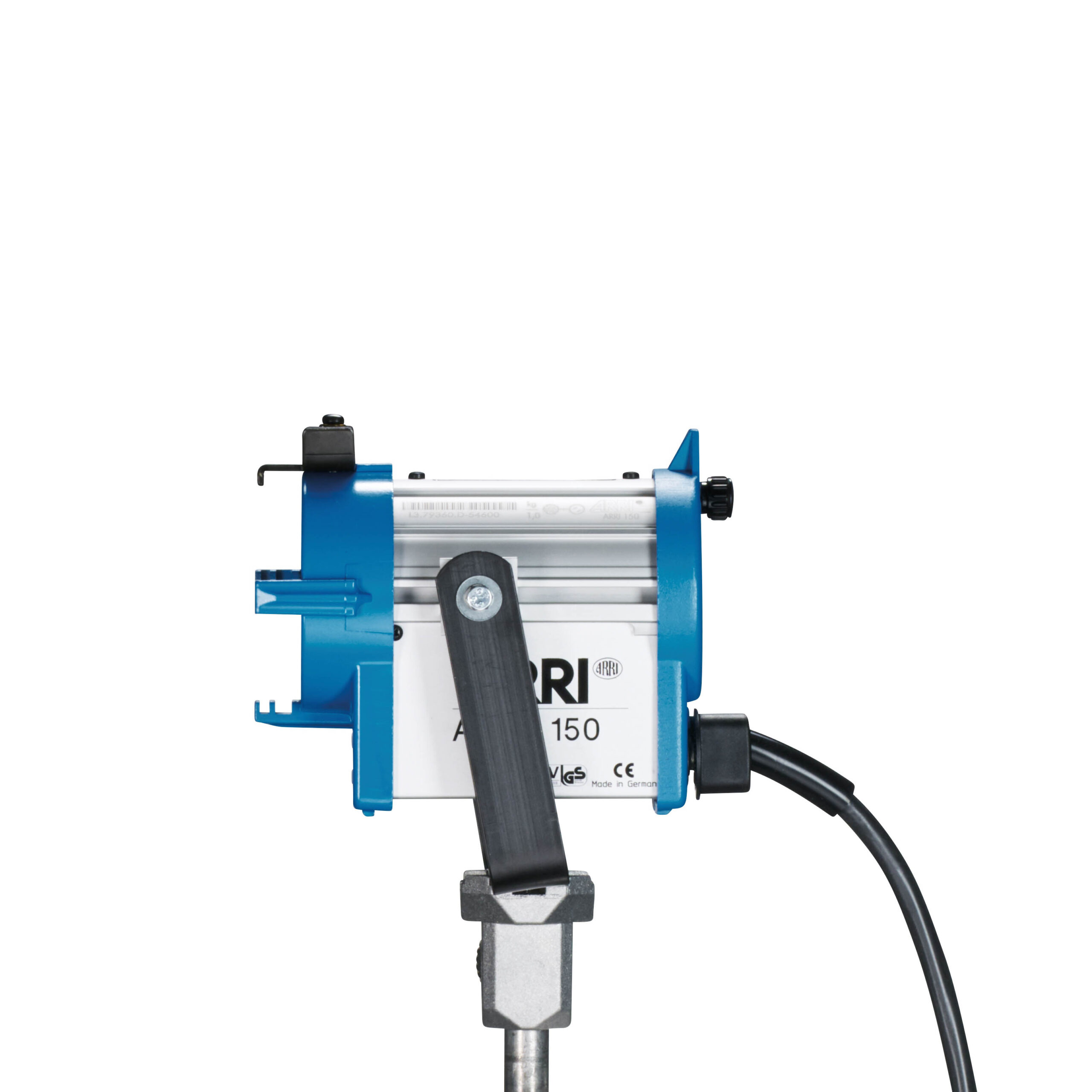
The ARRI 150 is a miniature tungsten Fresnel built for the small, controlled jobs that larger lamps make awkward: an edge on a face, a pool on a desk, a background highlight or a precise accent in a product shot. Its 50 mm lens, compact aluminium housing and mechanical focus make it a useful teaching fixture as well as a practical addition to an established lighting kit.
This is the conventional 150 W quartz-halogen lamphead, with a replaceable GX6.35 lamp. It is not an LED Fresnel and does not have electronic colour controls. Its attraction is straightforward optical control in a small package; the trade-offs are heat, lamp replacement and the need to match the globe to the supply voltage.
Key specifications
| Specification | Details |
|---|---|
| Source / maximum lamp power | Tungsten-halogen Fresnel; 150 W |
| Lamp base | GX6.35; use the approved lamp and voltage for the fixture |
| Lens / reflector | 50 mm glass Fresnel; spherical specular aluminium reflector |
| Published photometric settings | 14° spot, 30° medium and 44° flood in ARRI’s Junior overview |
| Control | Mechanical spot-to-flood focus; external compatible tungsten dimmer if required |
| Colour | Set by the installed tungsten lamp and operating voltage; electrical dimming warms the light |
| Mount | 16 mm / 5/8-inch baby receiver |
| Weight | Approximately 1.6 kg, manufacturer lamphead figure |
| Dimensions, H × W × L | 194 × 133 × 161 mm, including flange |
| Accessory diameter | 78 mm |
| Protection | IP20; Class I protective earth |
| Maximum ambient / surface temperature | 45°C ambient; up to 200°C surface temperature |
| Inclination | Up to 90° upward or downward, subject to the fitted lamp’s limits |
| Published safe distances | 0.9 m to illuminated surface; 0.5 m around the luminaire |
Strengths and limitations
Strengths
- A continuous tungsten source gives direct, visible control of the lighting effect.
- Lamp and accessory choices adapt the source to its job.
Limitations
- Heat and electrical load remain central to placement and circuit planning.
- Dimming changes colour; lamp code, voltage and fixture limits must match.
Practical uses
Use it when the illuminated area is small and its boundary matters. A tightly spotted 150 can pick out a bottle, put a highlight on a dark wall or separate a shoulder from a background without raising the whole room. Its short body is easier to position behind furniture than a larger 650 W Fresnel, although ventilation and heat clearance still govern placement.
The Fresnel lens produces a controllable hard source. Barn doors can trim spill and a snoot can confine it further, but neither turns the fixture into a sharp image projector. For a crisp window pattern or a focused gobo, use appropriate projection optics instead. The 150 can light diffusion for a small close source, but it has limited reserve once spread over a large frame.
A small LED spotlight is generally more convenient when battery operation, low heat or fast colour matching is the priority. The ARRI 150 remains useful when its optical character, small dimensions and simple wired dimming fit the scene. Compare the actual beam and accessory combination rather than a claimed ‘tungsten equivalent’ wattage.
Within the traditional Junior family, the 300 Plus provides more output and a larger accessory system. The 650 Plus moves further up in output and heat. Choose the smallest head that delivers the required level after diffusion, scrims and distance, rather than taking the smallest head and relying on an extreme spot setting.
| Setup | Working approach |
|---|---|
| Controlled key or accent | Choose focus or diffusion for the intended shadow and trim spill with compatible accessories. |
| Warm practical motivation | Meter at the chosen dimmer setting and balance colour through the camera. |
Output and colour
The Junior technical overview gives the following nominal centre readings. The angles are the poster’s photometric settings, rather than a promise that every old head has identical end stops. Lens cleanliness, lamp alignment, lamp type and actual supply voltage all affect the result.
| Setting | At 3 m | Beam diameter at 3 m | At 5 m |
|---|---|---|---|
| Spot, 14° | 456 lux | 0.74 m | 164 lux |
| Medium, 30° | 211 lux | 1.61 m | 76 lux |
| Flood, 44° | 167 lux | 2.42 m | 60 lux |
Power and batteries
At rated power, 150 W corresponds to approximately 1.25 A at 120 V or 0.65 A at 230 V, calculated as watts divided by volts. Those are simple lamp-load estimates, not approval of a particular cable, circuit or dimmer. Keep the protective earth intact and include the rest of the lighting package when planning distribution.
The correct 78 mm accessory family includes a four-leaf barn door, filter frame, scrims and snoot. Size accessories by this fixture’s holder, not by the word ‘ARRI’ alone: 300 Plus and 650 Plus accessories are larger. A single or double wire scrim is useful when the light is correctly positioned but too bright, and a half scrim can control an uneven fall across a surface.
Control, cooling and camera operation
Check the lamp’s voltage, wattage and base before installation. A GX6.35 lamp fitting the socket is only one compatibility check; the approved lamp geometry and the fixture’s rating also matter. The mains lead is not a voltage converter. A head fitted with a 120 V globe must not simply be plugged into a 230/240 V supply.
A suitable external tungsten dimmer offers simple fades, but the filament becomes warmer as voltage falls. That can be desirable for a motivated practical or sunset accent; it is a limitation when a fixed white balance must be maintained. Use scrims or distance for output reduction that avoids the deliberate colour shift of electrical dimming. Do not apply LED-style CRI, RGB or CCT-tuning claims to this lamphead.
Modifiers, rigging and the working package
ARRI specifies IP20 and up to 200°C surface temperature. Treat this as a hot indoor lamp, keep the stated clearances and allow it to cool before moving it into a case or changing the globe. Use the fixture’s permitted inclination together with any tighter limit imposed by the lamp manufacturer. The compact size does not make close contact with a curtain, paper or a practical shade acceptable.
On a used example, inspect the lens for cracks, the protective components and accessory latch for damage, the yoke and stand lock for reliable grip, and the cable entry for failed strain relief. Check that the focus carriage moves through its range without binding. Discoloured contacts, brittle insulation, a loose earth or evidence of an improvised lamp conversion warrant service before use; a successful switch-on test alone is insufficient.
Alternatives and related fixtures
| Fixture | Choose it for |
|---|---|
| ARRI LED L-Series | A colour-adjustable Fresnel with different operating and control hardware. |
| A supported soft-light system | A larger diffused emitting area when a hard source is not required. |
What people are saying
Nick Zgradic: a compact classic
Nick Zgradic’s Old School Lighting Show revisits the ARRI 150 as a compact fixture many crews learned with. It discusses the small Fresnel’s continuing place in a lighting kit. View the source.
Videos
ARRI 150: family guide
A tungsten-family demonstration; confirm the fixture and lamp configuration shown.
Rental and used-fixture checks
Check the exact model and revision, complete power package, mounting hardware and control leads. Inspect lamp holders, protective glass and ballast connections. Test the intended operating level, fade and camera settings before rigging.
Documentation and specifications
ARRI product information, technical overview and photometrics and operating manual. Read the document for the exact lamphead and regional version in use.
Product photograph: ARRI, via its official product page.
Browse Arri lights · tungsten lights · all equipment.