
Last Updated 12 hours ago
Overview
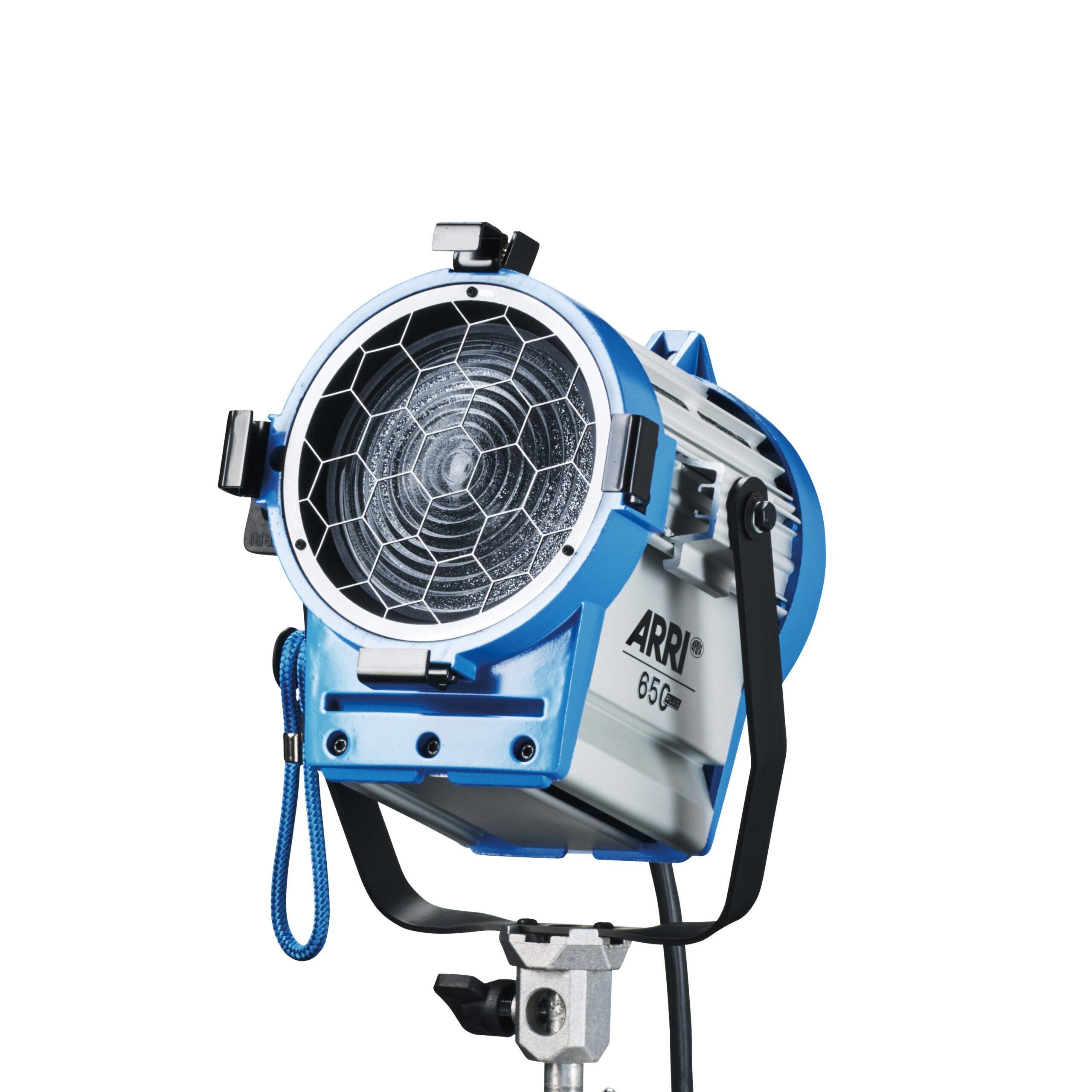
The ARRI 650 Plus is a 650W tungsten Fresnel: a focusable hard-light fixture using a replaceable tungsten-halogen lamp, a Fresnel lens and a reflector. It is a familiar tool for shaped keys, warm accents, backgrounds and learning conventional lighting control.
The 650 Plus is the smaller ARRI Junior head. Its compact size makes it useful in tighter spaces, but the heat, lamp voltage and external control arrangement still need to be understood.
Key specifications
| Specification | Details |
|---|---|
| Source | Replaceable tungsten-halogen lamp |
| Nominal lamp class | 650W; approved lower-power lamp options also listed |
| Lamp base | GY9.5 |
| Nominal CCT | 3,200K with the appropriate lamp at rated operation |
| Focus range | 12–52° |
| Voltage | 120V or 230V approved lamp versions |
| Dimming | External compatible tungsten dimming system, 0–100% |
| Lens diameter | 112mm |
| Accessory diameter | 168mm |
| Mounting | 16mm / ⅝in receiver |
| Head weight | Approximately 3kg |
| Weather rating | IP20 |
| Cooling | Passive fixture ventilation |
| Built-in colour / app control | None; control depends on external equipment |
Strengths and limitations
Strengths
- A continuous tungsten source gives direct, visible control of the lighting effect.
- Lamp and accessory choices adapt the source to its job.
Limitations
- Heat and electrical load remain central to placement and circuit planning.
- Dimming changes colour; lamp code, voltage and fixture limits must match.
Practical uses
The lamp base and rated voltage have to match the approved fixture configuration and actual supply. A voltage range in a general fixture manual is not a universal power converter: installing a 120V lamp does not make it suitable for direct operation from 230V.
ARRI lists several approved wattages. Use the specified lamp types and manufacturer instructions, rather than selecting a replacement only because it fits the socket. Lamp alignment, envelope condition and correct seating affect operation and the beam.
A tungsten Fresnel remains useful where its warm source character, simple optics, dim-to-warm behaviour and familiar mechanical controls suit the scene. It also teaches focus, scrim use, spill control and the exposure consequences of diffusion clearly.
An LED alternative may offer lower consumption, electronic CCT or colour changes and different remote control. Compare actual beam and shadow behaviour as well as efficiency. The tungsten-light explainer covers the source technology; fixture-specific operating limits are given above.
| Setup | Working approach |
|---|---|
| Controlled key or accent | Choose focus or diffusion for the intended shadow and trim spill with compatible accessories. |
| Warm practical motivation | Meter at the chosen dimmer setting and balance colour through the camera. |
Output and colour
ARRI supplies separate spot, medium and flood IES files. The table below is calculated from their on-axis candela using illuminance = candela ÷ distance², rounded to the nearest lux. These are planning calculations from the manufacturer files, not new measurements.
The file set uses an Osram CP89 650W/230V lamp and approximately 11.7°, 30° and 54.7° focus labels. Those tested labels differ slightly from the current headline focus range.
| IES condition | On-axis intensity | Calculated at 3m | Calculated at 5m | Calculated at 7m |
|---|---|---|---|---|
| Spot | 61,308 cd | 6,812 lux | 2,452 lux | 1,251 lux |
| Medium | 19,768 cd | 2,196 lux | 791 lux | 403 lux |
| Flood | 8,998 cd | 1,000 lux | 360 lux | 184 lux |
Power and batteries
The nominal 650W lamp class is a real location-power load. Include other lights and equipment when planning a supply, and use suitable connectors, cable and distribution. An LED with a similar-looking body may have very different demand; the lamp label and fixture documentation are the relevant reference.
There is no built-in wireless receiver or electronic colour system in the head. Console operation, if required, comes through an appropriate external dimmer and control system. Specify that dimmer as part of the package rather than describing the bare fixture as a DMX light.
Control, cooling and camera operation
Electrical dimming lowers a tungsten filament’s temperature, so the source becomes warmer as it dims. That can be an attractive part of a practical or sunset-style cue, but it can also break a colour match. A dimmer percentage is not a linear percentage of exposure.
Scrims offer a mechanical way to reduce intensity without the same shift caused by lowering filament temperature. A single or double scrim and a half scrim serve different control needs. Choose the appropriate accessory for the falloff across the subject, and keep hot accessories handled and stored safely.
Modifiers, rigging and the working package
Adjusting spot to flood changes beam coverage and centre intensity. It does not turn the fixture into a soft source. For softness, increase the apparent source size with an appropriate diffusion or bounce arrangement, then allow for the resulting exposure loss.
Barndoors can reduce spill and provide useful cuts, but their result depends on focus and distance. A separate flag may create a better-defined cut where required. Use the correct accessory diameter and ensure doors or frames are retained by the fixture’s latch.
The housing, focus control, lens and accessories become hot in operation. Leave the documented clearances and ventilation, allow cooling before handling or packing, and keep combustible materials outside the permitted distances. A Fresnel aimed at diffusion requires attention to both the fixture and the material it illuminates.
Disconnect and allow cooling before lamp changes. Follow the ARRI manual for handling the quartz lamp and inspecting the lens, guard, socket and cable. Never use a damaged lamp or protection assembly. Clean optical components appropriately; accumulated dirt can change output and heat behaviour.
The published 3kg head weight excludes the complete accessory and cable arrangement. Confirm the support interface on the actual unit and secure the full working package. A lightweight head can still become an awkward load with a large softbox.
The IP20 rating belongs to the specified fixture. IP20 does not provide rain protection; treat the 650 Plus as an indoor-style fixture unless an appropriate protected setup is provided. Heat, support and weather are separate considerations.
Alternatives and related fixtures
| Fixture | Choose it for |
|---|---|
| ARRI LED L-Series | A colour-adjustable Fresnel with different operating and control hardware. |
| A supported soft-light system | A larger diffused emitting area when a hard source is not required. |
| ARRI ARRILITE 750 Plus | A related compact tungsten package that uses an open-face reflector instead of a Fresnel lens. |
What people are saying
Owner review: the ARRI 650
The reviewer discusses the ARRI 650 as a used tungsten Fresnel option. Keep the demonstrated lamp, voltage and accessory configuration separate from any different used or modified unit. View the source.
Videos
ARRI 650 Plus: family guide
A tungsten-family demonstration; confirm the fixture and lamp configuration shown.
Rental and used-fixture checks
Check the exact model and revision, complete power package, mounting hardware and control leads. Inspect lamp holders, protective glass and ballast connections. Test the intended operating level, fade and camera settings before rigging.
Documentation and specifications
Official specifications, accessories and downloads · Operating manual · ARRI Photometrics.
Product photograph: ARRI.
Browse Arri lights · tungsten lights · all equipment.