
Last Updated 12 hours ago
Overview
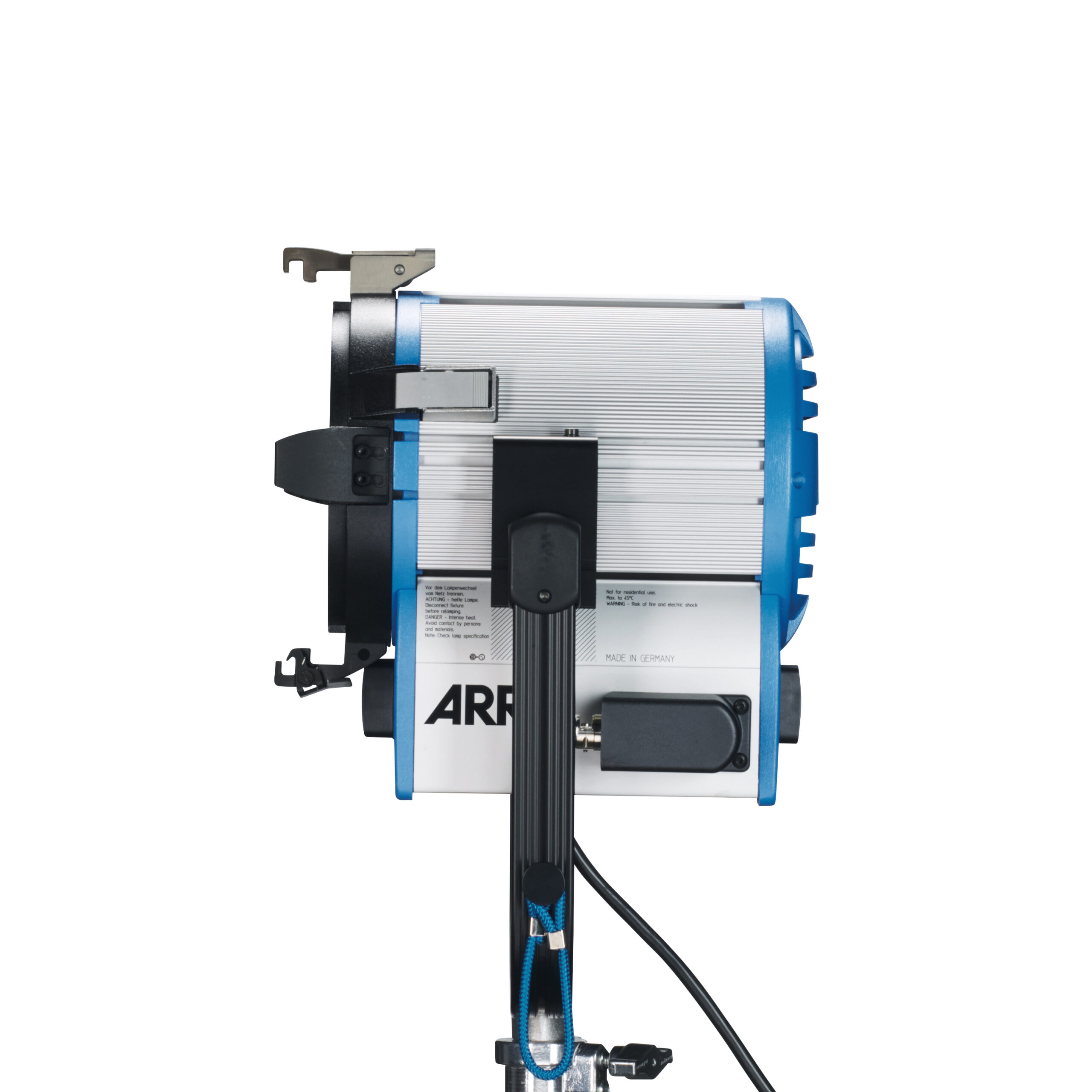
The ARRI True Blue T2 is a 2,000 W tungsten Fresnel for location and studio work. Its 175 mm lens and adjustable hard beam make it useful for a substantial key, a backlight, a window-motivated source or illumination sent through a separate diffusion frame. It is a conventional lamphead with modernised mechanical design, rather than an LED fixture with a tungsten-equivalent label.
The T2 combines front-to-rear focus travel with ARRI’s sliding stirrup, cross-cooling design and adjustable accessory brackets. Manual and pole-operated versions exist. This guide distinguishes their weights and controls, and keeps lamp wattage separate from the supply and dimmer capacity needed to operate the light.
Key specifications
| Specification | Details |
|---|---|
| Source / maximum power | 2,000 W tungsten-halogen Fresnel |
| Lamp base | G38; the April 2025 poster lists 230 V CP/41 and CP/73 FKK lamps and notes 120 V versions |
| Lens / reflector | 175 mm Fresnel; spherical specular aluminium |
| Published photometric settings | 12.7° spot, 30° medium, 60° flood |
| Control | Mechanical focus and aim; external tungsten dimmer for level |
| Manual version weight | Approximately 7.1 kg |
| Pole-operated version weight | Approximately 9.2 kg |
| Manual dimensions, H × W × L | 416 × 374 × 325 mm, including flange |
| Pole-operated dimensions, H × W × L | 436 × 357 × 326 mm, including flange |
| Mount | 28 mm / 1-1/8-inch junior spigot |
| Accessory diameters | 230 / 245 mm, depending on accessory |
| Protection | IP23; Class I protective earth |
| Maximum ambient / surface temperature | 45°C ambient; 190°C surface |
| Inclination | Up to 90° upward or downward, also subject to lamp restrictions |
| Safe distances | 3 m to illuminated surface; 1 m around the luminaire |
Strengths and limitations
Strengths
- A continuous tungsten source gives direct, visible control of the lighting effect.
- Lamp and accessory choices adapt the source to its job.
Limitations
- Heat and electrical load remain central to placement and circuit planning.
- Dimming changes colour; lamp code, voltage and fixture limits must match.
Practical uses
A T2 can create a motivated hard key with enough spread to cover movement, provide an edge across several actors, or feed a bounce or diffusion frame from a useful distance. Unlike a compact open-face lamp, its Fresnel optics offer an adjustable field with familiar barn-door and scrim control. The source becomes soft only when the emitting area presented to the subject is enlarged through diffusion or bounce.
The sliding stirrup helps rebalance a head fitted with accessories. That is useful when a lightbank or heavier front assembly changes the load on the tilt mechanism. Set the balance and lock the fixture correctly before raising it. Pole-operated versions suit inaccessible studio positions, but their mechanisms and additional weight must be included in the rigging plan.
| Setup | Working approach |
|---|---|
| Controlled key or accent | Choose focus or diffusion for the intended shadow and trim spill with compatible accessories. |
| Warm practical motivation | Meter at the chosen dimmer setting and balance colour through the camera. |
Output and colour
The April 2025 True Blue overview supplies the following nominal centre readings. The spot setting provides a much higher centre reading by concentrating the light into a smaller area. It should not be compared directly with another fixture measured at a wider beam angle.
| Focus | At 5 m | Diameter at 5 m | At 10 m |
|---|---|---|---|
| Spot, 12.7° | 7,776 lux | 1.11 m | 1,944 lux |
| Medium, 30° | 3,084 lux | 2.68 m | 771 lux |
| Flood, 60° | 1,300 lux | 5.77 m | 325 lux |
Power and batteries
The T2 requires a correctly rated G38 tungsten-halogen globe. The head’s name does not establish the lamp voltage: confirm the regional configuration, installed lamp and cable assembly. The manufacturer explicitly lists 120 V versions as well as its 230 V catalogue lamps. Never treat a two-voltage catalogue listing as automatic voltage conversion.
At 2,000 W, the nominal lamp load is about 16.7 A at 120 V or 8.7 A at 230 V. These are calculated operating values. A 120 V T2 therefore exceeds a 15 A supply’s rating on lamp power alone. Use correctly rated distribution, connectors and a suitable tungsten dimmer; a convenient domestic-looking plug is not evidence that the available circuit is suitable.
The head itself has no built-in DMX decoder or electronic CCT system. Console control belongs to the external dimmer arrangement. Reducing filament voltage warms the light, whereas wire scrims reduce level without that intentional spectral change. A large level adjustment may be better made with a lower-output fixture or different placement rather than by running this lamp deeply dimmed.
Control, cooling and camera operation
Use the documented control arrangement for this exact lamphead and power system. Check dimming behaviour, camera settings and thermal conditions at the intended working level.
Modifiers, rigging and the working package
ARRI lists four- and eight-leaf barn doors, scrims, a snoot, filter frame and compatible lightbank hardware. Check both accessory diameter and retention: the poster lists 230 and 245 mm interfaces, not one universal size for all T-series lamps. Keep enough room for cooling when adding front accessories.
Use barn doors to manage spill, scrims to reduce output and flags for a cut placed at the right distance from the receiving surface. Gels need suitable spacing and temperature capability. A softbox must be designed for a hot 2 kW source and attached with the correct ring; a modifier supplied for an unrelated LED fixture is not automatically suitable.
The manufacturer’s safe distances are three metres to the illuminated surface and one metre around the lamphead. The stated maximum surface temperature is 190°C, with a 45°C ambient limit. IP23 is a defined protection rating, not permission to ignore the operating manual’s environmental restrictions or expose distribution equipment to water.
Inspect the yoke, sliding stirrup, tilt lock, focus mechanism and accessory retainers on a used T2. Check the lens, safety protection, socket, earth and cable for condition, including damage hidden by tape or an aftermarket connector. Verify whether the listed mass is for a manual head, pole-operated head or packed kit; those figures are materially different.
Alternatives and related fixtures
The T2 is smaller than a T5 and generally easier to place when a 2 kW source is sufficient. The T1 trades output for lower power and a smaller body. A studio ST2 or ST2/3 is a different lamphead; do not transfer T2 dimensions or accessory sizes simply because the wattage appears similar.
An LED spotlight such as the Aputure LS 600x Pro offers different power, colour and control advantages. Compare measured levels at matching beam angles and through the intended modifier. A universal ‘2 kW replacement’ statement hides the optical and practical differences that determine whether a substitute will work.
| Fixture | Choose it for |
|---|---|
| ARRI LED L-Series | A colour-adjustable Fresnel with different operating and control hardware. |
| A supported soft-light system | A larger diffused emitting area when a hard source is not required. |
| ARRI True Blue ST2/3 | A studio Fresnel with approved 2kW/3kW configurations in its 230V version. |
| ARRI ARRILITE 2000 Plus | An open-face 2kW source to compare for bounce, diffusion and compatible hot-light softboxes. |
What people are saying
ARRI: operating the tungsten Fresnel
ARRI’s training presentation introduces the True Blue and its working format. It provides a practical companion to the exact fixture’s lamp, focus, clearance and accessory specifications. View the source.
Videos
ARRI True Blue T2: family guide
A tungsten-family demonstration; confirm the fixture and lamp configuration shown.
Rental and used-fixture checks
Check the exact model and revision, complete power package, mounting hardware and control leads. Inspect lamp holders, protective glass and ballast connections. Test the intended operating level, fade and camera settings before rigging.
Documentation and specifications
ARRI product information, technical overview and photometrics and operating manual. Read the document for the exact lamphead and regional version in use.
Product photograph: ARRI, via its official product page.
Browse Arri lights · tungsten lights · all equipment.