
Last Updated 2 days ago
Overview
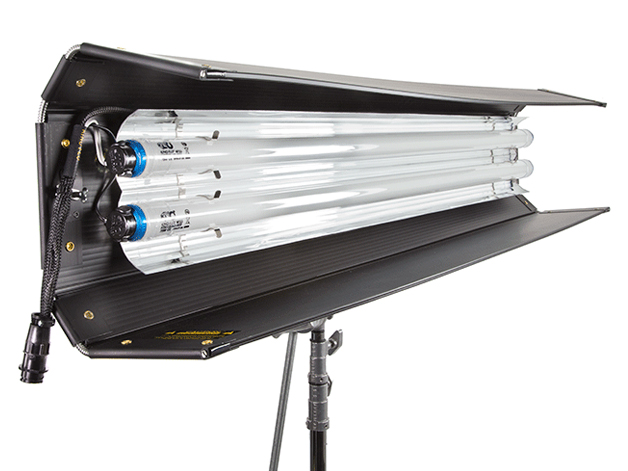
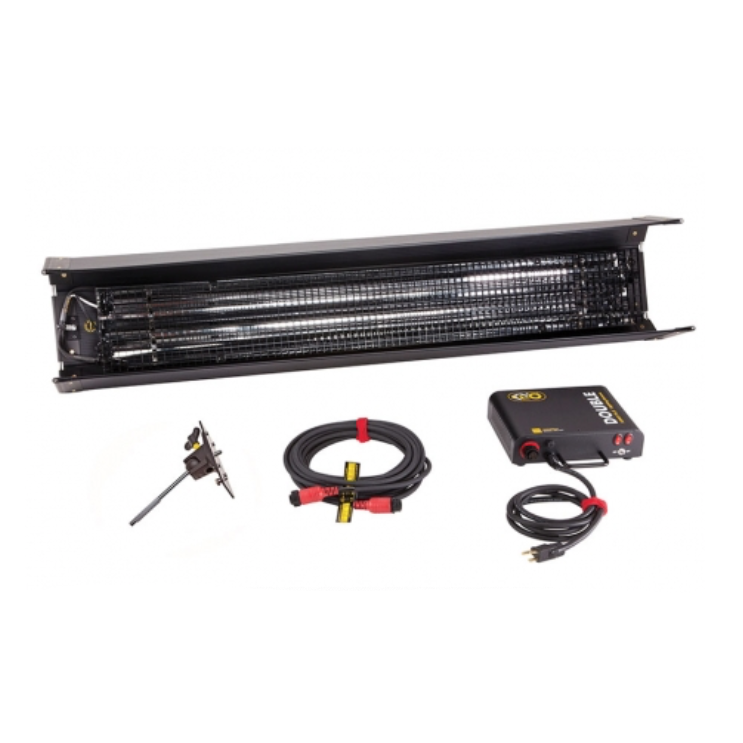

The Kino Flo 4ft Double, CFX-4802, is a narrow two-lamp fluorescent softlight with a remote ballast. Its long, slim surface is useful for a soft edge, a low-profile key, fill in a confined space or a controlled reflection on a product. It occupies less width than a four-lamp 4Bank while preserving the four-foot source length.
This is the fluorescent Double system, not an LED tube pair mounted in an old Kino shell. The detachable harness, correct lamps, mounting plate, extension cable and ballast make up the working light. A head-only sale omits much of the equipment needed to reproduce its documented behaviour.
- 4 ft Double Fluorescent Two matching F75/T12 tubes and a remote ballast.
- BAL-227 Universal Reference 1.3 A at 120 V or 0.7 A at 230 V in Kino Flo’s universal ballast documentation for this lamp type. Older ballasts have different ratings.
- KF32 or KF55 Lamp Sets Select warm tungsten or daylight with the installed matching lamps, not an electronic CCT dial.
- Weight 7.7 lb / 3.5 kg With Lamps. Fixture and lamps only; excludes separately supported ballast and cable.
- Beam Control Fluorescent array with barndoors; fit the matching 4 ft Double louver or Flozier for the intended spill and softness.
- No Published System IP Rating The cited fluorescent system manuals do not assign an IP code. Keep mains ballast and connectors dry. How to Read an IP Rating.
Key Specifications
| Specification | Details |
|---|---|
| Fixture code / lamp count | CFX-4802; two lamps |
| Lamp type | F75/T12, four-foot True Match fluorescent tubes |
| Colour examples | 488-K32-S / KF32 and 488-K55-S / KF55 |
| Dimensions | 52 × 7½ × 3½ inches; 6-inch barn doors, original catalogue |
| Fixture mass with lamps | 7.7 lb / 3.5 kg; ballast and kit weight are separate |
| Mount | Twist-lock plate; 3/8-inch grip-head pin or appropriate 16 mm receiver version |
| Cable | X09 Double extension family; 25 ft system extension |
| Older ballast example | BAL-210 Select/Ve, 120 V; F75 rating 2.4 A in archival catalogue |
| Later universal example | BAL-227, 100–240 V; F75 figures 1.3 A at 120 V / 0.7 A at 230 V in the 2017 manual |
| Output frequency | 25 kHz for the documented electronic ballast versions |
| Level selection | One or two lamps; 4ft/2ft output setting as documented |
| Diffusion accessories | DFS-4802 full or half Flozier; matching louver |
| Harness design | Removable harness, reflector and louver; use only the documented compatible system |
Output Calculator
Select the published setup and a manufacturer distance, or enter a custom throw where supported. The results describe centre-beam output, not the brightness across the whole beam.
Camera Settings
If the calculator does not load, use the published photometric table or source on this page. JavaScript is required.
F-stop is a planning estimate, not a meter reading. It uses direct, on-axis illuminance and includes only the optics and diffusion named in the selected setup. Meter on set to account for lens transmission, filters, added diffusion, bounce, dimming and ambient light.
How the exposure estimate works
N = √(E × ISO × t / C), where E is illuminance in lux and t = shutter angle ÷ (360 × fps). The default C = 340 is a dome reference; C = 250 is a flat reference. These are calibration constants, not a measured T-stop. A small nonzero digit is tenths of a stop above the displayed full stop.
Distance estimates and comparisons
Published points are used as given. Between published points the calculator fits a curve through the two nearest readings. Outside those points it uses the inverse-square law only when the fixture’s dataset permits it. Distances outside a configuration’s supported range are reported separately. Comparisons use one shared distance and camera setup; equal lux does not imply equal coverage.
View published readings for the selected configuration
Ballast and harness: Use the matching lamp-length setting and the specified ballast, harness and extension for this family. The manufacturer universal-system manual gives the ballast current and says to power down before connecting or disconnecting the lamp harness.
Strengths and Limitations
Strengths
- A bank of fluorescent tubes provides a broad close source.
- The established modifier and mounting system supports fast setup.
Limitations
- Lamp type, age and ballast configuration affect colour and output.
- Inspect older connectors, lamp holders and ballast cabling before use.
Practical Uses
The Double can run along a wall, sit above a narrow opening or create an elongated reflection without the width of a 4Bank. For a face close to the lamp, its four-foot dimension can create a soft transition in one direction while the narrower dimension retains more shape. Rotation and distance are useful creative controls, not merely mounting conveniences.
It can also serve as a modest edge or fill when a larger source produces too much spill. The tube pattern may show in reflective objects or close-up eyes. Use the correct diffusion sleeve when a smoother visible surface is needed, and check the reflection itself rather than relying only on the source’s overall brightness.
| Setup | Working approach |
|---|---|
| Close interview key | Set lamp arrangement and diffusion, then check white balance through the camera. |
| Reflection or fill | Orient the bank for the required highlight and control spill with the correct louver. |
Output and Colour
The original Kino Flo catalogue publishes the following four-foot Double readings. They describe that catalogue’s fluorescent configuration, not an LED-retrofitted shell or a guarantee for every later ballast generation. Lamp condition, operating temperature, louver, diffusion and ballast selection can change the delivered level.
| Distance | Centre illuminance |
|---|---|
| 4 ft / 1.22 m | 94 fc |
| 6 ft / 1.83 m | 45 fc |
| 8 ft / 2.44 m | 26 fc |
| 10 ft / 3.05 m | 17 fc |
Switching from two lamps to one reduces the emitting area as well as level. That can change a product reflection or the direction of the source’s centre. Position the light and choose the active lamp deliberately when the shot is sensitive to reflections or a precise edge.
The normal selector position for four-foot tubes is 4ft. Kino describes using 2ft mode on four-foot lamps in certain hot or restricted-airflow conditions to reduce a colour-temperature and green-spike problem, at roughly half a stop less exposure. Keep cooling paths open regardless. The switch is not a calibrated CCT dial, and dimming the mains is not an approved way to obtain a smooth fade.
Power and Batteries
The original Select/Ve catalogue lists 2.4 A at 120 V for F75 operation. The later universal BAL-227 manual lists 1.3 A at 120 V for its F75 configuration. Those are not two interchangeable estimates for the same unidentified box. Inspect the supplied ballast and use its rating when planning the package.
A universal BAL-227 accepts 100–240 V, while older Select versions can be dedicated to a regional supply. The tube wattage does not by itself establish mains watts or current, and a physically similar fluorescent tube is not proof of compatible colour or drive. Use the correct matched Kino lamp type and harness system.
Control, Cooling and Camera Operation
Inspect the shell, reflector, louver, tube clips, harness end connectors, cable locking rings and centre plate. Test both lamp channels, cold starting and operation over the complete intended cable length. Look for worn contacts or insulation and have electrical defects serviced before use.
Match lamps for colour, condition and age where possible. Allow the system to stabilise before judging its output, and test high-speed or unusual-shutter work with the actual ballast and camera. ‘Flicker-free’ in an old catalogue is not a universal guarantee across every recording condition. Confirm replacement-tube availability and use proper transport cases and lamp recycling procedures.
Modifiers, Rigging and the Working Package
The removable harness is one reason classic Kino fixtures remain adaptable. It allows the lamps to be used in documented configurations outside the shell, but it does not remove the need for protected lamps, suitable support and the manufacturer’s electrical precautions. Do not connect or disconnect lamp ends, harnesses or extensions with the ballast energised.
Use the Double’s X09 cable family and appropriate locking connectors, not an audio cable or a guessed pin-compatible substitute. The system manual documents remote operation up to 75 ft using its prescribed extensions. Check the mounting plate’s locking pin and the correct secondary suspension when hanging the head, and keep the ballast and cable weight from pulling on the fixture.
Alternatives and Related Fixtures
A four-foot 4Bank supplies more output and a wider source. A two-foot Double fits tighter spaces but gives less long-axis coverage. Modern LED tubes can provide colour and wireless control, but a conversion must use the replacement system’s approved wiring and power method. An LED-retrofitted Double should have its own specifications and photometrics, rather than inheriting the original fluorescent chart.
The original Double is a sensible working tool when the complete system is healthy and the narrow fluorescent source fits the image. It is less compelling as a purchase if several missing components or unreliable lamps have to be replaced before the first usable lighting test.
| Fixture | Choose it for |
|---|---|
| Kino Flo FreeStyle LED | A separate LED engine and controller system. |
| Kino Flo Diva-Lite LED | An LED alternative with different colour modes and power hardware. |
What People Are Saying
Field Feedback Summary
These are practical takeaways from Kino Flo’s operating instructions and the model-specific documentation cited below, not independent owner reviews.
What worked
- The 4ft Double’s separate lamp switches let a crew run one or both tubes without an upstream dimmer.
- The 7.7 lb lamped fixture separates from the remote ballast and accepts the locking X09 Double extension, useful where a narrow 52 in strip must fit above the frame.
- The CFX-4802 has replaceable HAR-4802 harness and REF-4802 reflector, plus its own LVR-4802-B louver; those part numbers help when rebuilding an incomplete set.
Drawbacks to plan for
- Do not run the Double on an SCR dimmer. Switch the ballast off before connecting or disconnecting the lamps, harness or extension.
- Select 4ft for its four-foot tubes in normal use. Kino notes the 2ft setting can change colour and cost about half a stop with four-foot tubes under hot or restricted-airflow conditions.
- Read the ballast label before power planning: the later BAL-227 manual quotes 1.3 A for F75 at 120 V and 0.7 A for its 230 V counterpart; the older 120 V BAL-210 Select/Ve has a different rating.
The Substream: Fluorescent-light Overview
The Substream introduces Kino Flo fluorescent lighting. The overview gives family context; use the exact lamp, ballast and mounting specifications for this model. View the guide.
Videos
Kino Flo: Fluorescent-light Overview
A family guide to the fluorescent format.
Rental and Used-fixture Checks
Ask for the two-lamp 4 ft housing, its locking harness and extension, a compatible ballast with the correct mains rating, and matched tubes. Set the ballast for 4 ft output where it has a tube-length selector, and check both tubes strike and switch on command. Inspect harness contacts, lamp locks and louver rather than looking for a protective glass cover this housing does not use. Kino Flo Double operating manual.
Documentation and Specifications
Manufacturer operating manual, original manufacturer catalogue with photometrics, Kino Flo manual archive and photograph and rental-inventory source. Current lamp and service-part availability should be confirmed for the exact unit. Later-generation electrical figures are from the 2017 universal 4Bank/Double/Single manual.
Product photograph: Product image via Sanwa Group.
Browse Kino Flo lights · fluorescent lights · all equipment.