
Last Updated 5 hours ago
Overview
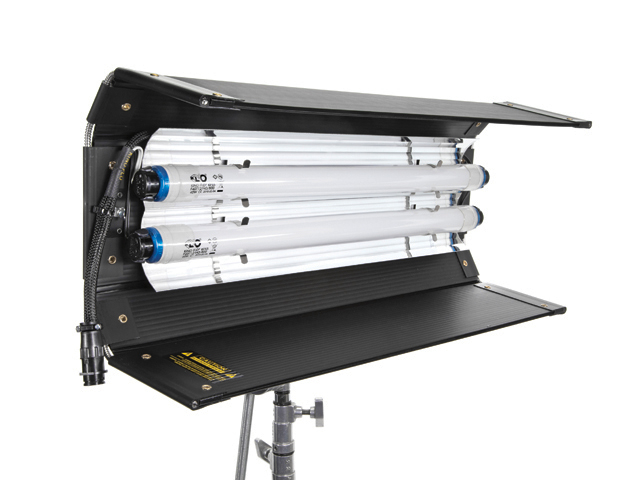


The Kino Flo 2ft Double, CFX-2402, is a compact two-lamp fluorescent source for confined locations, low-level fill and small soft accents. Its narrow body can fit where a four-lamp head is unnecessarily wide, while the remote ballast keeps part of the operating package away from the fixture.
This is the original-style two-foot fluorescent Double. The lamps are not self-contained battery tubes, and the shell alone is not a complete light. Correct tubes, harness, mount, head cable and ballast are essential; a used body converted to LED must be identified and specified separately.
- 2 ft Double Fluorescent Two matching F40/T12 tubes and a remote ballast.
- BAL-227 Universal Reference 1.2 A at 120 V or 0.7 A at 230 V in Kino Flo’s universal ballast documentation for this lamp type. Older ballasts have different ratings.
- KF32 or KF55 Lamp Sets Select warm tungsten or daylight with the installed matching lamps, not an electronic CCT dial.
- Weight 4.7 lb / 2.1 kg With Lamps. Fixture and lamps only; excludes separately supported ballast and cable.
- Beam Control Fluorescent array with barndoors; fit the matching 2 ft Double louver or Flozier for the intended spill and softness.
- No Published System IP Rating The cited fluorescent system manuals do not assign an IP code. Keep mains ballast and connectors dry. How to Read an IP Rating.
Key Specifications
| Specification | Details |
|---|---|
| Fixture / lamp count | CFX-2402; two fluorescent lamps |
| Lamp type | F40/T12, two-foot True Match tubes |
| Colour examples | 242-K32-S / KF32 and 242-K55-S / KF55 |
| Dimensions | 27 × 7½ × 3½ inches; 6-inch barn doors in the archival specification |
| Fixture mass with lamps | 4.7 lb / 2.1 kg, excluding separate ballast and full kit |
| Mount | Twist-lock centre plate; confirm grip-head pin or baby-receiver option |
| Head cable family | X09 Double cable; 25 ft system cable commonly listed |
| Older Select/Ve input example | 120 V; F40 current 1.6 A in original catalogue |
| Later BAL-227 universal example | 100–240 V input; F40 figures 1.2 A at 120 V / 0.7 A at 230 V in 2017 manual |
| Normal output setting | 2ft; do not use 4ft mode to boost two-foot tubes |
| Level / colour control | One/two lamp switching; colour selected by lamp set |
| Diffusion / spill accessories | DFS-D2 Flozier family and matching two-foot Double louver |
| Remote-run guidance | Manufacturer system manual permits up to 75 ft with the specified extension arrangement |
Output Calculator
Select the published setup and a manufacturer distance, or enter a custom throw where supported. The results describe centre-beam output, not the brightness across the whole beam.
Camera Settings
If the calculator does not load, use the published photometric table or source on this page. JavaScript is required.
F-stop is a planning estimate, not a meter reading. It uses direct, on-axis illuminance and includes only the optics and diffusion named in the selected setup. Meter on set to account for lens transmission, filters, added diffusion, bounce, dimming and ambient light.
How the exposure estimate works
N = √(E × ISO × t / C), where E is illuminance in lux and t = shutter angle ÷ (360 × fps). The default C = 340 is a dome reference; C = 250 is a flat reference. These are calibration constants, not a measured T-stop. A small nonzero digit is tenths of a stop above the displayed full stop.
Distance estimates and comparisons
Published points are used as given. Between published points the calculator fits a curve through the two nearest readings. Outside those points it uses the inverse-square law only when the fixture’s dataset permits it. Distances outside a configuration’s supported range are reported separately. Comparisons use one shared distance and camera setup; equal lux does not imply equal coverage.
View published readings for the selected configuration
Ballast and harness: Use the matching lamp-length setting and the specified ballast, harness and extension for this family. The manufacturer universal-system manual gives the ballast current and says to power down before connecting or disconnecting the lamp harness.
Strengths and Limitations
Strengths
- A bank of fluorescent tubes provides a broad close source.
- The established modifier and mounting system supports fast setup.
Limitations
- Lamp type, age and ballast configuration affect colour and output.
- Inspect older connectors, lamp holders and ballast cabling before use.
Practical Uses
The 2ft Double is useful for a restrained eye-level fill, a compact edge, a lift under a shelf or an unobtrusive source near a small set. Its narrow face can keep spill down compared with a wider bank, while its shallow body is easier to position than a tungsten head aimed into a separate bounce.
It has less output and a shorter emitting area than the four-foot Double. At a close distance that may be enough for a face or detail, but moving it further away changes both softness and level. A two-lamp fluorescent should not be described as a large soft key simply because it is in the Kino family. Test the actual subject distance and modifier.
| Setup | Working approach |
|---|---|
| Close interview key | Set lamp arrangement and diffusion, then check white balance through the camera. |
| Reflection or fill | Orient the bank for the required highlight and control spill with the correct louver. |
Output and Colour
The original Kino Flo catalogue publishes the following two-foot Double readings. They describe that catalogue’s fluorescent configuration, not an LED-retrofitted shell or a guarantee for every later ballast generation. Lamp condition, operating temperature, louver, diffusion and ballast selection can change the delivered level.
| Distance | Centre illuminance |
|---|---|
| 4 ft / 1.22 m | 35 fc |
| 6 ft / 1.83 m | 16 fc |
| 8 ft / 2.44 m | 9 fc |
| 10 ft / 3.05 m | 6 fc |
Kino specifies the 2ft selector position for two-foot lamps. Its manual warns that operating these tubes at the 4ft setting produces a substantial colour-temperature rise and green spike. If an old package appears unusually green, verify that setting and the lamp type before assuming a gel is the only solution.
Use a matched KF32 or KF55 set as appropriate to the scene, and check the tubes’ condition. Temperature, age and drive can influence the result. Keep the fixture ends and airflow paths open; do not seal the louver in diffusion or gel. Allow lamps to reach stable operation before assessing an exposure or a colour match with a modern LED.
Power and Batteries
The archival Select/Ve figure for F40 operation is 1.6 A at 120 V. The later universal BAL-227 manual lists 1.2 A at 120 V and 0.7 A at 230 V. The ballast generation determines which figures are relevant; avoid copying the later rating onto an older voltage-specific unit.
Universal BAL-227 input is 100–240 V, while older Select ballasts require their specified regional supply. Do not power the system through an SCR dimmer. The operating manual calls for a non-dim source when fed from a dimmer pack, and connecting the head to an arbitrary household fluorescent ballast is not an equivalent system.
Control, Cooling and Camera Operation
One/two lamp switching gives useful stepped reduction. It also moves or reduces the emitting surface, which can change a reflected highlight or a delicate edge. Check the camera after switching a tube, especially for close-ups of polished objects or glass.
A correct two-foot Double Flozier can blend the visible lamp pattern, and the louver can reduce spill. Additional diffusion costs output, which is particularly relevant with this small fixture. A continuous fade or fast calibrated colour change is usually more convenient with a modern LED system than with a non-dimming fluorescent Double.
Modifiers, Rigging and the Working Package
The 4.7 lb catalogue mass includes lamps, not the entire working package. Seat and lock the centre plate, select suitable support, relieve cable pull and use the manufacturer’s secondary-suspension arrangement for a hung head. The light’s small size does not justify placing it loosely above a person or attaching it with an unverified improvised mount.
Turn off the ballast before changing lamp, harness or extension connections. Use the X09 Double cable and properly locked connectors, and respect the system manual’s maximum remote-run arrangement. A cable that physically mates is not necessarily wired or rated correctly; keep undocumented adapters out of the package.
Alternatives and Related Fixtures
The two-foot 4Bank is a stronger and wider source; the four-foot Double provides a longer reflection and more coverage. A current LED tube or compact panel offers more convenient battery, dimming or colour options. The classic 2ft Double remains useful when its small source shape suits the shot and the complete fluorescent system is in good condition with obtainable replacement lamps.
| Fixture | Choose it for |
|---|---|
| Kino Flo FreeStyle LED | A separate LED engine and controller system. |
| Kino Flo Diva-Lite LED | An LED alternative with different colour modes and power hardware. |
What People Are Saying
Documented Setup Notes
These points are based on Kino Flo documentation for this original fluorescent configuration. They are not independent owner reviews. 4Bank/Double/Single manual.
Where it helps
- The two-tube, 2.1 kg head suits a small fill or accent where a four-lamp shell is too wide.
- The Double ballast provides two lamp channels, so the crew can select one or two tubes for a simple level change.
- The dedicated Double head cable allows the ballast to stay accessible when the head is in a tight spot.
Drawbacks to plan for
- Use the CFX-2402 Double and its own keyed extension cable, not a 4Bank connection as a direct substitute.
- The BAL-227 reference is 1.2 A at 120 V or 0.7 A at 230 V for the specified F40 lamps; check an older Select ballast separately.
- A 2 ft Double has only two lamps and its own front accessories. Meter the exact setup rather than applying a four-lamp chart.
The Substream: Fluorescent-light Overview
The Substream introduces Kino Flo fluorescent lighting. The overview gives family context; use the exact lamp, ballast and mounting specifications for this model. View the guide.
Videos
Kino Flo: Fluorescent-light Overview
A family guide to the fluorescent format.
Rental and Used-fixture Checks
Check the shell, reflector, louver, lamp clips and locking end connectors. Test both lamp channels and the full cable/ballast arrangement, including starting from cold. Intermittent illumination when a connector moves, brittle insulation or worn contacts needs service, not tape as a permanent fix.
Protect tubes in a proper lamp case and follow manufacturer handling and recycling guidance. Test unusual shutter or high-frame-rate work using the actual system rather than relying solely on the old high-frequency ballast claim. If the fixture has LED replacement tubes, record the retrofit brand, wiring and power method and replace the fluorescent performance chart with data for that conversion.
Documentation and Specifications
Manufacturer operating manual, original manufacturer catalogue with photometrics, Kino Flo manual archive and photograph and rental-inventory source. Current lamp and service-part availability should be confirmed for the exact unit. Later-generation electrical figures are from the 2017 universal 4Bank/Double/Single manual.
Product photograph: Product image via Sanwa Group.
Browse Kino Flo lights · fluorescent lights · all equipment.