
Last Updated 7 hours ago
Overview
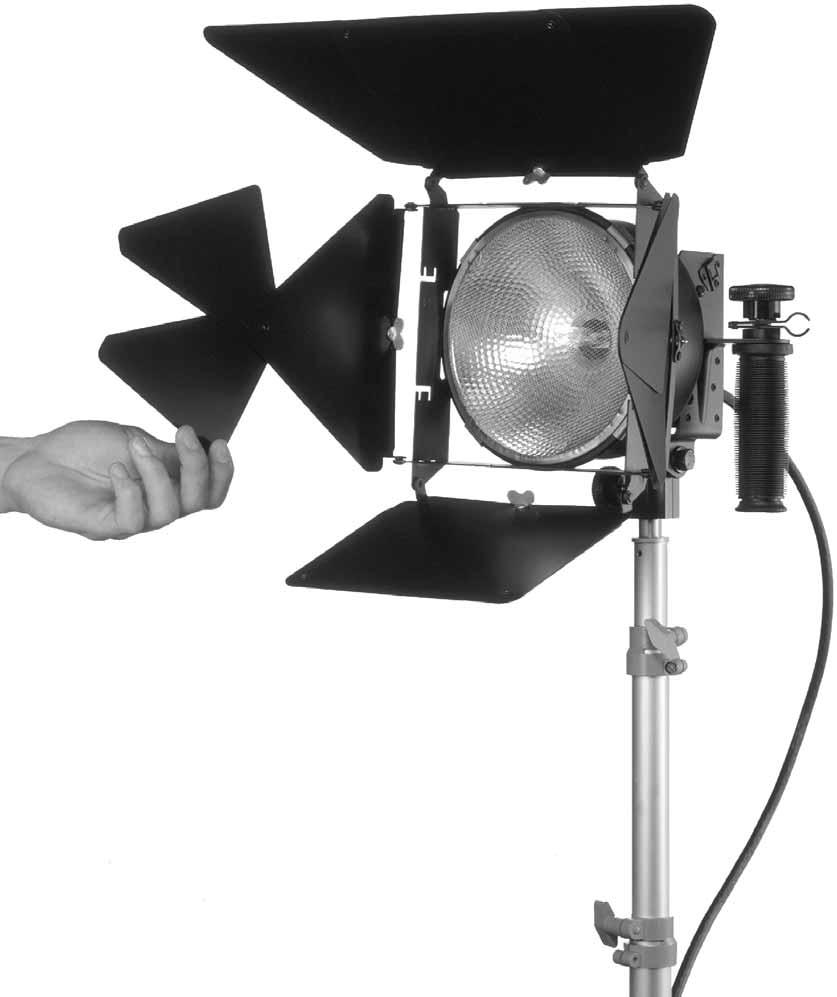
The Lowel DP Light is a focusable open-face tungsten-halogen fixture rated up to 1,000 W. It is useful for a strong compact key, backlight, background illumination or feeding an appropriate umbrella, bounce or diffusion surface. Its small aluminium body and no-yoke tilt arrangement make it a recognisable traditional location workhorse.
The DP is not a Fresnel. Its peened parabolic reflector and moving lamp provide spot-to-flood adjustment, while an optional super-spot reflector changes the optical configuration. This guide separates those configurations and the approved 500, 750 and 1,000 W lamp choices.
Key specifications
| Specification | Details |
|---|---|
| Source / maximum lamp power | Focusable open-face tungsten-halogen; 1,000 W |
| Optics | Peened parabolic normal reflector; optional super-spot reflector |
| 120 V lamp examples | FEL 1,000 W; EHF 750 W; EHC 500 W, all listed at 3200 K |
| Other lamp options | Approved 3000 K longer-life and 220/230/240 V alternatives are listed |
| Normal FEL focus range | Approximately 8:1 in the manufacturer’s chart |
| Lamp-load current | Approximately 8.3 A with 1,000 W at 120 V |
| Weight | 2.8 lb / 1.3 kg without 16 ft cable; 3.6 lb / 1.6 kg with it |
| Mount | 5/8-inch / 16 mm stud |
| Control | Mechanical focus, inline switch and suitable external tungsten dimmer |
| Tilt mechanism | 170° constant-tension travel; actual operating restrictions still apply |
| Front safety component | Protective screen required |
| Umbrella restriction | Do not operate in spot or half-spot focus with the umbrella |
| Orientation restriction | Do not operate tipped onto its side |
| Accessory boundary | DP controls and reflectors are not automatically interchangeable with Omni or Tota parts |
Strengths and limitations
| Strength | Limitation |
|---|---|
| A continuous tungsten source gives direct, visible control of the lighting effect. | Heat and electrical load remain central to placement and circuit planning. |
| Lamp and accessory choices adapt the source to its job. | Dimming changes colour; lamp code, voltage and fixture limits must match. |
Practical uses
Use the DP when a compact hard source needs more output than a small Omni. It can give a pronounced back edge, lift a background from a distance or light a bounce without the volume of a large Fresnel body. The normal reflector produces a useful adjustable field; its shadow and spill behaviour remain those of an open-face fixture.
For an indirect key, choose a bounce or heat-rated diffusion arrangement large enough to create the intended softness, and spread the lamp to illuminate it sensibly. A narrow high-intensity hotspot on a large frame is not the same as using the whole frame as a source. Check the final level and distribution after every modifier is fitted.
| Setup | Working approach |
|---|---|
| Controlled key or accent | Choose focus or diffusion for the intended shadow and trim spill with compatible accessories. |
| Warm practical motivation | Meter at the chosen dimmer setting and balance colour through the camera. |
Output and colour
The original DP instructions provide these centre readings at ten feet with the protective screen. The super-spot column requires the corresponding reflector; it is not the normal reflector’s ordinary spot position.
| 120 V lamp | Flood | Spot | Super-spot |
|---|---|---|---|
| FEL 1,000 W, 3200 K | 88 fc | 711 fc | 1,161 fc |
| EHF 750 W, 3200 K | 73 fc | 554 fc | 892 fc |
| EHC 500 W, 3200 K | 43 fc | 390 fc | 678 fc |
Electrical dimming offers familiar fades but makes the light warmer as lamp voltage decreases. If the scene needs consistent colour, consider distance, suitable optical attenuation or a different approved lamp. A 500 W longer-life 3000 K globe and a 500 W 3200 K filming globe also have different colour and output before any dimming occurs.
Identify the reflector when comparing levels. The very high super-spot figure comes with a narrower optical configuration, not a free increase in broad usable illumination. A used DP with the wrong or damaged reflector may not resemble the manufacturer’s normal-beam chart even with a new lamp.
Power and batteries
Lowel lists several approved power and voltage options. FEL, EHF and EHC are different 120 V globe choices; there are other rated-voltage and colour-temperature alternatives in the lamp table. Use the exact compatible base, power and geometry rather than a bulb that merely appears to fit.
A 1,000 W lamp at 120 V has a nominal load of about 8.3 A. Add the other fixtures on the circuit and use a suitable cable, connector and external dimmer. A 230/240 V catalogue lamp option does not make a head carrying a 120 V globe safe on a higher-voltage supply. Verify the complete unit’s regional configuration before connection.
Control, cooling and camera operation
Use the documented control arrangement for this exact lamphead and power system. Check dimming behaviour, camera settings and thermal conditions at the intended working level.
Modifiers, rigging and the working package
The manufacturer requires the protective screen and warns about hot lamp fragments, heat and ultraviolet exposure from close direct use. Keep the light away from people, delicate objects and flammable materials, preserve ventilation and let it cool before relamping or packing. Do not operate it tipped onto its side.
Lowel specifically prohibits spot or half-spot focus when using the umbrella accessory because concentrated light can scorch the material. Use an appropriate umbrella and the documented setup, rather than an unrelated fabric modifier. The tilt mechanism’s advertised travel is not permission to disregard lamp orientation or operating restrictions.
DP barn doors and their rotating accessory holder, gel frame, reflectors, diffusion accessories and mounting pieces form a specific system. Confirm exact fit and retention when buying missing parts. Include the cable, front accessories and any umbrella leverage when selecting support; the bare body’s low mass is not the complete working load.
Inspect the screen, reflector, socket contacts, focus travel, tilt tension and accessory holder. Check the removable power connection, switch, insulation, earth and strain relief for condition. The instructions warn that incomplete lamp seating can cause arcing and damage; relamping should be done disconnected and carefully, not by manipulating a live globe.
Alternatives and related fixtures
The Omni is smaller and lower powered, the Tota gives broad flood coverage and the Rifa is a dedicated softlight. A tungsten Fresnel gives a different field and control system; a current LED spotlight adds colour and electronic conveniences. A healthy DP remains useful when its direct or bounced tungsten role is clear and its power, heat and accessory requirements fit the location.
| Fixture | Choose it for |
|---|---|
| ARRI LED L-Series | A colour-adjustable Fresnel with different operating and control hardware. |
| A supported soft-light system | A larger diffused emitting area when a hard source is not required. |
What people are saying
Brendan Grant: DP operation and circuit load
Brendan Grant explains the DP’s features, operating approach and circuit loading. The tutorial concerns the 1000 W open-face configuration. View the source.
Videos
Lowel DP Light (Tungsten): family guide
A guide to the named Lowel fixture or family; verify lamp and revision.
Rental and used-fixture checks
Check the exact model and revision, complete power package, mounting hardware and control leads. Inspect lamp holders, protective glass and ballast connections. Test the intended operating level, fade and camera settings before rigging.
Documentation and specifications
Original manufacturer instructions, hosted archive copy, Lowel catalogue with lamp and output tables and Tiffen/Lowel’s guide to using the lighting system. Confirm the actual unit’s revision, installed lamp and electrical condition before use.
Product photograph: Lowel, original manufacturer catalogue photograph.
Browse Lowel lights · tungsten lights · all equipment.