
Last Updated 7 hours ago
Overview
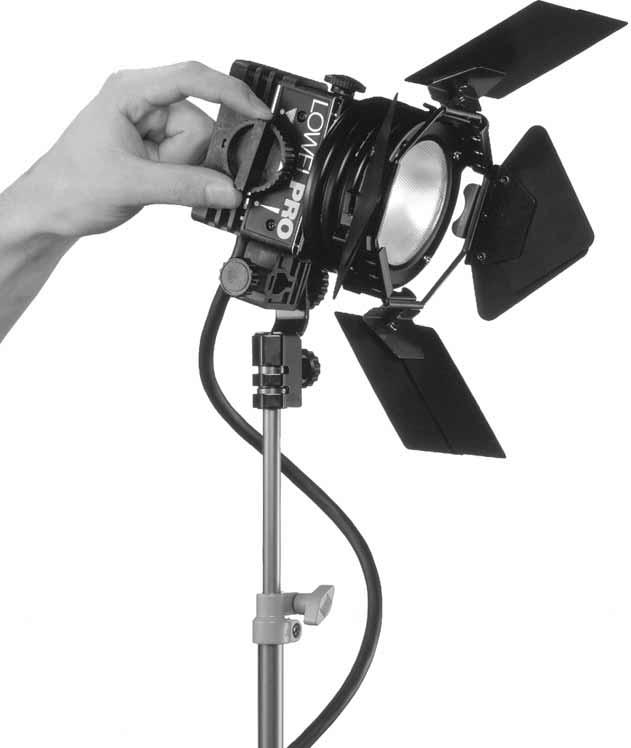
The Lowel Pro-light is a very small focusable tungsten-halogen fixture for accents, close keys, fill and interview backlight. A high-intensity reflector and prismatic front glass create an adjustable beam from a body light enough for a compact location kit. It is a reflector-and-glass system, not a conventional miniature Fresnel.
This guide covers the classic up-to-250 W Pro-light. The manufacturer’s recommended FVL 200 W lamp can be more useful than simply selecting the highest wattage. Pre- and post-April-2003 versions also have important front-housing and cable differences, especially for the 230 V lamp option.
Key specifications
| Specification | Details |
|---|---|
| Source / maximum power | Focusable tungsten-halogen; 250 W maximum, with approved lamp and voltage combinations |
| Normal optics | High-intensity reflector plus prismatic glass |
| 120 V lamp examples | FVL 200 W; FSH 125 W; GCA 250 W appears in the catalogue |
| Low-voltage examples | GCC 100 W at 12 V; GCB 200 W at 30 V; approved 50 W option also listed |
| 230 V option | GLF/P44 235 W; fits CE, updated or correctly updated-front-housing versions as specified |
| FVL focus range | Approximately 6:1, manufacturer table |
| Super-spot mode | Clear safety glass in place of prismatic glass; separate output configuration |
| Mass | 1.3 lb / 590 g with captive cable; 2 lb / 907 g with extension |
| Mount / switch | 5/8-inch stud fitting; in-head switch |
| Cable revision | Updated 2003 version uses an IEC extension connection; older cable is model-specific |
| Mechanical tilt travel | 160° stated; operating orientation restrictions are tighter |
| Downward operating limit | Do not tilt down beyond 45° or operate sideways, per instructions |
| Inverted use | Do not operate upside down with lamps over 125 W |
| Maximum-current context | Published 8.3 A maximum concerns the complete range, including low-voltage use; it is not a 200 W mains draw |
Strengths and limitations
| Strength | Limitation |
|---|---|
| A continuous tungsten source gives direct, visible control of the lighting effect. | Heat and electrical load remain central to placement and circuit planning. |
| Lamp and accessory choices adapt the source to its job. | Dimming changes colour; lamp code, voltage and fixture limits must match. |
Practical uses
The Pro-light can put a controlled edge on a shoulder, add a background accent or provide a compact low-level key. A suitable small bounce or diffusion setup can create fill, but the modest power leaves less reserve for large soft sources. Its strongest use is often as a small directional tool rather than as the only light for a large scene.
The prismatic glass and reflector provide Fresnel-like control without making this a Fresnel lamphead. Barn doors trim spill, while clear safety glass creates a tighter non-focusing super-spot arrangement. Do not compare the super-spot reading with another fixture’s broad flood and call the result a general output advantage.
| Setup | Working approach |
|---|---|
| Controlled key or accent | Choose focus or diffusion for the intended shadow and trim spill with compatible accessories. |
| Warm practical motivation | Meter at the chosen dimmer setting and balance colour through the camera. |
Output and colour
The Pro-light instructions and original catalogue publish these ten-foot centre readings. The super-spot setting requires clear safety glass instead of the standard prismatic glass; it is a separate optical arrangement.
| Lamp / supply | Flood | Spot | Super-spot |
|---|---|---|---|
| FVL 200 W, 120 V | 23 fc | 143 fc | 302 fc |
| FSH 125 W, 120 V | 11 fc | 48 fc | 139 fc |
| GLF/P44 235 W, 230 V | 39 fc | 81 fc | 178 fc |
Power and batteries
The catalogue recommends FVL 200 W over the older GCA 250 W option for efficiency and focus range. Its own table shows a higher normal spot reading for FVL, despite the lower nominal wattage. Lamp geometry and optics matter; maximum wattage is not automatically maximum useful beam performance.
Use the exact approved globe, and verify its rated voltage. The lamp table includes mains and battery-voltage options, but the body does not convert voltage. A 200 W FVL at 120 V represents a nominal lamp load of about 1.7 A; a 100 W lamp at 12 V is about 8.3 A. Those very different cases explain why the maximum-current figure must be kept in context.
Lowel identifies an updated front housing and cable arrangement from April 2003. The GLF/P44 230 V lamp requires the CE version, updated Pro-light or an older fixture with the specified updated front housing. Do not fit it to an unidentified early example simply because a seller supplies a European cord.
Battery operation requires the proper low-voltage lamp and the documented adapter cable and power source. The older Pro-light cable is model-specific and is not an ordinary general-purpose extension lead. The updated IEC connection does not by itself make the lamp universal-voltage. Record the actual revision in a used-kit inventory.
Control, cooling and camera operation
A suitable external tungsten dimmer reduces output and warms the filament colour. For a fixed colour relationship, consider the lamp choice, optical attenuation or distance instead. The published lamp colours apply at rated operation, not at every dimmer setting.
The manual’s operating restrictions are more important than the broad mechanical tilt claim: do not tilt down beyond 45°, operate sideways, or run the head upside down with a lamp above 125 W. It also warns against downward use when mounted on top of a camera. A head that can physically swivel into a position is not necessarily approved to operate there.
Modifiers, rigging and the working package
Keep ventilation clear, avoid close direct exposure of people or flammable materials, and retain the correct protective front glass. The manual warns that the upper front knob can become hot and that the cable must stay away from the hot front housing. Disconnect the power and allow cooling before opening the head, relamping or changing glass.
Inspect the reflector, glass, front lock, focus mechanism, stand fitting, tilt tension, switch, socket and cable entry. Confirm which cable and front-housing revision is present, and check for heat damage or improvised repairs. Test an older head only after its electrical and protective components are known to be serviceable.
Alternatives and related fixtures
A small Dedo offers a different precision optical system and accessory range. A 150 or 300 W Fresnel provides a conventional Fresnel field, while a compact LED spotlight simplifies batteries, colour and low-heat work. The Pro-light remains useful as a lightweight accent tool when its exact lamp, revision, protection and orientation requirements are respected.
| Fixture | Choose it for |
|---|---|
| ARRI LED L-Series | A colour-adjustable Fresnel with different operating and control hardware. |
| A supported soft-light system | A larger diffused emitting area when a hard source is not required. |
What people are saying
Kevin McRoberts: a compact interview kit
Kevin McRoberts describes an interview kit built around a Rifa 55, Pro-light and reflectors, fitting into a small tripod-sized bag. View the source.
Videos
Lowel Pro-light (Tungsten): family guide
Lowel kit chapters: Omni 4:57, Tota 15:50, Pro-light 25:00.
Rental and used-fixture checks
Check the exact model and revision, complete power package, mounting hardware and control leads. Inspect lamp holders, protective glass and ballast connections. Test the intended operating level, fade and camera settings before rigging.
Documentation and specifications
Original manufacturer instructions, hosted archive copy, Lowel catalogue with lamp and output tables and Tiffen/Lowel’s guide to using the lighting system. Confirm the actual unit’s revision, installed lamp and electrical condition before use.
Product photograph: Lowel, original manufacturer catalogue photograph.
Browse Lowel lights · tungsten lights · all equipment.