
Last Updated 3 days ago
Overview
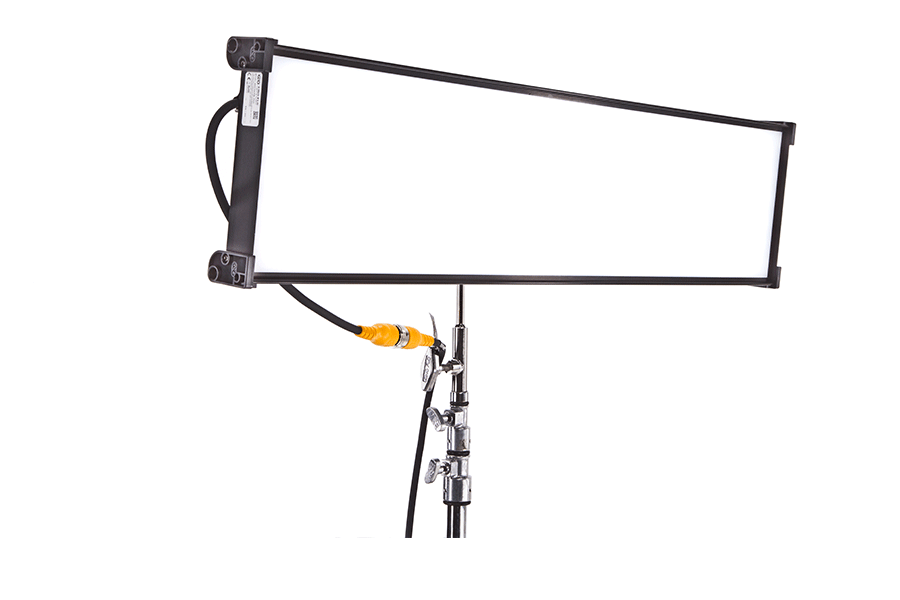
The Kino Flo FreeStyle 31 is a full-colour LED soft-panel system with an elongated removable panel and separate FreeStyle controller. It combines a slim source with a barn-door shell, louver options and a quick-release arrangement for using the panel outside that shell. It is useful for close soft lighting and long reflections in practical interiors.
The 31 is a panel system rather than a tube bank. It should not be specified from fluorescent Kino Flo data or from the similarly named FreeStyle T-series. The complete fixture, stripped panel, GT tray and controller are distinct components when comparing weight and rigging.
Key specifications
| Specification | Details |
|---|---|
| Source | True Match full-colour LED panel; removable from barn-door shell |
| Fixture identification | CFX-F31; standard fixture versus CFX-F31T / 31GT tray |
| Listed CCT range | 2500–9900 K |
| Published colour metrics | CRI >96; TLCI >96; TM-30-18 Rf 95, Rg 103 |
| Current controller family | FreeStyle 152 LED DMX, correctly matched to the panel |
| Controller AC rating | 100–240 V, 50/60 Hz, 150 W; 1.25 A at 120 V |
| Controller DC rating | 18–36 V DC; 6.25 A at 24 V |
| Control | Local, DMX and LumenRadio wireless DMX; firmware/profile dependent colour and FX modes |
| Dimensions in product features | 40.5 × 3.5 × 11 in, with the specified 6.5 in barn-door arrangement |
| Component weights in product overview | Overview: complete fixture approximately 14.5 lb / 6.6 kg; removable panel approximately 8.5 lb / 4 kg |
| Head cable | 25 ft documented system cable; approved extensions up to the stated 50 ft arrangement |
| Spill control | Barn doors; removable 90° louver, optional 60° louver |
| Cooling | Passive LED/controller design |
| Controller temperature range | −10 to 40°C |
Strengths and limitations
Strengths
- A broad emitting face suits soft keys and controlled reflections.
- Model-specific controls allow repeatable white or colour settings.
Limitations
- Diffusion and grids change both the exposure and the useful coverage.
- The controller, supply and rigging are part of the complete package.
Practical uses
The 31’s elongated format is useful when a narrow rectangular source fits the set better than a square panel. Horizontally it can provide a long catchlight or cover a seated subject from a shallow position; vertically it can give a different edge or product reflection. Its source geometry matters more to those choices than a generic controller wattage.
The panel can be removed from the barn-door shell to reduce the assembly’s footprint. That can help above cabinetry, near a low ceiling or in a dressed interior, while keeping the controller accessible elsewhere. The bare panel still needs appropriate mounting and light control; removing the shell is not permission to let it hang from the head cable.
| Setup | Working approach |
|---|---|
| Interview key | Set source size and distance for the required wrap, then add a grid or flags. |
| Product reflection | Watch the actual reflection while adjusting orientation and diffusion. |
Output and colour
The manufacturer-hosted Light Laboratory report identifies June 2017, 100% intensity, 6500 K, no louver, LED-150X or LED-151X controller. The measurements are absolute and the report says not to rescale its candela values for another lamp rating. Its older tested controller is identified separately from a current LED-152X package.
Using the report’s peak intensity, a calculated far-field estimate at five metres is about 112 lux (candela ÷ distance²). This is a derived orientation figure, not a new measurement or a promise for close placement. Louvers, diffusion, firmware settings and the actual operating package require their own check.
| Report datum | Value |
|---|---|
| Luminaire light output | 7,766 lumens |
| Peak intensity | 2,808 candela |
| Recorded test input | 123.05 W |
| Test arrangement | June 2017, 100% intensity, 6500 K, no louver, LED-150X or LED-151X controller |
Power and batteries
The current product system uses the FreeStyle 152 LED DMX controller. Its manual specifies 100–240 V AC, 50/60 Hz, 150 W, or 18–36 V DC, with a listed 6.25 A at 24 V. That is a controller/system rating, separate from the power recorded in an older photometric test. Use the actual controller label for circuit and battery planning.
A compatible-looking head cable does not make a fluorescent Kino Flo ballast an appropriate LED controller. Use the approved FreeStyle head/controller combination and extension arrangement. The product page describes a 25 ft head cable in the system and operation up to 50 ft away through the prescribed cables; it does not authorise arbitrary extensions or altered pinouts.
A battery must provide the required voltage and continuous current, not only enough watt-hours. Use a suitable DC supply and correct cable polarity. Support the controller and power source independently so their weight and cable pull do not load the removable panel or its connector.
Control, cooling and camera operation
The FreeStyle controller provides white-light adjustment, green/magenta correction and full-colour modes, including hue/saturation, RGB, gels and xy in the documented firmware family. Camera profiles and colour-space options affect the fixture’s colour calculations; they are not a substitute for checking the chosen camera, lens and subject. Record those settings when matching a second light.
The controller includes wired DMX and LumenRadio wireless DMX. Choose a documented personality and match it to the console profile and firmware. A simple white mode and a colour/FX personality expose different controls and channel footprints. Confirm addressing and signal-loss behaviour before the light becomes difficult to reach.
Kino Flo describes a stable white level through CCT changes and quiet passive cooling. Check the actual operating mode and use a camera test for unusual frame rates or shutter settings. Do not present a white-light CRI or TLCI figure as a guarantee for every saturated colour, every camera or every firmware setting.
Modifiers, rigging and the working package
Kino Flo lists dedicated 90° and 60° louvers, Flozier diffusion, a SnapBag and a 40° SnapGrid for the 31 family. Choose the accessory that fits the exact panel and shell. A louver controls spill, while diffusion changes the emitting face and a lightbank adds depth. They should not be treated as interchangeable labels for the same beam.
For a product reflection, examine the source in the object before deciding how much diffusion is needed. An accessory that looks smooth to the eye may still reveal structure in a glossy surface. The archival open-face data is a useful baseline, but it is not the reading available after a grid, lightbank or bounce.
Alternatives and related fixtures
The 21 gives a more compact head, while the 41 extends the source further. A LiteMat 4 Plus offers a different panel shape and tunable-white control package. Choose the 31 for its elongated detachable full-colour source rather than assuming it is simply a brighter 21.
Published weights vary with mount and document revision. Weigh the actual panel, mount, modifier and cable arrangement for a rigging decision, and include the separate controller and supply when comparing a complete transport package.
| Fixture | Choose it for |
|---|---|
| Kino Flo FreeStyle | A modular soft-source and controller system. |
| LiteMat Spectrum | A shallow full-colour format with generation-specific control hardware. |
What people are saying
Kino Flo: the FreeStyle family
Kino Flo’s Cine Gear presentation introduces the FreeStyle family and its modular approach. Compare the demonstrated panel and controller with the size and hardware in the intended kit. View the source.
Videos
Kino Flo FreeStyle 31: family guide
Manufacturer presentation of the FreeStyle family; specifications remain size-specific.
Rental and used-fixture checks
The removable panel reduces head size and weight but still needs a secure mounting method. Use the intended twist-on plate, corner rigging points and compatible hardware, with suitable independent retention above people. Lock the mount and account for cables, modifiers and leverage, rather than judging support only by the panel’s bare mass.
Keep the controller’s heat-dissipation paths clear and follow its −10 to 40°C operating range. Protect the fixture, controller and connections from conditions outside their instructions. Inspect the panel face, LED uniformity, cable entries, shell, barn doors, corner fittings, mount lock and controller connectors.
Test several white settings, saturated colours, low-end fades, blackout and the intended DMX/radio route on a used package. Confirm the controller version, approved head cable, mount, louver and any diffusion are included. Do not infer an LED engine’s condition or remaining serviceability from the appearance of its outer shell alone.
Documentation and specifications
Official product information, panel/controller instructions and identified open-face photometric report.
Product photograph: Kino Flo official product photograph.
Browse Kino Flo lights · LED panels · all equipment.