
Last Updated 14 hours ago
Overview
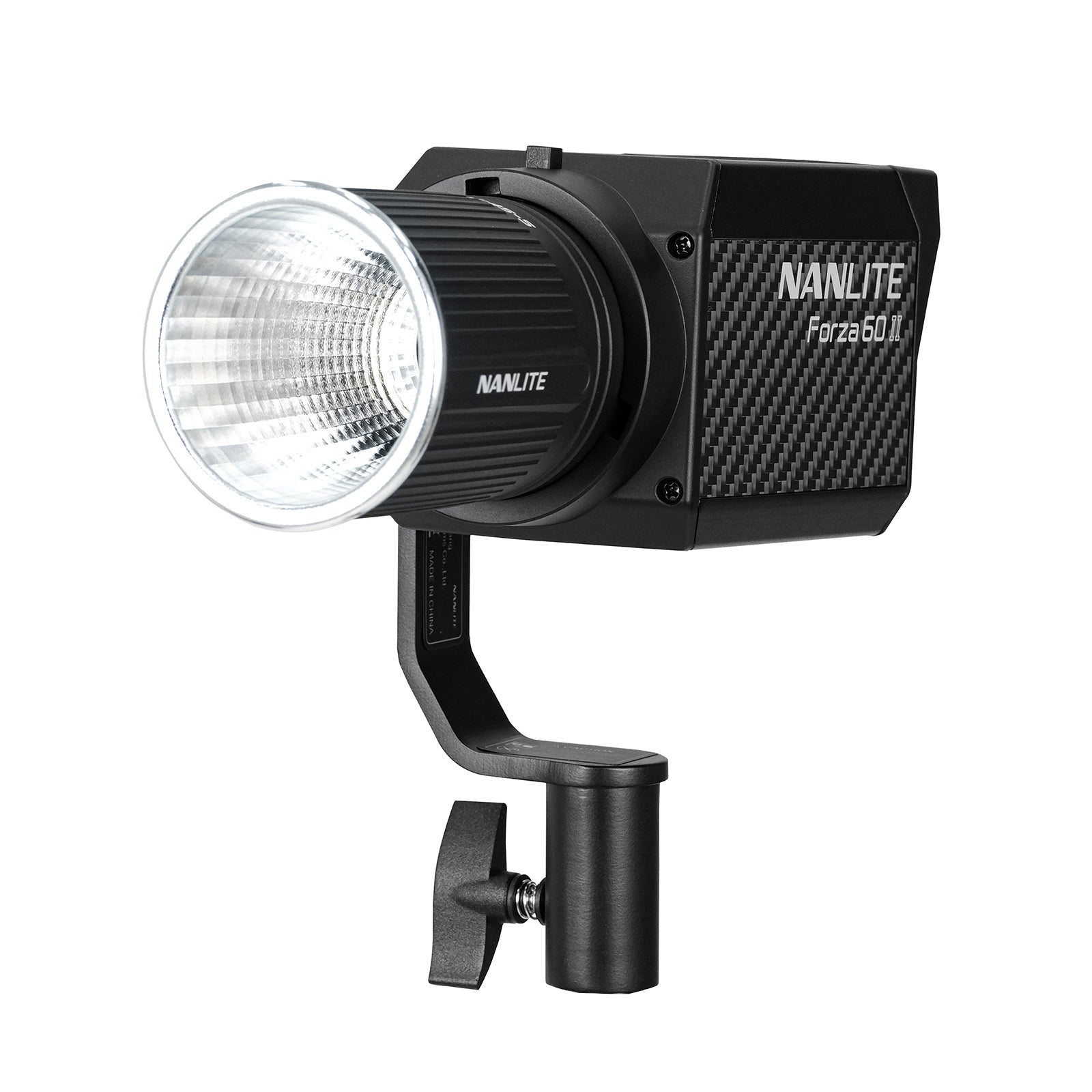
The Nanlite Forza 60 II is a compact daylight LED spotlight with a 72 W rated draw, an FM accessory mount and a head weighing 0.84 kg. It is useful as a small hard key, a portable bounce source, a focused accent or the engine for an FM projection attachment.
The second-generation daylight model differs from the original Forza 60. The Forza 60B II changes colour temperature, while the Forza 60C is a different full-colour design. The plain “60 II” stays at 5600 K; its main upgrades over the original 60 include control, fan management and the revised reflector package.
Key specifications
| Specification | Details |
|---|---|
| Fixture class | COB LED spotlight |
| Rated power | 72 W |
| CCT / tint | 5600 K daylight |
| Manufacturer colour metrics | CRI 95; TLCI 98; average TM-30 Rf 93 / Rg 103 |
| Dimming | 0–100% |
| AC supply | 100–240 V, 50/60 Hz through the specified power system |
| DC / battery interface | 15 V DC, 6 A maximum; approved battery grip also supported |
| Accessory mount | Nanlite FM; supplied adapter accepts compatible Bowens accessories |
| Head dimensions | 200 × 108 × 84 mm, excluding COB protective cap |
| Component weights | Head 0.84 kg; adapter 0.45 kg |
| Control | Onboard, 2.4 GHz, Bluetooth/NANLINK, wired DMX/RDM |
| Integrated CRMX | Not listed for this model |
Strengths and limitations
Strengths
- The compact FM head keeps dedicated small optics and a travel kit manageable.
- Fixed daylight simplifies matching and exposure decisions.
- Wired DMX/RDM and NANLINK support more than local control.
Limitations
- A Bowens adapter adds bulk and does not guarantee support for a heavy modifier.
- Warm white needs correction gel, with an associated output loss.
- The original model has no integrated CRMX receiver; small-head DMX adapters must be included where required.
Practical uses
The small head is useful where access and placement matter more than lighting a large distant area: an interview key through a modest softbox, a bounce in a compact room, a product edge or a patterned accent. The native source is small and directional. A softbox changes the apparent source size; it also changes the usable level and the working footprint.
For a cut window pattern or logo, an appropriate FM projector is more suitable than trying to obtain a crisp image with reflector barndoors. For a controllable pool without projected detail, the FL-11 changes beam spread. Neither accessory is included merely because the light has an FM mount; identify the actual kit contents.
Its roughly two-hundred-millimetre body can fit into a tight location, but the reflector, yoke, Bowens adapter and modifier add length and clearance. Position the complete assembly before committing to an overhead or concealed placement.
| Setup | Working approach |
|---|---|
| Interview key | Use a compact FM softbox close to the subject and control spill; retain enough distance for comfortable framing. |
| Shaped accent | Use a manufacturer-approved Fresnel or projector for a controlled highlight, edge or background pattern. |
| Portable location | Select the supported battery arrangement and cooling mode before deciding the working level. |
Output and colour
The figures below come from Nanlite’s model-specific technical photometric table, at 5600 K. They are centre illuminance for the named optical setup, not total lumens, edge coverage or a prediction for a different softbox. Optional attachments are identified separately from the supplied reflector.
A focused attachment concentrates light into a smaller field. Its higher centre value does not establish that it illuminates a larger area or produces more total light. Measure the working area after diffusion, flags and colour/tint choices are in place.
| Configuration at 5600 K | 1 m | 3 m |
|---|---|---|
| Bare head | 3,420 lux | 414 lux |
| Supplied reflector | 17,620 lux | 1,651 lux |
| FL-11 Fresnel, 10° spot | 41,580 lux | 4,039 lux |
| FL-11 Fresnel, 45° flood | 9,478 lux | 973 lux |
| PJ-FMM-19 projection attachment | 60,000 lux | 4,469 lux |
The documented CCT range and colour scores are listed above for this exact model. CRI, TLCI and TM-30 describe different aspects of colour reproduction; they do not make two lights with the same Kelvin setting spectrally identical. Check skin, textiles and product colours through the intended camera when mixing sources.
The fixture offers 0–100% dimming and built-in intensity effects. For a repeatable setup, record the output level, fan mode, optical attachment and colour or tint setting that the model provides. Check a fade and the camera’s intended frame rate/shutter combination before relying on a very low level or a fast effect.
Power and batteries
The approved adapter takes 100–240 V AC, 50/60 Hz and feeds the light’s 15 V input. The supplied BT-BG-FZ60 grip provides an alternative using two suitable NP-F batteries or an approved V-mount arrangement; Nanlite recommends NP-F packs of 6600 mAh or greater. Those are external batteries, not an internal cell. Match the grip, lead and discharge capability to the instructions.
Battery watt-hours describe stored energy; maximum discharge describes whether the pack can sustain the load. Both matter, as do the approved lead and connector. For planning, identify the power source and operating level rather than quoting one runtime for every colour, fan mode and battery condition.
Use the specified supply and interconnects, provide strain relief and keep the electronics ventilated. The quoted head mass excludes the complete cable, power and grip package. Check the label on the actual regional supply before circuit planning or substituting any component.
Control, cooling and camera operation
Control options include the onboard interface, Nanlite’s 2.4 GHz remote ecosystem, Bluetooth/NANLINK and wired DMX/RDM. NANLINK radio control is a different connection from LumenRadio CRMX; the manufacturer specifications do not list an integrated CRMX receiver.
Wired DMX/RDM requires the correct model-compatible adapter cable for the light’s control port; include that cable in a console-controlled package. Set the address and matching personality, terminate the final fixture in a wired run and test signal-loss behaviour before a cue-dependent take.
USB firmware updating and app features depend on the installed version. Match the manual and console profile to that version. On a used fixture, confirm app connection, wired control and firmware access rather than judging the control package only by a working local dimmer.
Modifiers, rigging and the working package
Fan-off mode limits maximum output to 30%. The published 20 dBA fan claim is a manufacturer figure, not a sound test in every recording environment.
A fan-off choice trades available level for silence. Test it with the actual microphone and keep the thermal paths clear. Choose a different placement or operating level if the required output cannot be maintained in the selected cooling mode.
Check the COB window, accessory lock, yoke, tilt handle, connectors and supply lead. Try the intended reflector or optical attachment, inspect the beam for unexpected colour or uniformity problems, and confirm the mount locks positively. Protect the open head and electronics from moisture and conditions outside the matching manual; no general outdoor waterproof rating is established by the manufacturer specifications.
Alternatives and related fixtures
A Forza 300B II supplies a much larger bi-colour source package at a greater power and carrying cost. The 60B II is the closer size alternative when variable white is essential. Choose the daylight 60 II when its compact head and FM optical options are the useful combination.
| Fixture | Choose it for |
|---|---|
| Forza 60B II | Variable-white adjustment in a similarly compact head. |
| amaran COB 60x S | A compact bi-colour Bowens alternative with different control and power options. |
What people are saying
Fellow Filmmaker: useful upgrades in a compact kit
Fellow Filmmaker’s review of the 60 II and 60B II describes both as useful lights with welcome changes, while noting details that could still improve. It is a paired review; the fixed-daylight 60 II and variable-white 60B II have different output and colour specifications.
Videos
Fellow Filmmaker: Forza 60 II and 60B II
A paired review of the second-generation compact heads.
Rental and used-fixture checks
Confirm the Forza 60 II label, matching power hardware and all control leads. Inspect the emitter cover, FM latch, yoke and connector strain relief, then test the intended modifier, low-level fade and remote-control path. Run at the planned level until warm before assessing fan sound at the microphone.
Documentation and specifications
official product specifications and photometry and manufacturer operating manual.
Product photograph: Nanlite / Nanlite Japan official product photograph.
Browse Nanlite lights · COB lights · all equipment.