
Last Updated 3 days ago
Overview
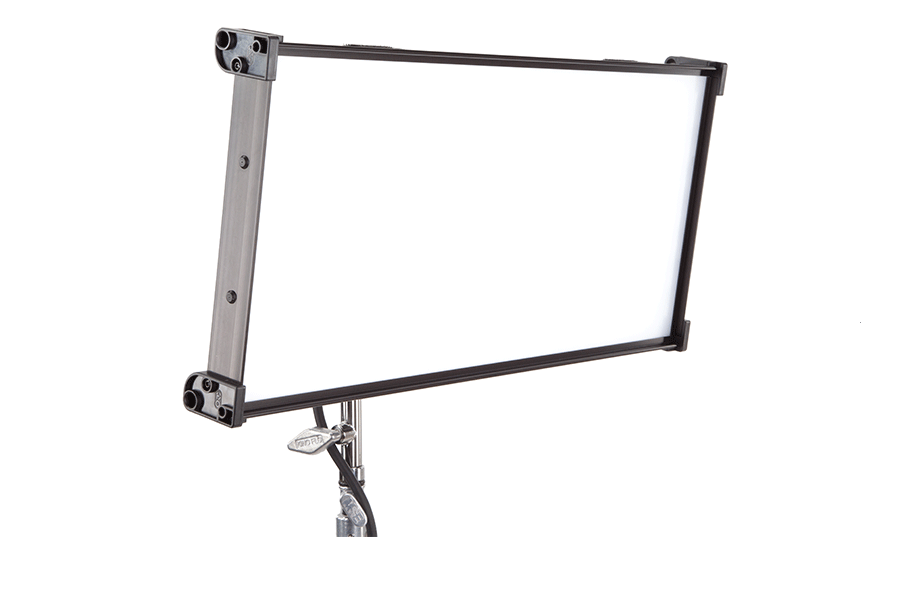
The Kino Flo Diva-Lite 21 LED is a full-colour LED panel for compact interview keys, close fill and a relatively broad rectangular reflection. Local controls, mains electronics and wireless DMX are integrated into the fixture, making it a different package from the remote-controller FreeStyle LED range.
The LED DMX fixture is available in centre-mount and yoke versions. Its operating specifications and archival photometric configurations differ from those of the fluorescent Diva-Lite 200/400.
Key specifications
| Specification | Details |
|---|---|
| Fixture generation | Diva-Lite 21 LED DMX; integrated electronics |
| Center / yoke models | DIV-L21XCU / DIV-L21XYU |
| Rated input power | 150 W, AC or DC |
| AC input | 100–240 V AC, 50/60 Hz; 1.25 A at 120 V / 0.65 A at 230 V |
| DC input | 18–36 V DC; 6.25 A at 24 V |
| White range | 2500–9900 K, with green/magenta adjustment |
| Colour operation | White, gels/hue, RGB and CIE xy; firmware dependent |
| Colour metrics | Manufacturer: CRI >96; TLCI >96; TM-30 Rf 95, Rg 103 |
| Dimming | 1–100% in the February 2025 manual |
| Remote control | Wired DMX and built-in LumenRadio wireless DMX |
| Center-mount dimensions / mass | 60 × 11.5 × 29 cm / 5.5 kg |
| Yoke-mount dimensions / mass | 72.5 × 11.5 × 37 cm / 6 kg |
| Included / optional louver | 90° included; 60° optional |
| USB Mini-B | Firmware service connection |
Strengths and limitations
Strengths
- A broad emitting face suits soft keys and controlled reflections.
- Model-specific controls allow repeatable white or colour settings.
Limitations
- Diffusion and grids change both the exposure and the useful coverage.
- The controller, supply and rigging are part of the complete package.
Practical uses
The 21 is the shortest, widest member of this LED Diva family. Its center-mount body is 60 cm long and 29 cm high, making it practical where the longer 31 or 41 creates clearance problems. Its source shape gives a different reflection from the slender 41 even though both carry a 150 W rating.
For a close portrait, a SnapBag can spread and unify the apparent face, while the supplied louver helps contain spill. Check eye and spectacle reflections at the final position. The louver changes the field; it does not turn the open face into a Fresnel.
The electronics are integrated into the fixture. This reduces the separate controller and head-cable arrangement associated with a FreeStyle LED package, but the complete Diva is heavier than a detachable lightweight panel face. Compare the whole supported assembly, including modifier and cabling.
| Setup | Working approach |
|---|---|
| Interview key | Set source size and distance for the required wrap, then add a grid or flags. |
| Product reflection | Watch the actual reflection while adjusting orientation and diffusion. |
Output and colour
Kino Flo publishes a model-specific photometric report dated June 13, 2017. Its condition is 6500 K, 100%, no louver. The figures below identify that particular sample and test, rather than implying that every colour, louver or later firmware produces the same result.
The report’s measured electrical draw is 128.64 W. This is a test measurement, while 150 W is the fixture’s rated power. Keep those values distinct for circuit planning. Reported total lumens describe all emitted light; peak candela describes intensity in the brightest direction.
The 5 m estimate below is calculated from peak candela divided by distance squared. It is an on-axis far-field estimate for the open face, not a separate measurement or a guarantee of edge-to-edge coverage. Consult the original report’s distribution plots when coverage matters.
| Archival open-face result | Value |
|---|---|
| Total flux | 8,256 lm |
| Peak intensity | 2,991 cd |
| Test electrical draw | 128.64 W |
| Calculated on-axis illuminance at 5 m | 119.6 lux |
Power and batteries
The fixture accepts 100–240 V AC or 18–36 V DC. At the rated 150 W, the manual lists 6.25 A at 24 V. A battery system needs the correct regulated voltage, connector, polarity and continuous current capability; a nominal battery label alone is insufficient.
Use the actual battery-system instructions and allow for conversion losses, ageing and cold conditions when budgeting runtime. The 150 W rating is not a 150 Wh battery-duration claim. Retain power and data strain relief so the fixture can tilt without loading a connector.
Do not transfer the fluorescent Diva-Lite 200/400 lamp and ballast specifications to this LED model. This is an integrated LED fixture with different controls, power requirements and optical accessories.
Control, cooling and camera operation
The current operating manual describes white light, gels/hue, RGB and CIE xy controls. Green/magenta adjustment helps fit a mixed practical-light environment. A camera test remains useful because matching a Kelvin number does not establish matching spectral response on skin, fabric or reflective products.
Camera LUT selections apply CIE xy corrections for listed camera families. The documented selections include ARRI Alexa, Sony Venice, Panavision DXL and Panasonic Varicam. Record the selected correction; resetting the controller returns it to the Kino Flo default setting.
The manual also lists Rec. 709/sRGB, P3 D65 and Rec. 2020 colour-space selections. These affect RGB and hue/saturation behaviour, not every white-light setting. A saved RGB triplet has meaning only with its colour space, firmware and operating mode.
The product download page lists firmware and matching DMX profiles, including the 6.0 release resources. Check the actual unit before promising a particular effect or console personality. The USB Mini-B connection is for firmware service; it is not a battery-charging port.
Wired DMX and a built-in LumenRadio receiver provide separate control routes. Patch the correct profile and starting address, and confirm the mode on the fixture and console agree. The manual describes automatic DMX termination, avoiding an assumption that an external end terminator is always required at the fixture.
For wireless operation, link the receiver to a compatible transmitter and test the actual route through the shooting location. Check fades, blackout and signal-loss behaviour before shooting. A wireless fixture still requires AC or a suitable external DC supply.
The February 2025 manual specifies a 1–100% dimming range. That specified minimum does not establish a smooth fade from black. Evaluate the bottom of the fade and the blackout cue using the chosen firmware and remote-control route, especially for visible practical effects.
Modifiers, rigging and the working package
The center-mount and yoke versions have separate dimensions and listed weights. Use the value for the actual mounting version when planning support and clearance. The center mount accepts the specified Kino lollipop hardware; inspect the plate, lock and receiver before elevated use.
The manufacturer lists a 90° louver and an optional 60° louver. A matching SnapBag includes diffusion choices, while the 40° SnapGrid is designed for the appropriate SnapBag. These accessories change spread and transmission; the open-face report cannot be used as their output table.
Inspect the emitting surface, colour uniformity, local controls, mains/DC connectors, mount and wireless linking. Run white, tint, saturated-colour and dimming tests after the fixture warms up. For a used unit, confirm that the correct mount, louver, power lead and firmware-service cable are included.
Alternatives and related fixtures
The LED Diva sizes share a 150 W rated input, so geometry is a primary selection factor. A FreeStyle LED package offers a detachable panel and remote control box; a legacy fluorescent Diva offers a different lamp-based workflow. The LiteMat 4 Plus is another lightweight-head option, with a separate power/control system and a variable-white rather than full-colour engine.
| Fixture | Choose it for |
|---|---|
| Kino Flo FreeStyle | A modular soft-source and controller system. |
| LiteMat Spectrum | A shallow full-colour format with generation-specific control hardware. |
What people are saying
Elliot Smith: the LED Diva format
Elliot Smith’s NAB report presents Diva-Lite LED as a compact location soft-light system. The introduction concerns the LED family; the older fluorescent Diva uses different lamps and controls. View the source.
Videos
Kino Flo Diva-Lite 21 LED: family guide
Kriss Hampton’s overview compares the Diva-Lite, FreeStyle, Select and Celeb LED families.
Rental and used-fixture checks
Check the exact model and revision, complete power package, mounting hardware and control leads. Inspect emitting surface, connectors and support points. Test the intended operating level, fade and camera settings before rigging.
Documentation and specifications
official model page and firmware downloads, Diva-Lite LED operating manual, revision D, February 2025 and model-specific archival open-face photometric report.
Product photograph: Kino Flo official product photograph.
Browse Kino Flo lights · LED panels · all equipment.