
Last Updated 5 hours ago
ColorSource Fresnel V Overview
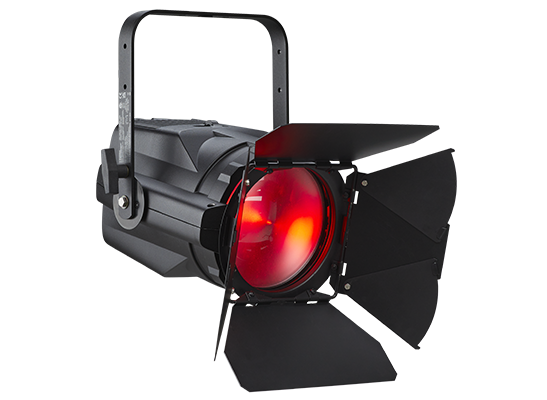
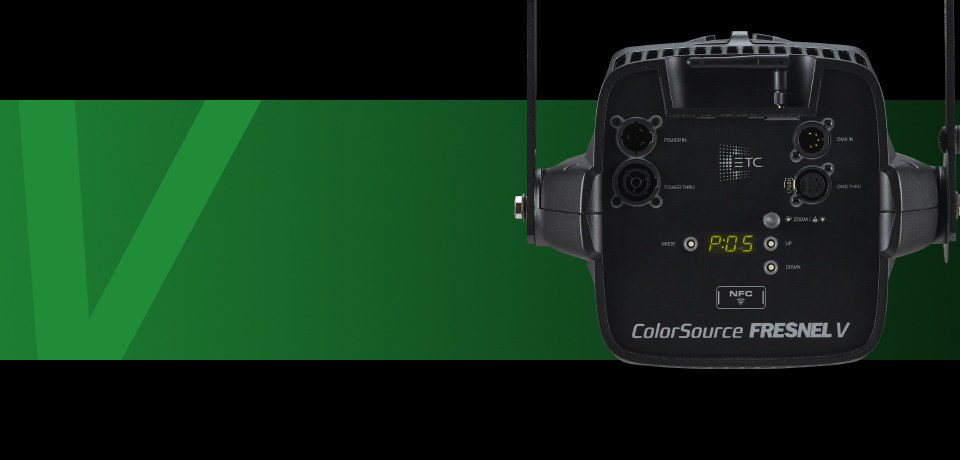

The ETC ColorSource Fresnel V is a five-colour RGBIL LED Fresnel with motorised zoom, adjustable locally or through DMX. Indigo and lime extend the colour-mixing options beyond a basic RGB fixture; this is a different engine from ETC’s eight-colour Lustr X8.
- RGBIL LED Fresnel RGBIL: red, green, blue, indigo and lime
- Power 148.4 W, typical at 120 V AC
- Colour Temperature 3,200 K and 5,600 K ETC’s published photometry settings.
- Weight 6.24 kg
- Beam Angle 13–44° motorised zoom
- IP Rating IP20 · indoor dry locations. IP ratings guide.
ColorSource Fresnel V Specifications
| Specification | Details |
|---|---|
| Light engine | RGBIL: red, green, blue, indigo and lime |
| White-light range | Colour mixing; white settings depend on the control profile |
| Optical system | 190mm aperture |
| Beam coverage | 13–44° motorised zoom |
| Typical input at 120V | 148.4W; see power section for test conditions |
| Published weight | 6.24kg; see working-package notes |
| DC operation | AC powered; no direct battery input listed |
| Protection | IP20; indoor dry-location equipment |
| Control | 5-pin DMX/RDM; Multiverse on equipped models; NFC configuration |
| Flicker settings | 5kHz default / 25kHz via RDM |
| Wireless | Multiverse on equipped versions; verify the ordered model |
ColorSource Fresnel V Output Calculator
Estimate centre-beam output or compare two settings at the same throw. The calculator uses candela from the ETC ColorSource Fresnel V datasheet, rev E, pp. 4–5. These readings are for the standard V, not the V MAX. ETC labels the Full On Direct setting separately from its 3,200 K and 5,600 K tests.
Camera Settings
At 5 m (16.4 ft) in spot (13°), 5,600 K gives about 3,074 lx at beam centre; 3,200 K gives about 3,087 lx. The reference table works without JavaScript.
Published intensity data and calculation method
Lux = candela ÷ distance in metres squared. Foot-candles = lux ÷ 10.7639. The camera estimate uses f-number = √(lux × ISO × shutter time ÷ meter reference). The small digit is tenths of a stop, not a T-stop.
The minimum throw is 3.048 m, the closest tabulated throw used here. Beyond that, these are inverse-square estimates at beam centre, not measurements or coverage predictions. Only ETC’s published focus and output settings are included; diffusion, accessories and dimming are not modelled. Meter the working setup.
| Focus | Full On Direct | 3,200 K | 5,600 K |
|---|---|---|---|
| Spot (13°) | 86,166 | 77,172 | 76,845 |
| Mid (22°) | 38,530 | 34,508 | 34,362 |
| Flood (44°) | 11,602 | 10,391 | 10,347 |
Strengths and Limitations
| Aspect | Working implication |
|---|---|
| Strength | Adjustable coverage without replacing the whole head. |
| Strength | NFC setup and a console control path for repeatable programming. |
| Limitation | Wash optics cannot project sharp gobos or shutter cuts. |
| Limitation | Active cooling and IP20 protection require attention to sound and location conditions. |
Practical Uses
- Set a repeatable top or back wash for filmed performances and stage productions.
- Use a narrower setting for an accent, then widen for a larger scene without exchanging the whole fixture.
- Balance saturated scenic colour against white keys through the production camera; equal console percentages do not produce equal exposure.
Motorised zoom can change coverage in a cue, but also changes centre illuminance and edge position. Establish level at the chosen zoom. During recorded dialogue, listen for zoom-motor noise before including a live focus change in the shot.
Output and Colour
| Manufacturer reference | Published value |
|---|---|
| Published maximum flux | 5,330 lumens |
| Typical input, 120V | 148.4W |
Lumen ratings describe total flux, while lux describes light arriving at a surface. Do not read the flux table as a lux measurement at a particular distance. Use ETC’s linked photometry for the exact array, lens, focus and diffusion configuration. Meter the working setup after adding colour, diffusion or other modifiers.
The RGBIL engine uses five colours, including indigo and lime. It is a colour-mixing system rather than a dedicated variable-white fos/4 engine. Select the correct console personality and calibrated operating mode before matching units; a raw emitter mix is a different control choice from a calibrated colour request.
Power and Batteries
ETC lists 148.4W typical input at 120V. The operating range is 100–240V AC, 50/60Hz. Supply constant power and use the fixture’s electronic dimming; the power-through connector does not make the fixture suitable for a conventional phase-dimmed circuit.
Check the supply lead, grounding, connector rating and total circuit load. Published fixture-per-circuit counts assume a particular breaker and supply condition; they are not a universal instruction for every outlet or distribution system. Account for startup current as well as steady running draw.
Control, Cooling and Camera Operation
| Control path | Operation |
|---|---|
| Wired control | 5-pin DMX and RDM. Match operating mode and DMX footprint to the console profile. |
| Wireless control | City Theatrical Multiverse on equipped versions. It is a different system from CRMX; confirm the transmitter and receiving hardware. |
| NFC | ETC Set Light configures supported fixture properties at close range. NFC setup is separate from continuous wireless DMX control. |
| Cooling and PWM | Active fan cooling; use the specified frequency choices and test the actual fan setting, dimming level, shutter and frame rate. |
Test low-level fades as well as full output. A high PWM frequency alone does not prove flicker-free results at every frame rate and shutter combination. Listen to the fan at the microphone position after the fixture has reached working temperature. Save cooling, colour and operating-mode settings with the lighting notes.
Modifiers, Rigging and the Working Package
Use the correct frame and retention system for the 190mm aperture. Fit only approved accessories, keep the fan path clear and support the fixture through its yoke. A nominal seven-inch lens description is not a universal accessory fitting.
IP20 describes an indoor fixture, so plan a suitable dry environment. Keep vents unobstructed and follow the regional manual’s mounting and clearance instructions. For overhead work, use the designated mounting and secondary attachment points with hardware rated for the complete assembly.
Alternatives and Related Fixtures
| Compare | When it helps |
|---|---|
| ETC Source Four tungsten | A tungsten profile when shutter cuts and pattern projection matter; it needs an appropriate lamp and external dimming. |
| ETC lighting hub | Compare ETC’s panel, Fresnel and profile formats by the beam needed for the job. |
| All equipment | Compare other manufacturers with the same source size, working distance and modifier. |
What People Are Saying
Field Feedback at a Glance
These observations refer to the standard Fresnel V, not the V MAX. They come from Alexandre Roy’s SONO Mag test, an installed theatre rig, and a console operator’s account.
What worked
- Roy found the yoke well balanced during handling.
- His test showed a soft beam edge for overlapping washes.
- The Capitol Theatre’s lighting schedule places the Fresnel V in its top wash, distinct from the tungsten front wash and the cyc fixtures.
Drawbacks to plan for
- Roy saw a marked hotspot in the middle of the beam. Check the centre and overlap, not only the soft edge.
- Roy found the three-character display and local menus limited. ETC’s NFC app provides another way to configure it.
- In a 2023 Vari-Lite support thread, an operator could adjust colours manually after RDM discovery, but the generic profile lacked the console’s colour tools. They reported those tools working after updating to a ZerOS version with the fixture profile. Check your library before programming.
Videos
ETC’s manufacturer walkthrough shows the Fresnel controls; it is not independent evidence of output or silent operation. The specifications above are for the standard Fresnel V.
Rental and Used-Fixture Checks
Exercise the zoom through the whole travel before a job. ETC documents reports of grinding on some Fresnel V units and says it made improvements. The note does not tell you how common it is. On early Multiverse units, check firmware if the fixture becomes unresponsive; ETC’s lockup note identifies a radio issue fixed starting with software 4.1.2.
- Confirm the model label, array and regional power rating; housing appearance alone may not identify the light engine.
- Inspect the Fresnel lens, focus travel, barn-door retention and yoke lock.
- Test every colour channel, low-level fades, fan operation and the intended wired or wireless control mode.
- Check firmware against the manufacturer’s support notes and run the required camera test before rigging.
Documentation and Specifications
ETC colour-calibration modes · ETC fixture directory and photometry downloads
Photographs: ETC. Family photographs and shared housing details are identified in their captions.
Browse ETC lighting · all equipment.