
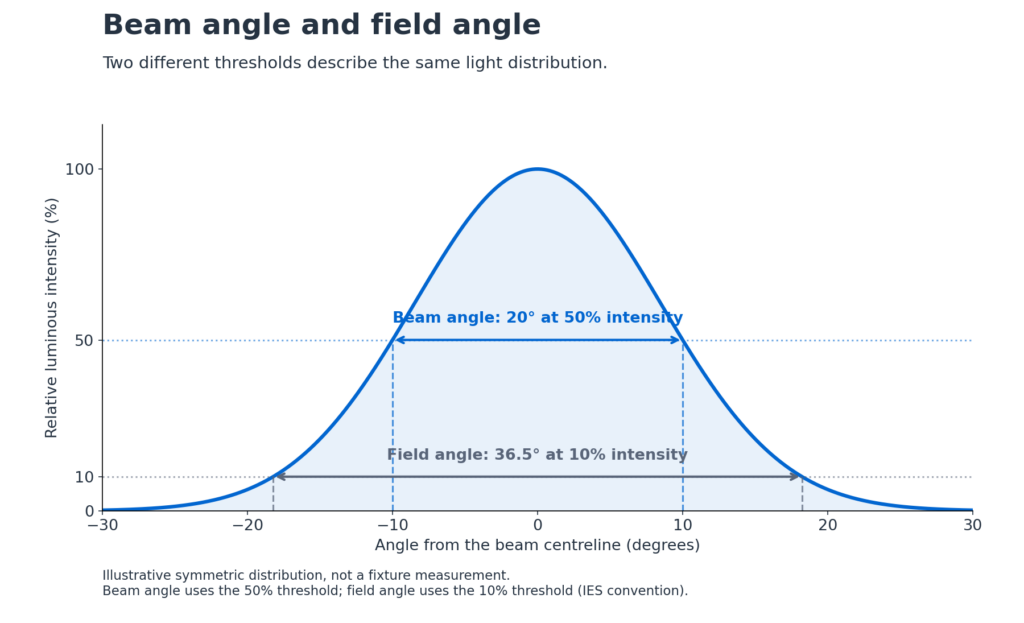
Field angle is the angular width between the directions where luminous intensity falls to 10% of its maximum, using the IES convention. For a typical single-peaked beam it is wider than the 50% beam angle.
Why the distinction matters
A field-angle figure describes the outer spread at a lower intensity threshold. It is not a guarantee of useful, even exposure across that entire area. A fixture may reach a wall across its field while leaving the edges much dimmer than the centre.
Comparing fixtures
Use like-for-like definitions. Comparing one fixture’s 10% field angle with another’s 50% beam angle can give a misleading impression of coverage. Some product families use field angle as the named lens angle; read the photometric sheet.
Practical example
A light with a 20° beam angle and a 40° field angle has a brighter central region with a broader, weaker spread around it. For a group portrait, check the edge readings across the people rather than assuming the full 40° field is evenly lit.
Related terms
Beam Angle · Lux · Inverse-Square Law · Spill · Feathering