
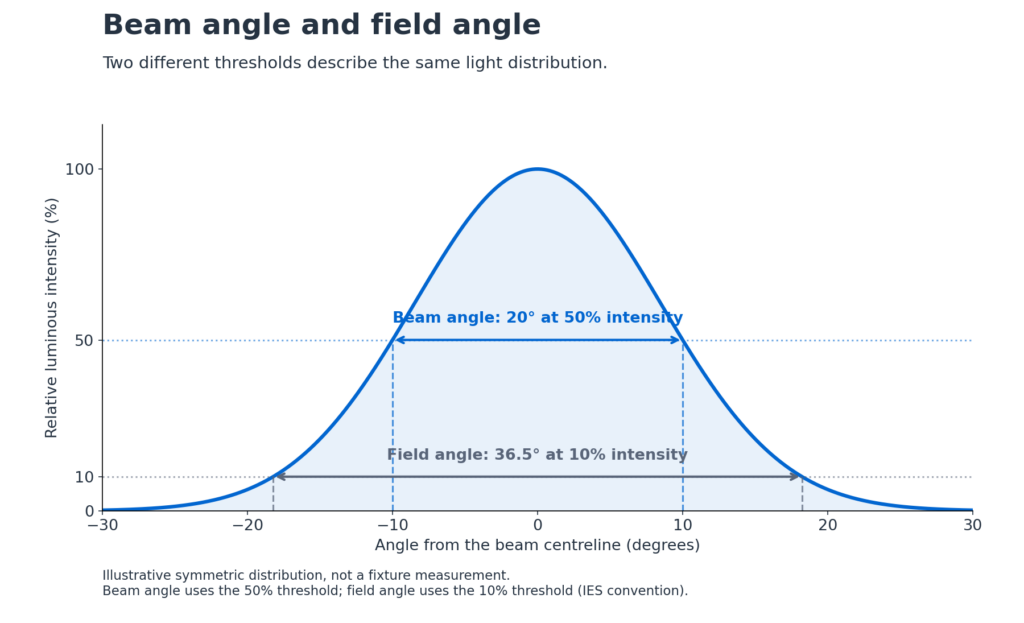
Beam angle is the angular width between the two directions where luminous intensity falls to 50% of its maximum, using the IES convention. A non-circular beam may need separate horizontal and vertical angles.
Coverage and brightness
A narrower angle usually concentrates light into a smaller area. It does not, by itself, tell you the fixture’s output, how even the beam is, or how sharply the visible edge cuts off. Compare the centre measurement and the distribution across the beam.
Estimating a diameter
For an ideal circular cone striking a perpendicular plane, diameter = 2 × distance × tan(angle ÷ 2). A 30° angle at 3 m gives approximately 1.61 m across. This describes that angular boundary, not an evenly illuminated circle.
Reading product pages
Check whether an advertised angle is a beam angle, a field angle or a manufacturer’s nominal spread. Reflectors, Fresnels, projection attachments and diffusion can all change the distribution, so record the accessory used with each measurement.
Related terms
Field Angle · Lux · Diffusion · Grid · Spill